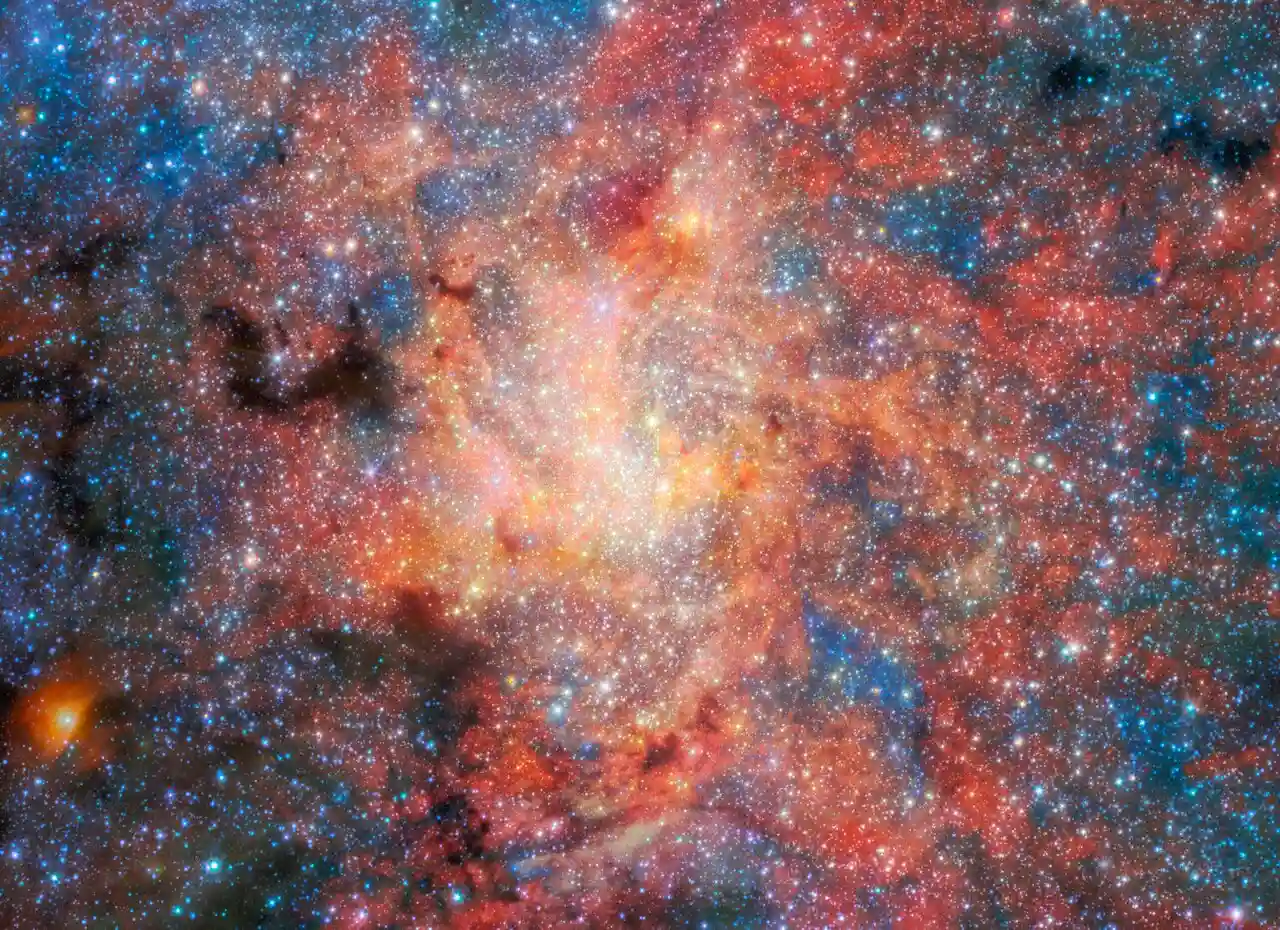
The centre of the Milky Way is a difficult place for fragile molecules. Sagittarius A*, the supermassive black hole at the heart of our galaxy, is surrounded by intense radiation, fast-moving gas and a dense crowd of stars. Yet a star near that black hole is blowing material into space, and the material contains both dust and water.
The finding comes from new observations of IRS 3 made with the James Webb Space Telescope’s Mid-Infrared Instrument, or MIRI. The star sits about 0.17 parsecs from Sagittarius A* in projection—roughly 0.55 light-years. That is close on the scale of the Galactic Centre, where the black hole’s gravity and radiation dominate the environment.
The result does not mean that Webb found a lake, an ocean or a habitable pocket beside a black hole. The water is present as molecules in the cool outer layers of a vast envelope surrounding a dying star. What is remarkable is that those molecules, along with newly formed dust, can exist and survive in such a harsh part of the galaxy.
What IRS 3 is doing there
IRS 3 is an asymptotic giant branch star, a late stage in the life of a star that began with several times the Sun’s mass. As these stars exhaust the fuel in their cores, they swell, pulsate and lose their outer layers through powerful winds. Gas moves away from the surface, cools and allows solid grains to condense.
Those grains become part of the interstellar medium. Later generations of stars and planets inherit material from this recycling process. AGB stars are therefore important suppliers of carbon, silicates and other ingredients that eventually become part of new planetary systems.
The new study estimates that IRS 3 has a mass of about six Suns and a luminosity close to 60,000 times that of the Sun. The researchers modelled a dusty envelope extending to roughly 10,000 astronomical units. For comparison, Neptune orbits at about 30 astronomical units from the Sun.
How Webb found the water
MIRI does not photograph a bottle of water around IRS 3. It spreads the star’s infrared light into a spectrum. Molecules absorb particular wavelengths, leaving fingerprints that can be compared with laboratory data and physical models.
The spectrum contains a broad silicate feature near 9.7 micrometres and another absorption feature near 18.5 micrometres. Those signatures point to oxygen-rich dust made from silicates and aluminium oxide. The researchers also report clear signs of H₂O in the envelope—the first such detection for this star in the study.
The model describes several shells with a strong temperature gradient. Material close to the star is around 1,000 kelvins hotter than the outer layers. As the wind travels outward, the gas expands and cools. That creates the conditions in which dust grains can form and water molecules can remain intact rather than being broken apart by the star’s radiation.
Surviving so close to Sagittarius A*
Sagittarius A* contains roughly four million times the Sun’s mass. It is quiet compared with the bright quasars found in some distant galaxies, but the Galactic Centre is still a violent neighbourhood. Stars move through a crowded region, and the black hole’s radiation can strip or heat material around them.
IRS 3 is not sitting on the edge of the event horizon. Its projected distance is about 0.17 parsecs, and the star’s own wind is responsible for most of the envelope that Webb observed. Even so, the result shows that the black hole’s surroundings do not automatically erase every molecule produced by an evolved star.
The paper estimates a mass-loss rate of about 6 × 10⁻⁵ solar masses per year if the wind travels at 15 kilometres per second. That outflow continuously feeds the local interstellar medium. Some of the material may later mix with gas in the Galactic Centre, where new stars can form.
A small clue about the life of galaxies
Dust is easy to take for granted because it is everywhere in astronomy images. It is also one of the ways galaxies change. Dust cools gas, helps shield molecules from radiation and becomes part of the disks around young stars. Understanding where dust forms helps researchers explain how later stars and planets acquired heavier elements.
The IRS 3 result is useful because it tests that process under extreme conditions. If an oxygen-rich giant can keep producing silicate dust and water-bearing gas near Sagittarius A*, similar stars may contribute to the chemical inventory of galactic centres more effectively than models once allowed.
It also gives Webb a target that can be revisited. Future spectra can show whether the shells change, whether the water signature varies with the star’s pulsations and how the outflow interacts with gas around the black hole. The next observation will not simply make a sharper picture. It can show how a dying star feeds its surroundings over time.
What the discovery does not say
Water is not a synonym for life. In this case it is a chemical species identified in a stellar envelope, alongside silicates and aluminium oxide. The envelope is hot, diffuse and bombarded by radiation; it is nothing like a planet’s surface or an ocean.
Nor does the finding show that Sagittarius A* is creating water. The molecules are associated with the evolved star and its wind. The black hole supplies the extreme setting that makes the observation interesting, but the star is the source of the material being studied.
Curiosmos has previously looked at what astronomers can learn from the region around Sagittarius A* in our report on the first black-hole photographs. The new Webb result adds a different layer to that picture: instead of the black hole’s shadow, researchers are tracing the dust and molecules that survive in its neighbourhood.
The universe is full of places that look hostile from a distance. IRS 3 shows why the details matter. Even beside the Milky Way’s central black hole, an old star can still shed the raw material from which the next generation of cosmic objects may be built.