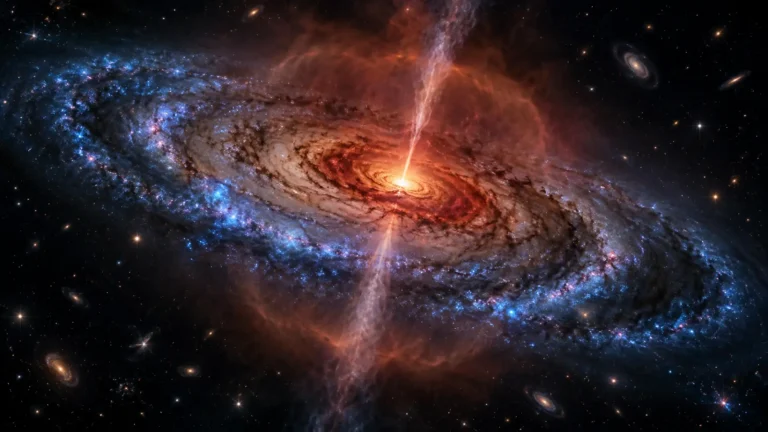
Two stars once considered promising Dyson sphere candidates have now been removed from the list. Follow-up observations with NASA’s James Webb Space Telescope showed that the infrared glow did not come from enormous artificial structures around the stars. It came from unrelated galaxies lying behind them.
The candidates were selected by Project Hephaistos, a Swedish-led search for possible technosignatures. The project looked for stars that appeared unusually faint in visible light but unusually bright in infrared wavelengths. That combination can be produced by warm dust, but it is also the kind of waste heat astronomers might expect from a structure collecting a star’s energy.
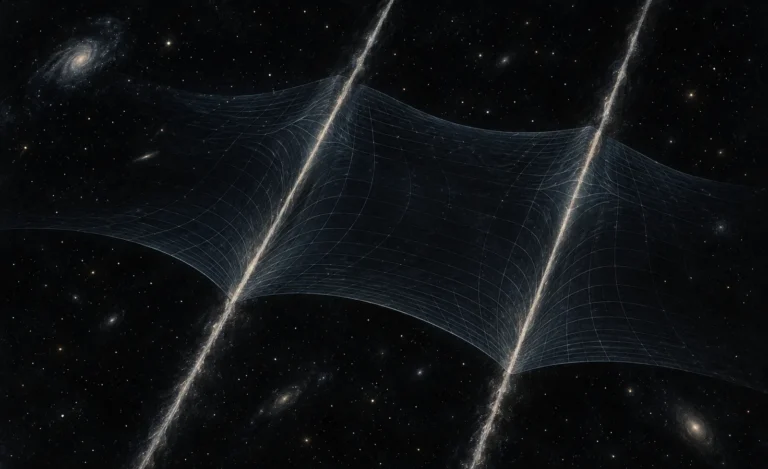
A Dyson sphere is a hypothetical system built around a star to capture its radiation. It would not have to be a single solid shell. A swarm of orbiting satellites could collect energy and release some of it as infrared waste heat, creating a signal that telescopes might detect even when the technology itself could not be seen. Curiosmos has previously explained how astronomers search for alien technosignatures and why a Dyson swarm is more plausible than a rigid shell.
The two targets were faint M-dwarf stars identified in a survey of roughly one million stars within about 1,000 light-years of Earth. Data from the European Space Agency’s Gaia mission and NASA’s WISE telescope made the stars look promising. WISE, however, has relatively coarse resolution in the infrared, so light from a foreground star and a distant background galaxy can blur into one source.
Webb could separate the objects. In each case, the supposed excess belonged to a background galaxy projected close to the M dwarf. One has a spectrum consistent with a Hot Dust-Obscured Galaxy, a rare and heavily dust-shrouded type of galaxy. The other has the extended shape and spectrum of a dusty starburst galaxy.
That distinction is the central result. The stars themselves do not show evidence of Dyson megastructures in these observations, and the study does not say that the search for extraterrestrial technology has failed. It shows how easily a distant galaxy can imitate the infrared signature researchers are looking for when a survey image does not have enough detail to separate the sources.
The result also gives future searches a practical test. Any candidate selected from a wide survey needs higher-resolution imaging and spectroscopy before it can be treated as a serious technosignature. The authors warn that background-galaxy contamination may affect a substantial fraction of the Project Hephaistos candidates.
Better mid-infrared surveys planned for the 2030s should make that screening easier. Astronomers can also look for repeated changes in a star’s brightness. A swarm of orbiting collectors could produce a regular pattern, although natural stars and dusty galaxies vary as well.
For now, Webb has replaced a tempting signal with a more ordinary explanation. That is still useful: it narrows the list of places where an artificial heat signature could be hiding and gives astronomers a clearer idea of what a convincing candidate would have to survive.