A city is more than one genetic signature
Imagine opening a grave beneath an ancient street and finding that the person buried there was related to people hundreds of kilometres away. It is the kind of result that seems to redraw a map in a single line.
But ancient DNA rarely gives archaeologists a simple answer to the question, “Who founded this city?” It can show relationships between individuals and populations, reveal episodes of movement and sometimes identify biological connections that objects alone cannot. It cannot, by itself, tell us what language a person spoke, which political group they joined or how they understood their own identity.
Cities rarely have one founding population; people arrive at different times. A settlement may keep its name and buildings while its population changes, mixes or grows through several migrations.
What the samples actually measure
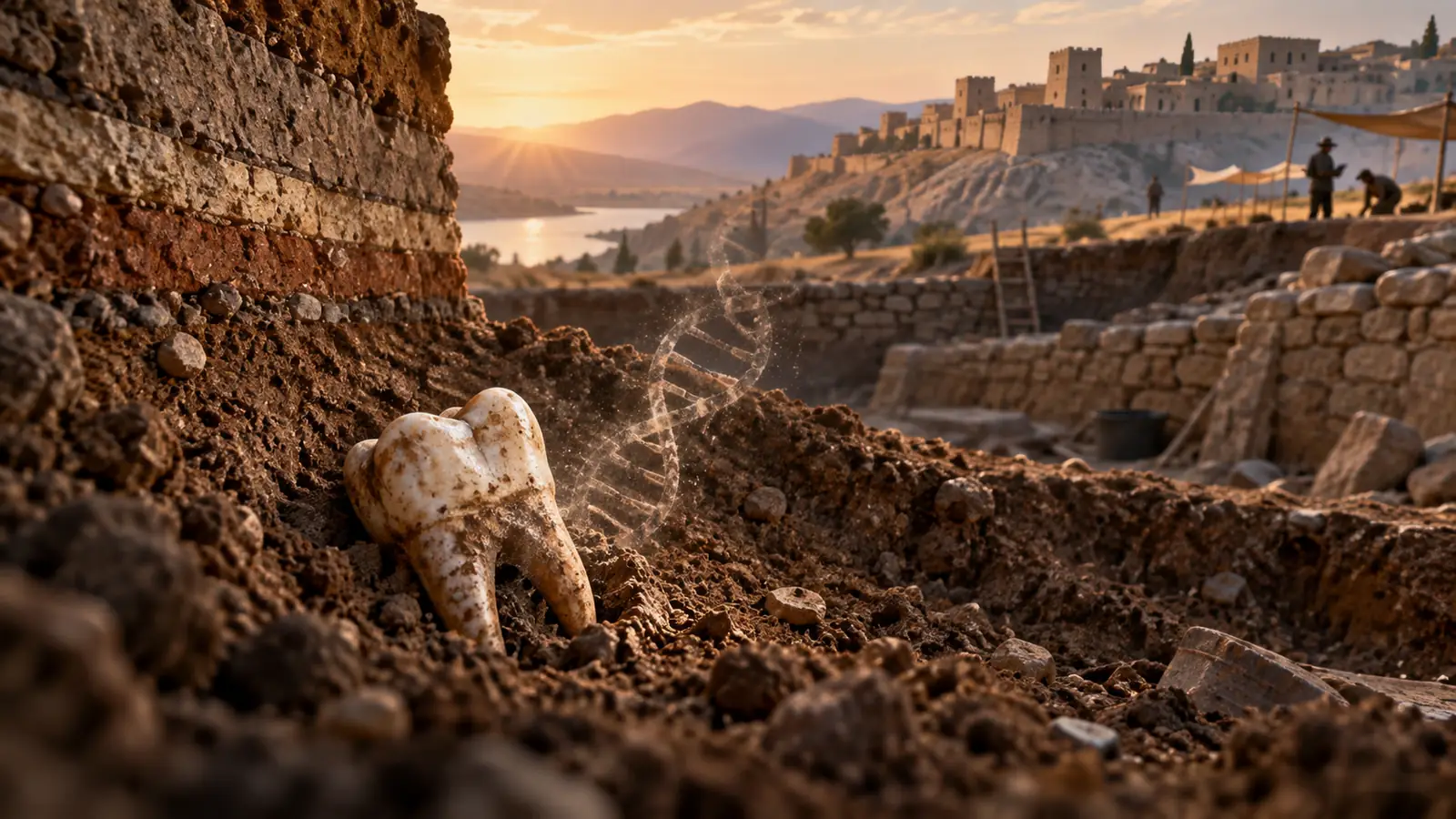
Researchers usually recover DNA from teeth or the dense part of the inner ear bone. The material is damaged by age and contamination, so laboratories look for chemical patterns that distinguish ancient molecules from modern ones. When enough genetic material survives, the sequence can be compared with other ancient and present-day genomes.
The comparison is statistical. A genome may share more inherited segments with one population than another, suggesting a closer biological relationship. That does not mean the individual “belonged” to a modern nation. Modern populations are not frozen versions of ancient ones, and the categories on a present-day map did not exist for most of human history.
The ancient Near East is a useful example. A large study of genomes from hunter-gatherers and early farmers found that people associated with early farming communities had several ancestry streams, including lineages that had already been separated for thousands of years. The result is less like a single people spreading from one point and more like a network of communities exchanging genes, technologies and ideas.
Can DNA identify a city's first inhabitants?
Sometimes it can narrow the possibilities. If the earliest burials at a site share a genetic profile with a known nearby population, archaeologists can test whether the settlement grew from local communities or received a substantial migrant population. Later burials can show whether that pattern continued.
Yet the word “first” is difficult. The oldest graves found by archaeologists are not automatically the first people to live there. Earlier burials may have disappeared, remained unexcavated or never been made in a form that survives. A DNA sample also represents one person, or one small group, rather than an entire city.
Genetic evidence works best beside other evidence. Pottery, house plans, food remains, burial customs, isotopes and ancient texts can show how people lived and what they carried with them. DNA can reveal a relationship; an object or a settlement layer may show how that relationship became part of daily life. For a wider look at what ancient DNA can and cannot say about lost populations, see our earlier DNA explainer.
What migration looks like in the record
The most interesting discoveries are often mixed ones. A city can contain people with local ancestry and others whose ancestors came from distant regions. The pattern may point to marriage networks, trade, seasonal movement, forced migration or the arrival of a new political power. DNA alone cannot choose between those explanations.
Isotopes can help. The chemistry of tooth enamel records aspects of the landscape where a person grew up, while DNA describes biological ancestry. If the two signals point in different directions, a person may have moved during life, or their biological relatives may have moved before them. That difference turns a genetic result into a human question: was this a community of newcomers, or a local population connected to a much wider world?
Related reading: For a related look at how genetic evidence changes the story of ancient communities, see our report on two human species living together in Israel.
The question that remains open
Ancient DNA is powerful because it can expose connections that the visible ruins hide. It is also limited because a genome is not a biography. It cannot tell us whether a traveller was welcomed, enslaved, married into a family or simply passing through.
A good reconstruction keeps the city in view. A genetic connection is the beginning of the investigation, not the end. What happened to the people who carried it? Did they bring a new craft, a new crop or a new way of organising a neighbourhood? Sometimes the most revealing discovery is not that a city had distant connections, but how those connections changed the place itself.