There is no old Slavic equivalent of the Iliad or the Edda to open and read from beginning to end. What survives is scattered through other people’s books: a Byzantine historian’s brief report, a Kyiv chronicle’s list of idols, accounts of Baltic temples written by Christian clerics.
Those fragments preserve names and glimpses of ritual. They do not add up to one settled pantheon shared by every Slavic community. The picture changes with the place and century each writer describes.
A lightning god with no name
In the sixth century, the Byzantine historian Procopius wrote about the Sclaveni and Antes. He said they worshipped a god associated with lightning and believed him to be the ruler of all things. Procopius did not give the god a name or describe a family of deities. He also mentioned sacrifices of cattle and other victims.
Keep exploring
Continue with Curiosmos
That brief account is one of the earliest substantial written descriptions of Slavic religion. It tells us that an outside observer saw a powerful lightning god at the centre of worship. It cannot tell us whether people in every region shared the same beliefs or what stories they told about the god.
Vladimir’s idols in Kyiv
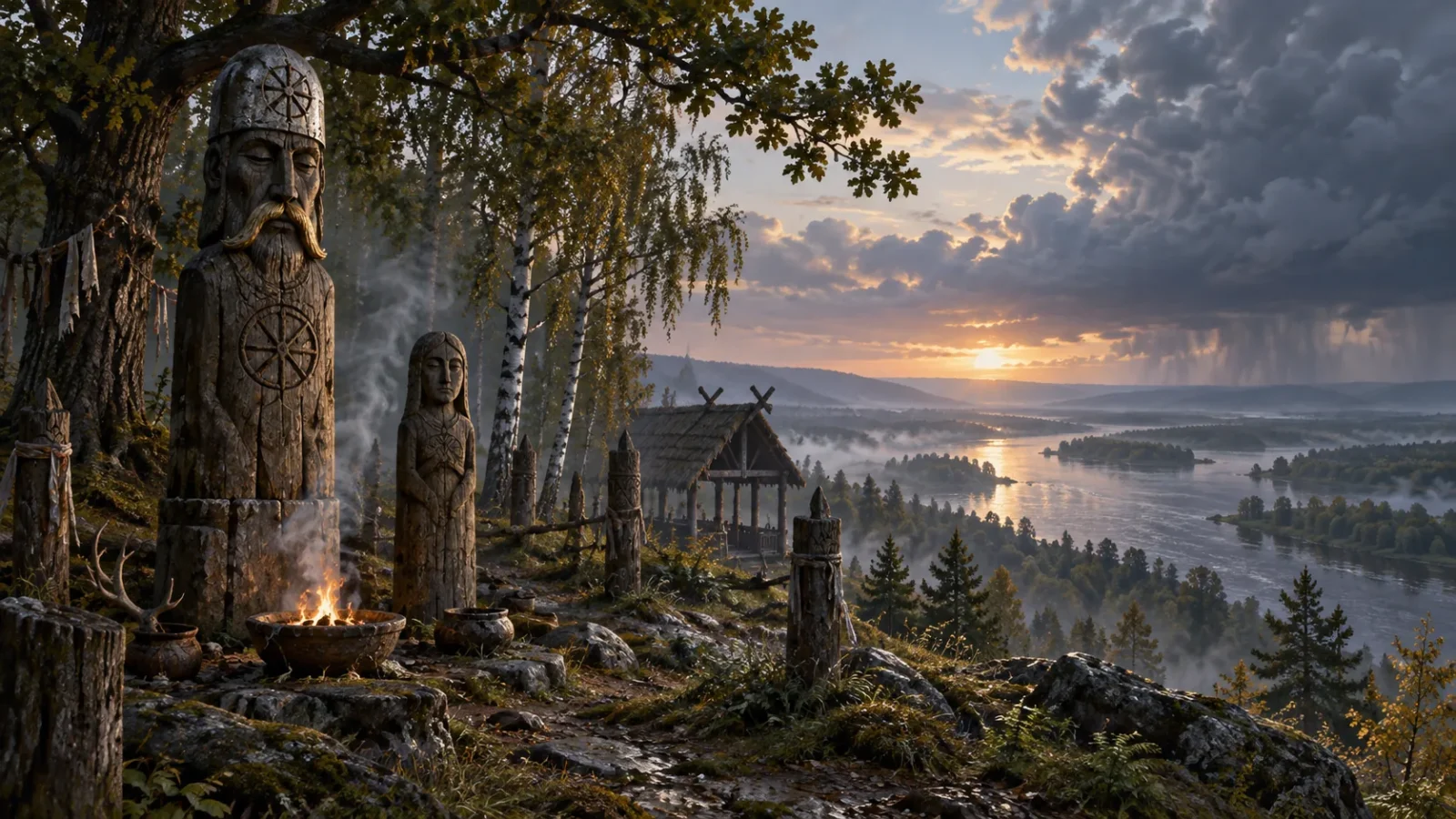
The Primary Chronicle, compiled in Kyiv in the early twelfth century, recounts a religious programme set up by Prince Vladimir in 980. The list names Perun, Khors, Dazhbog, Stribog, Simargl and Mokosh. Perun’s image is described with a wooden body, a silver head and a golden moustache.
These names were placed together in a public sanctuary, but the chronicle does not give each one a neat job title. Later scholars have proposed links between Khors and the sun, Dazhbog and wealth, and Simargl and Iranian imagery. The proposals draw on language and comparisons with neighbouring cultures, and some remain disputed.
Veles appears elsewhere in the chronicle, in oaths made between Rus’ and Byzantium, where he is associated with cattle. The text does not preserve a tale of a great battle between Veles and Perun. That familiar myth is a modern reconstruction from linguistic, folkloric and comparative evidence, rather than a story copied from one medieval source.
Across the Baltic, different sanctuaries
Christian writers describing western Baltic Slavs centuries later reported temples, priests, divination and large cult images. Helmold of Bosau, a twelfth-century cleric, wrote of a high heavenly god and lesser spirits. Other accounts describe Svantevit’s sanctuary on Rügen, where religion and political authority came together at Arkona.
These writers give us details absent from the Kyiv list, but they were describing communities they hoped to convert. Their accounts preserve observations through a missionary lens. They also concern a different region and a later period. The Baltic evidence should not be blended into the Kyiv list as if both were pages from the same handbook.
Slavic-speaking communities lived across a huge area and changed over many centuries. Local gods and rites would have taken shape alongside neighbouring peoples and political powers. A thunder god could matter across regions without belonging to a centrally organized religion.
How much can archaeology add?
Archaeology can locate sanctuaries, ritual deposits and carved figures, but naming a god is harder when inscriptions are missing. A figure carrying a weapon might represent a deity, an ancestor or a local hero. A place-name may preserve an old association, but names and customs can shift after conversion to Christianity.
Between the chronicles and the archaeological record, a few themes do emerge: storms, oaths, cattle and wealth, sacred places and rulers who used public ritual. Perun has the clearest early profile because lightning, princely power and oath-taking appear across more than one source. Mokosh is the only female figure named in Vladimir’s list, though the records leave her role uncertain.
We are left with a handful of names, written down by outsiders and separated by geography and time. They open onto a much larger world of local practice and oral stories, most of which was never recorded. The surviving sources do not give us the whole mythology; they show how much variation may have lived inside those fragments.
For a useful comparison, see Curiosmos’ account of Yggdrasil and the nine worlds, where medieval texts preserve a different northern religious tradition in far greater detail.
Sources
- The Primary Chronicle, Vladimir’s 980 idol list, University of Texas at Austin.
- “Procopius on the Religion of the Early Slavs,” Studia Ceranea, University of Łódź.
- “The Slavs,” The New Cambridge Medieval History.
- Medieval East Slavic Literature, University of Bergen.
- Helmold’s Chronicle of the Slavs, translated text and notes.