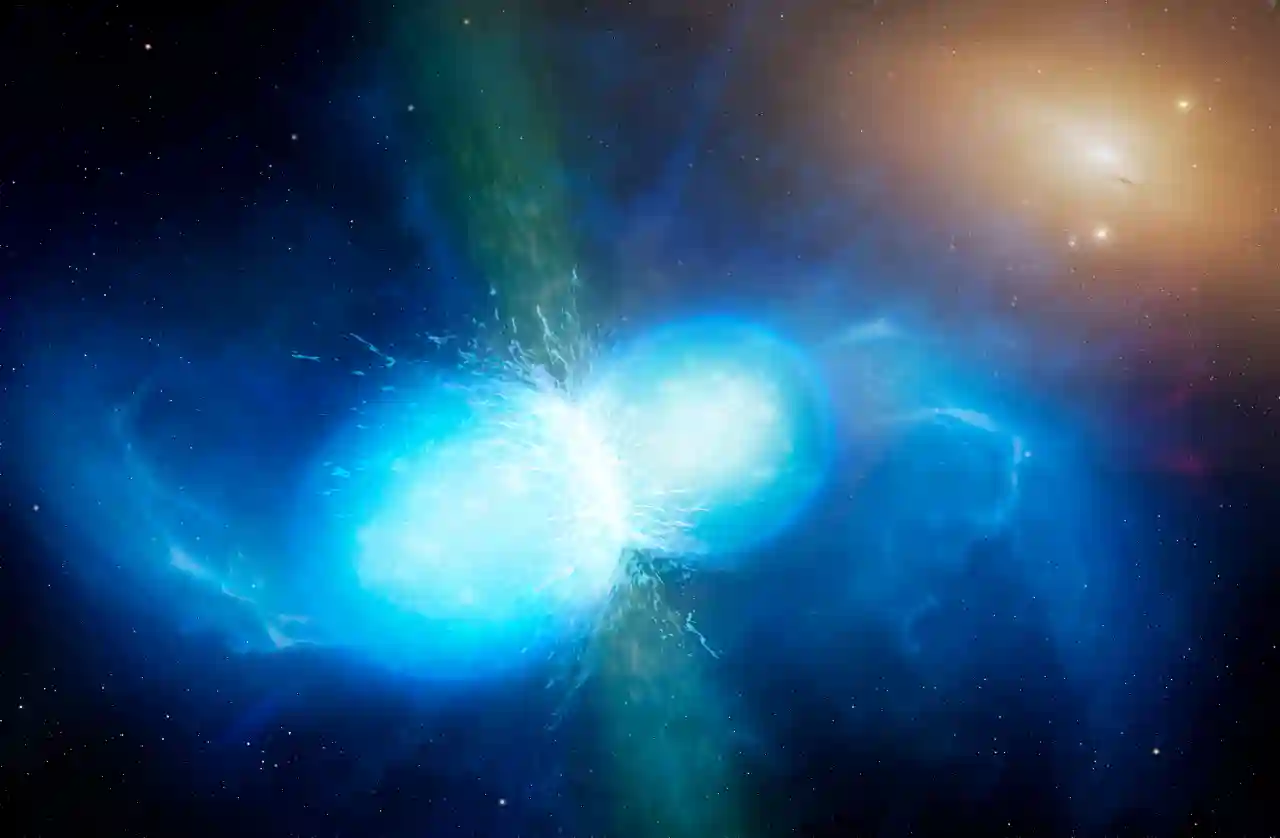
A neutron star is what remains after the core of a massive star collapses. It is not a small ordinary star. It is the crushed core of a dead one, compressed until protons and electrons are forced together and most of the material becomes neutrons.
The result is one of the strangest objects in the universe: more massive than the Sun, but only about 20 kilometers across. A neutron star would fit inside a city, yet its gravity and magnetic field can be far stronger than anything found on Earth.
How a neutron star is born
A massive star spends its life balancing gravity with the pressure produced by nuclear reactions in its core. When the fuel needed to support that core runs out, gravity wins. The inner region collapses in a fraction of a second while the outer layers are blown into space in a supernova.
If the collapsed core is not too massive to become a black hole, it settles into a neutron star. The star’s birth can leave behind a rapidly spinning object surrounded by the expanding remains of the explosion.
Why neutron stars are so dense
Ordinary matter is mostly empty space at the scale of atoms. In a neutron star, that structure has been squeezed away. The interior is packed so tightly that a spoonful of neutron-star material would have an unimaginable mass on Earth.
Scientists still debate the details of the deepest layers. The outer crust is thought to be a rigid lattice of atomic nuclei and electrons. Farther down, matter becomes a dense fluid of neutrons, with exotic states possible near the center. Measurements of a star’s mass, radius, and cooling rate help test those models.
The size is not a simple measurement to make. A neutron star’s powerful gravity bends the light leaving its surface, allowing an observer to see more than half of the star at once. Its rapid rotation can also change the shape by a small but measurable amount. Those effects have to be included when astronomers infer the radius from X-ray observations.
Pulsars and magnetars
Many neutron stars rotate several times per second, and some spin hundreds of times each second. If beams of radio waves or other radiation sweep past Earth during that rotation, telescopes detect a regular pulse. These objects are called pulsars.
Magnetars are neutron stars with especially powerful magnetic fields. Their magnetic activity can produce bursts of high-energy radiation. Curiosmos has covered how NASA’s IXPE mission studies a magnetar and the way its field changes the behavior of light.
What happens when two neutron stars collide?
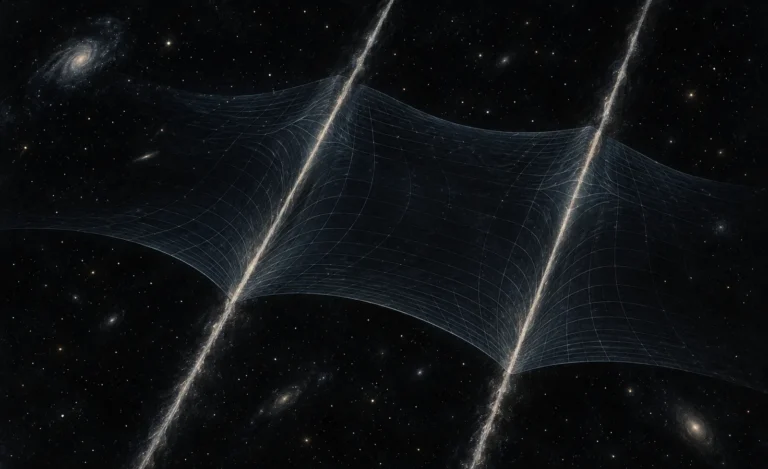
Binary neutron stars can slowly lose orbital energy through gravitational waves. Eventually they spiral together and merge. The collision sends ripples through spacetime and can produce a short gamma-ray burst, a glowing kilonova, and newly forged heavy elements.
Gold and platinum are among the elements scientists think can be created in these violent events. The connection between a gravitational-wave signal and a visible explosion gave astronomers a new way to study both the merger and the material it ejects.
Why neutron stars matter
Neutron stars are natural laboratories for physics under pressure that cannot be reproduced on Earth. They connect the lives of massive stars to supernova remnants, gravitational waves, pulsars, magnetic fields, and the origin of some of the heaviest elements.
They are small only in size. In everything that happens inside them, neutron stars are among the universe’s most extreme objects.
Their signals also make them remarkably precise clocks. A stable pulsar can keep time more reliably than many Earth-made instruments, and tiny changes in its pulse can reveal an orbiting companion, a passing gravitational disturbance, or a change in the space between Earth and the star.