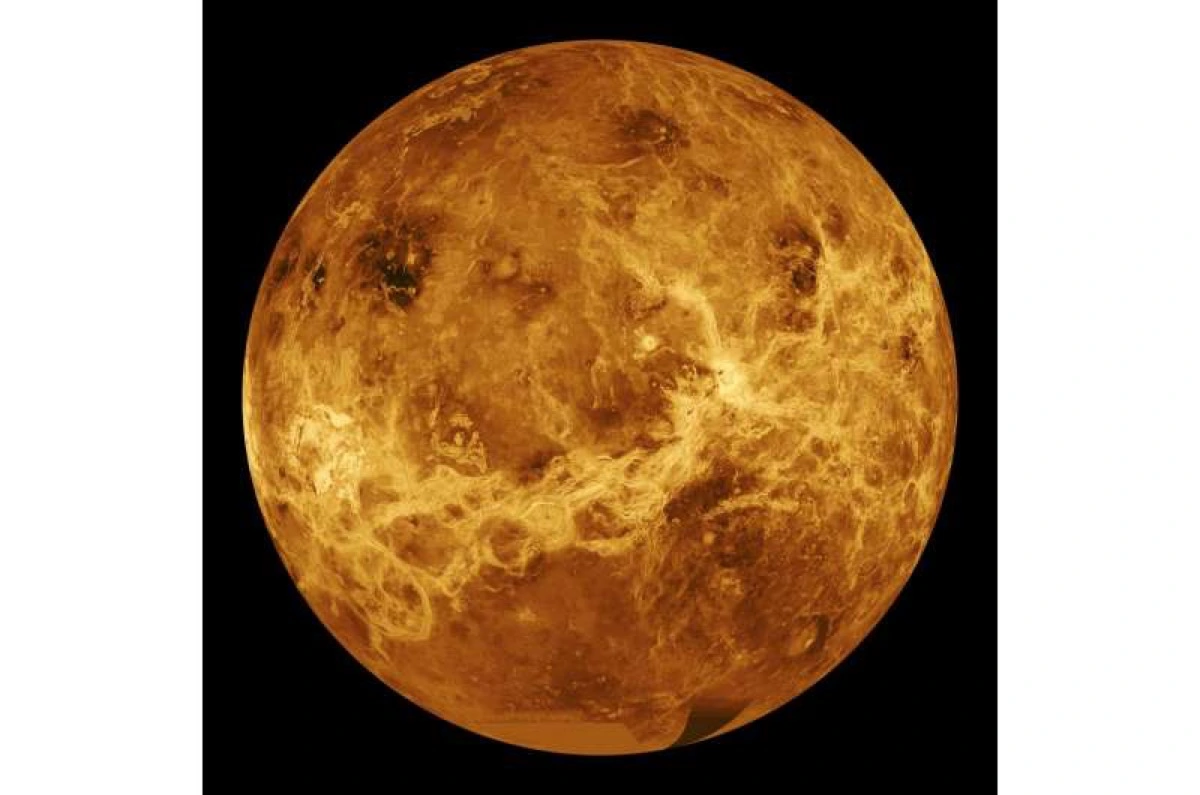
Venus looks pale yellow in ordinary photographs, but ultraviolet images reveal dark and bright bands moving through its upper clouds. Scientists have known about those markings for about a century. The material causing them is still unidentified, and a new study now shows that it must absorb ultraviolet light with unusual strength or be present at a high concentration.
The research team combined observations of Venus with a radiative-transfer model. That model follows how sunlight is scattered by cloud droplets and atmospheric molecules before it reaches a telescope. The approach allowed the researchers to estimate how the liquid inside the droplets would behave if it could be collected and measured in a laboratory.
This distinction matters because a cloud can look bright even when the material inside its particles is dark. Tiny droplets scatter light efficiently, much as smoke can appear white while the material collected from it forms a dark, tar-like suspension. Venus’ cloud particles work in a similar way, so the planet’s pale colour does not reveal the colour of the absorber itself.
Between 365 and 455 nanometres, the model requires a decadic absorption coefficient of about 1,278 inverse centimetres at 375 nanometres. In ordinary terms, the unknown material would have to be an extremely efficient absorber, occur in a substantial concentration, or both.
Some carbon-based molecules could meet that requirement. The study uses efficient porphyrin-like pigments as examples, but the authors do not identify chlorophyll, haem, or any other biological compound as the Venus absorber. “Organic” in this context means carbon-based; it does not mean biological or alive.
The shape of the spectrum also narrows the possibilities. Simple organic compounds exposed to concentrated sulfuric acid can form complex dark mixtures that absorb broadly and would look brown or black. Venus’ inferred absorption falls more sharply across the measured range, which points toward a more chemically defined substance that survives the harsh cloud environment.
The study therefore sets a test for future candidates rather than naming one. Any proposed absorber must match the strength and shape of the ultraviolet absorption, remain compatible with sulfuric-acid droplets, and be distributed through the clouds in a physically plausible way.
Future Venus missions could examine the chemistry directly. The Morning Star Missions initiative is developing instruments for in-situ measurements, including a nephelometer designed to look for fluorescence that might be associated with organic molecules. Until those measurements are made, Venus’ dark ultraviolet markings remain a chemical mystery with a much tighter set of requirements.