Popular images of the asteroid belt usually show a spacecraft weaving through a crowded field of tumbling rocks. The real region between Mars and Jupiter is far less dramatic—and more interesting. It contains millions of bodies, but the distances between the larger objects are enormous. A spacecraft can cross it without performing the cinematic dance seen in science fiction.
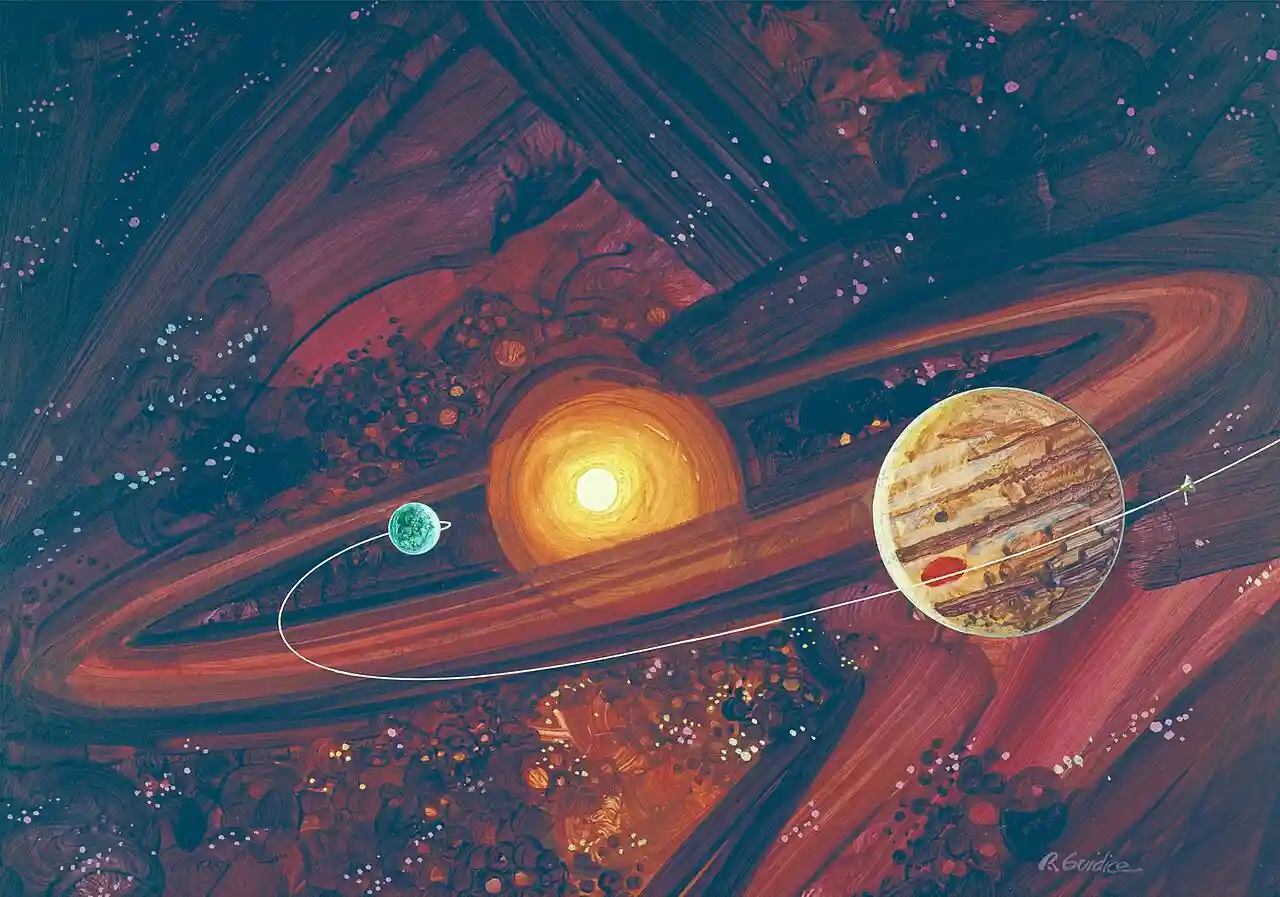
The main asteroid belt is a broad zone between the orbits of Mars and Jupiter. Its objects orbit the Sun, just as the planets do, but most never became part of a larger world.
Leftovers from the Solar System’s birth
About 4.6 billion years ago, the Solar System formed from a rotating cloud of gas and dust. Grains collided and stuck together, producing pebbles, rocks and planetesimals. In the inner Solar System, repeated collisions helped build Mercury, Venus, Earth and Mars.
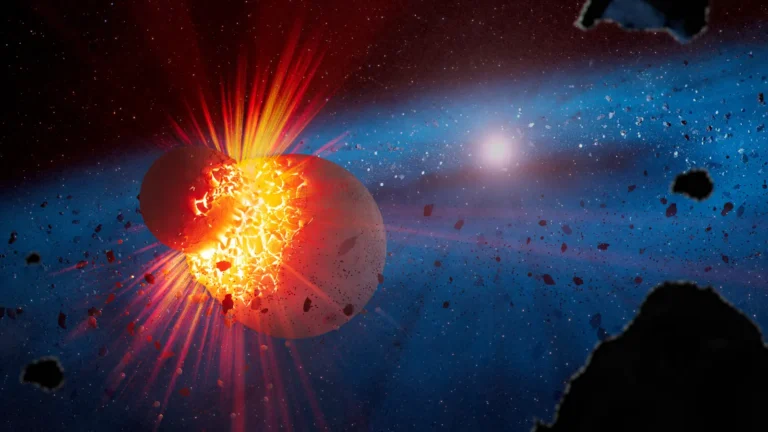
The material between Mars and Jupiter followed a different path. Jupiter’s enormous gravity stirred the region and made it difficult for many bodies to settle into the orderly, growing planet they might otherwise have become. Collisions were more likely to break objects apart or send them onto new orbits.
The belt is therefore not the remains of a single destroyed planet. It is a population of leftover material that never completed the process of planet formation. Some bodies are primitive and rich in carbon; others are rocky, metallic or partially differentiated.
It is mostly empty space
NASA describes the asteroid belt as much less crowded than films suggest. Even with more than a million known main-belt asteroids, individual objects are usually separated by vast distances. The largest residents are rare compared with the countless smaller pieces of debris.
This is why missions can pass through the belt without constantly dodging rocks. Spacecraft still track possible encounters and avoid hazards, but the chance of a random collision with a large asteroid is extremely small. The belt has a high population by Solar System standards, not a high density.
Ceres and Vesta show how varied the belt is
The biggest body in the main belt is Ceres, a dwarf planet with enough gravity to become round. NASA’s Dawn mission also visited Vesta, a much smaller but strongly differentiated protoplanet. Vesta has a crust, mantle and core-like structure, while many asteroids are irregular fragments.
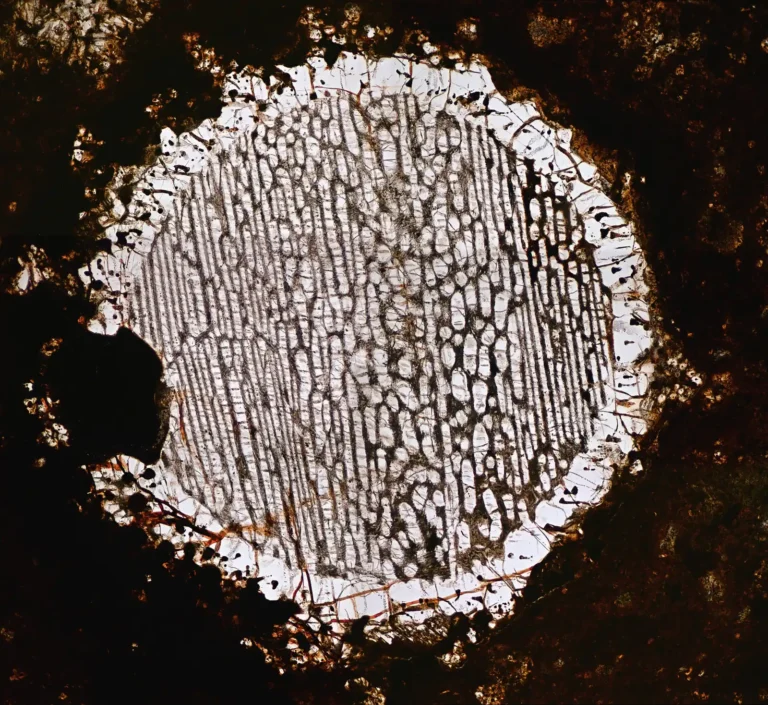
Those differences are clues to the conditions that existed when the planets were forming. Asteroids preserve chemical and physical material that was never fully melted into a planet. Meteorites found on Earth provide additional samples of that ancient population.
Not every space rock belongs to the belt
Near-Earth asteroids have orbits that bring them close to Earth’s neighbourhood. Some may once have been nudged out of the main belt by gravitational resonances with Jupiter or by collisions. Comets usually contain more ice and often arrive from colder regions of the Solar System.
Far beyond Neptune lies the Kuiper Belt, a separate population of icy bodies. Curiosmos has examined that distant region in our look at the outer comet reservoirs, and covered the changing classification of a small body in the story of an object long called an asteroid that turned out to be a comet.
The asteroid belt is best understood as a geological archive in orbit. It is a place where the Solar System’s early building materials still travel around the Sun, separated by so much space that the region feels empty from the inside. The drama is not in dodging rocks. It is in what those rocks remember.