Look up at the night sky and it is easy to imagine a few bright worlds hanging in an empty blackness. But what are we really looking at when we say “the Solar System”? It is a family shaped by one star’s gravity, built from the same ancient disk of gas and dust, and still spreading far beyond the planets we know best.
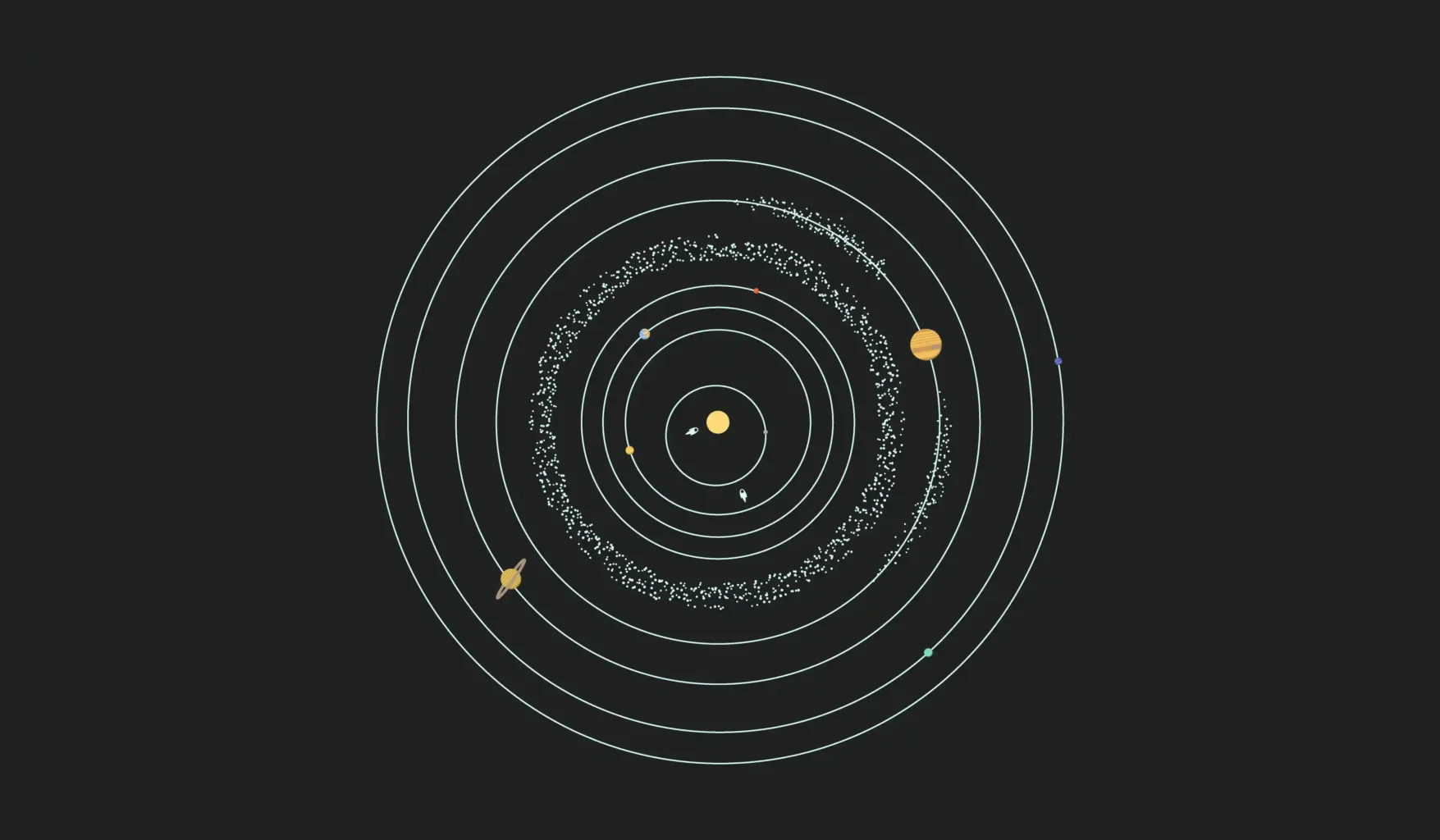
The Sun, eight planets, hundreds of moons, dwarf planets, asteroids and comets all belong to that family. Their distances and materials are different, but their history is connected. The most useful picture is not a neat diagram. It is a changing neighborhood with a center, crowded inner streets and a dim outer region whose boundaries depend on what we are trying to measure.
How the Solar System formed
About 4.6 billion years ago, a cloud of gas and dust collapsed under its own gravity. As it contracted, it spun faster and flattened into a disk. Most of the material gathered at the center, where the young Sun began to shine. The remaining grains collided, stuck together and grew into larger rocks, planetesimals and, eventually, planets.
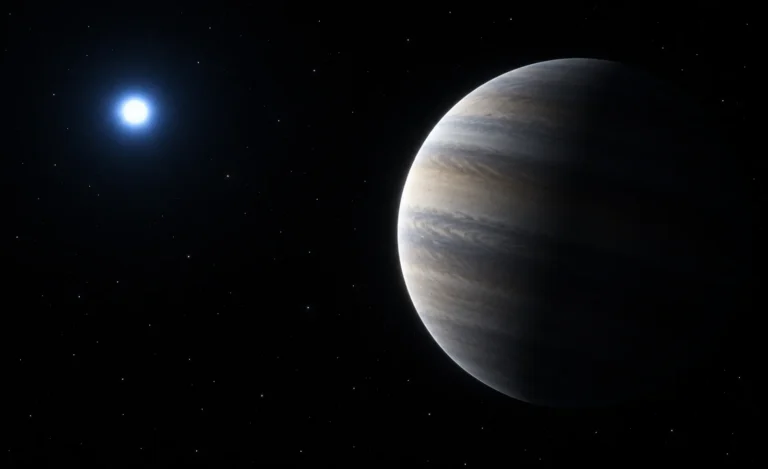
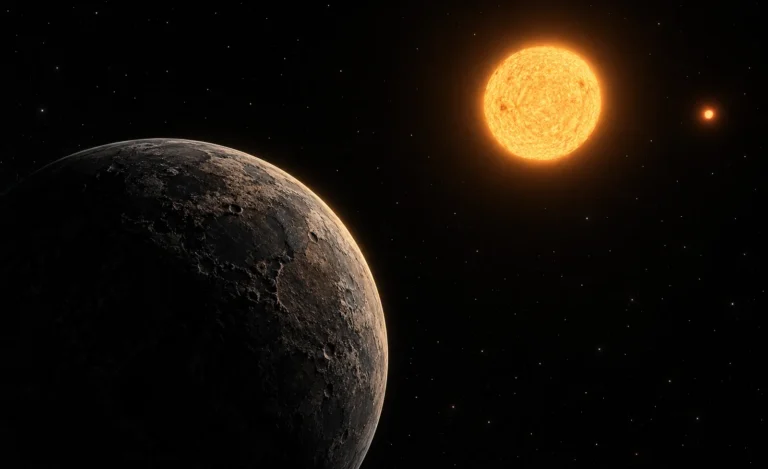
That origin helps explain a division we can still see. Close to the Sun, heat made it difficult for light gases to remain solid, so Mercury, Venus, Earth and Mars grew as relatively small, rocky worlds. Farther out, colder conditions allowed ice to survive. The giant planets gathered enough material to hold thick envelopes of hydrogen and helium, while Uranus and Neptune contain a larger share of water, ammonia and methane ices around their deeper interiors.
Why the planets are not all alike
Distance from the Sun matters, but it does not explain everything. Each planet formed from a different mixture of material, gathered a different amount and then changed through impacts, chemistry, atmospheric loss and interior heat. Earth’s active surface, Mars’s dry valleys and Jupiter’s enormous atmosphere are different chapters in the same story.
Even the labels need care. Jupiter and Saturn are gas giants. Uranus and Neptune are usually called ice giants because ices make up more of their interiors, although those materials are not floating as familiar blocks of ice. A planet’s name gives us a starting point; its history is written in the details.
What lies beyond the eight planets?
The Solar System does not stop at Neptune. The Kuiper Belt contains a broad population of icy bodies, including dwarf planets, beyond Neptune’s orbit. Much farther away, the Oort Cloud is thought to be a distant reservoir of comets, although no spacecraft or telescope has photographed it directly. It is an inference from the paths of long-period comets and from the way the Sun’s gravity can preserve those distant orbits.
Closer to the Sun, the main asteroid belt occupies the region between Mars and Jupiter. It is not a solid wall of rocks. Most of its volume is empty space. Curiosmos has explored how astronomers distinguish asteroids from comets, and examined the remote comet shell beyond the known planets.
Does the Sun control everything?
The Sun contains almost all of the Solar System’s mass, so its gravity dominates the planets’ orbits. Its light and solar wind also shape the space through which those worlds move. The heliosphere—the bubble carved by the solar wind—extends far beyond the planets and changes as the Sun’s activity rises and falls.
But the Sun is not the only influence. Jupiter can alter the paths of comets and asteroids. Moons raise tides, rings preserve evidence of collisions, and small bodies hold material that has changed little since the Solar System formed. The neighborhood is organized around one star, but it is not motionless or simple.
A neighborhood we are still discovering
Every spacecraft visit changes the map. We have flown past planets, landed on asteroids and comets, sampled the solar wind and watched distant objects move through the dark. Yet large parts of our own neighborhood have never been seen up close. A new mission does more than add a photograph: it tests how a star, its planets and its leftovers can grow from one cloud of material.
That is why the Solar System remains more than a list of worlds. It is the nearest example we have of planetary history—and a reminder that even the place we call home still has an outer edge waiting to be understood.