What would a lightning strike mean if you lived in the Roman world? It was not simply weather. A bolt could be a message, a warning—or an event that changed the legal and religious status of the ground it touched.
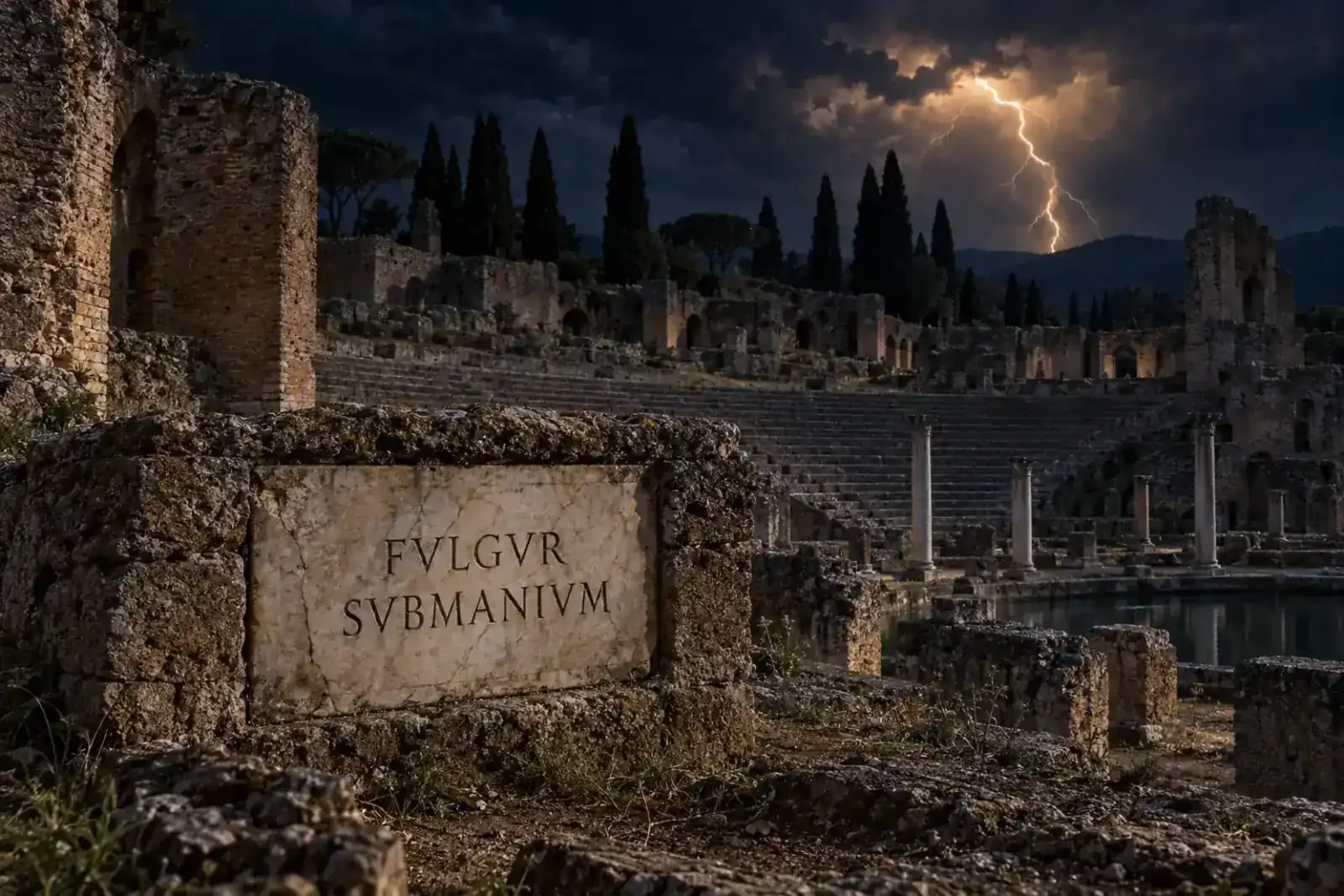
A newly reported marble inscription at Hadrian’s Villa near Tivoli gives that old question a remarkably physical form. The inscription reads FVLGVR SVBMANIVM, a Latin formula referring to a fulgur submanium: a nocturnal lightning strike attributed to Summanus, a Roman deity associated with lightning at night.
The find was made in the area known as the Amphitheatre during archaeological investigations led by the Department of Humanities of the University of Urbino Carlo Bo, under a concession from Italy’s Ministry of Culture and in collaboration with the Istituto Villa Adriana e Villa d’Este. The Ministry says the slab remains in its original position, set into a small structure of tufa blocks and mortar. That context is the most important part of the discovery. We are not looking at an inscription pulled from the soil with no story attached; we are looking at a marker still connected to the space it was meant to define.
What does FVLGVR SVBMANIVM mean?
Roman inscriptions used V where modern Latin spelling would use U, so the formula can be read as fulgur submanium. In the Ministry’s explanation, the phrase identifies a lightning strike as belonging to Summanus, the god of nocturnal thunderbolts. The wording does not tell us that the marble slab itself was struck by lightning. It tells us how the event was classified and remembered.
That distinction matters. The evidence is an ancient label and its architectural setting, not a preserved flash of electricity. Archaeologists can therefore discuss the ritual meaning without claiming that the inscription proves exactly where the bolt landed or what object it hit.
How did Romans make a lightning-struck place sacred?
Roman religious practice treated a place hit by lightning as religiosus—set apart because divine power had entered the human landscape. The broader ritual is known as fulgur conditum, literally a lightning that had been placed or buried. Objects or traces associated with the strike could be collected, deposited in the ground and accompanied by formulas and sacrifices. A small boundary or marker could then identify the area as different from ordinary space.
The structure at Hadrian’s Villa may have been a marker or the boundary of a bidental, a sacred place connected with a lightning event. The interpretation is still provisional, but it fits the inscription and the building’s position. A bidental was not a theatrical monument designed to tell tourists a story. It was a practical religious response: isolate the place, perform the correct rites and preserve the memory of what the gods had touched.
The Romans had many deities whose identities overlapped and changed across time. Summanus was especially associated with lightning at night, when a flash was harder to explain through ordinary observation. Curiosmos has previously looked at the many gods who filled Roman religious life; this inscription adds a very local example of how one divine power could shape a physical site. A similar question of context runs through our report on a Ramesses II inscription: where a text survives can matter as much as what it says.
Why was the find made near the Amphitheatre?
Hadrian’s Villa is often imagined as a collection of spectacular rooms, pools and gardens. Archaeological work shows a more complicated landscape, repeatedly altered after the emperor’s lifetime. The inscription was found near a palace building identified in the Amphitheatre area during work in 2024. Researchers now want to understand the relationship between the lightning-related structure, the levelling of that palace and the later burial of its remains.
That sequence could help date the ritual and clarify how this part of the villa was reorganised. Was a sacred boundary created while the imperial complex was still active? Did a lightning event become important when an earlier building was being dismantled? Or did later occupants use an existing religious marker to explain a changed landscape? The inscription cannot answer those questions alone, but it gives archaeologists a fixed point from which to ask them.
A small stone with a larger consequence
The slab measures only about 40 by 35 centimetres, yet it changes how the area can be read. A lightning strike was not only an omen described in a text; it could redirect movement, prohibit ordinary use and require a ritual boundary. The result was a conversation between atmosphere, architecture and law.
It also warns us against treating Roman religion as a list of myths detached from daily life. A storm could alter a building plan. A formula carved in stone could preserve a decision made after a single flash. And a place that looks like a fragment of a ruined villa may once have been recognised as a point where the human and divine worlds met.
The Ministry describes the discovery as a rare addition to the evidence for fulgur conditum. Further excavation and study of the inscription’s stratigraphic relationships should show whether the marker belongs to the villa’s imperial phase or to one of the later transformations that reshaped the site. For now, the most intriguing question is simple: how many other Roman landscapes still hide the physical boundaries of a storm that people once believed had changed the ground forever?