Earth has seasons because its axis is tilted by about 23.4 degrees. As the planet travels around the Sun, one hemisphere leans toward the Sun while the other leans away. The tilt changes the angle of sunlight and the length of daylight, producing the yearly pattern of summer, autumn, winter and spring.
Distance from the Sun is not the main cause. Earth’s orbit is slightly oval, but the Northern Hemisphere is in winter when Earth is actually a little closer to the Sun than it is during northern summer.
Sunlight arrives at different angles
When a hemisphere tilts toward the Sun, sunlight strikes it more directly. The same energy is concentrated over a smaller area, and the Sun remains above the horizon for more hours. Those conditions warm the surface more efficiently.
When the hemisphere tilts away, the Sun stays lower in the sky. Its rays spread over a larger area and pass through more atmosphere. Shorter days also give the ground less time to absorb sunlight. Together, those changes produce winter in that hemisphere.
NASA’s seasonal explanation compares Earth with Mars and shows how the same basic geometry works on other worlds.
Why the hemispheres have opposite seasons
Earth’s axis keeps pointing in nearly the same direction as the planet orbits. Around June, the Northern Hemisphere leans toward the Sun and experiences summer, while the Southern Hemisphere leans away and experiences winter. Around December, the arrangement reverses.
Spring and autumn occur between those extremes. During an equinox, neither hemisphere is tilted strongly toward the Sun, so day and night are close to equal in length in most places. The exact timing and local daylight depend on latitude, the atmosphere and how sunrise and sunset are defined.
What solstices mark
A solstice is the point in the year when one hemisphere reaches its greatest tilt toward or away from the Sun. It produces the longest day and shortest night of the year in one hemisphere, with the reverse in the other.
The Sun does not suddenly change its power at a solstice. Earth’s orientation changes the way that energy is distributed. At high latitudes, the difference is dramatic: some regions receive nearly continuous daylight in summer and almost none in winter.
Why seasons feel different by latitude
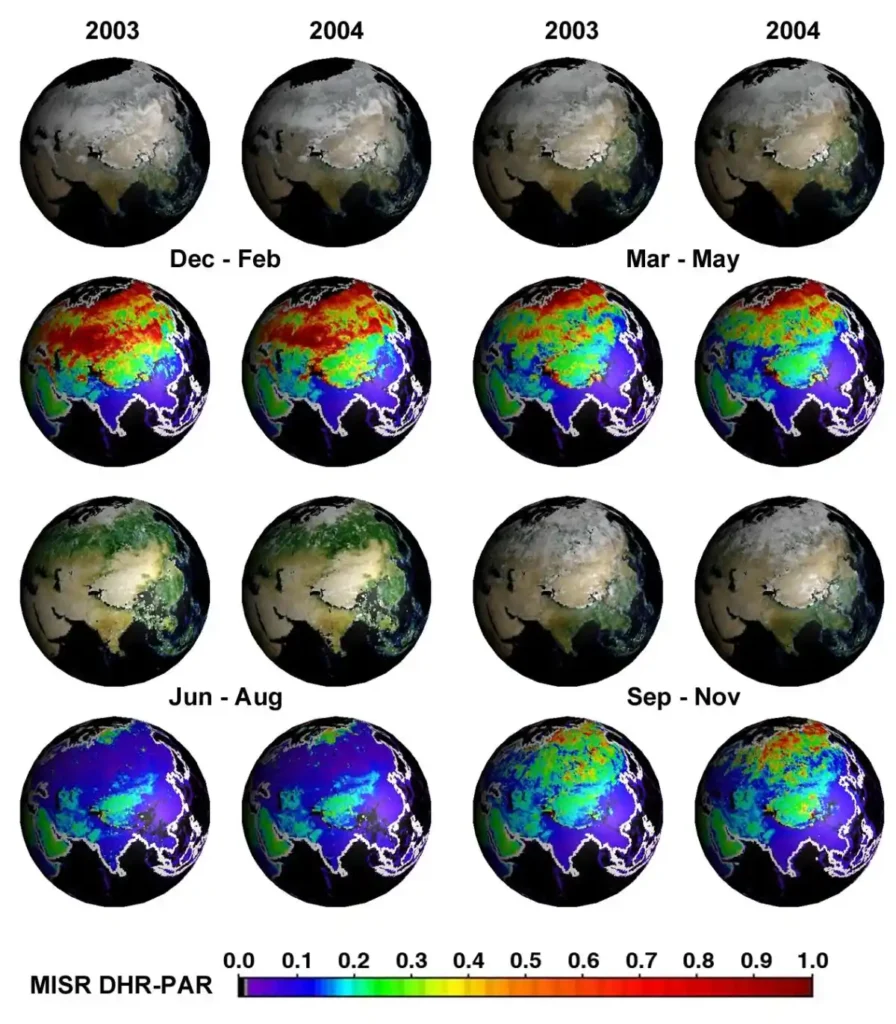
Near the equator, the Sun stays high in the sky for much of the year, so the annual change in daylight is modest. Farther north or south, the same tilt produces larger swings in solar angle and day length. Polar regions can move from weeks of sunlight to weeks of darkness while the equatorial tropics pass through a much smaller seasonal cycle.
Climate adds another layer. Water warms and cools slowly, snow reflects sunlight and winds carry heat between latitudes. Those effects can delay the hottest and coldest parts of the year, which is why the warmest day does not usually arrive on the summer solstice itself.
Why summer is not caused by Earth’s distance from the Sun
Seasons are not identical everywhere. Oceans store heat, mountains alter local weather and atmospheric circulation moves energy from one region to another. The tilt sets the basic rhythm, while Earth’s surface and atmosphere determine what each place experiences. Ancient observers measured part of that rhythm in monuments such as Chankillo, the oldest surviving astronomical observatory.
The uneven orbit around the Sun does have effects. Earth moves a little faster when it is closer to the Sun, so the seasons are not exactly equal in length. That orbital difference is much smaller than the effect of axial tilt on the sunlight received by each hemisphere.
Curiosmos has also covered how ancient observers tracked the changing sky. Long before modern orbital diagrams, people noticed the shifting sunrise points, changing shadows and annual return of the Sun’s path.
Other worlds have seasons too
Mars has an axial tilt similar to Earth’s, so its northern and southern hemispheres also take turns receiving stronger sunlight. Uranus is tilted so dramatically that its poles can face the Sun for long stretches of its very long year. Pluto combines a tilted axis with a strongly oval orbit, giving it an even more extreme seasonal cycle.
Seasons are therefore a consequence of geometry and sunlight, not a special feature of Earth’s weather. The same physics appears across the Solar System, shaped by each planet’s tilt, orbit and atmosphere.
That regularity made the seasons useful long before modern clocks. The changing sunrise point, noon shadow and length of daylight gave communities a way to organise planting, travel and ceremonies. The measurements were local, but they were tracking the same planetary tilt that spacecraft now calculate from orbit.
The short answer
Earth has seasons because its axis is tilted. That tilt changes the angle and duration of sunlight each hemisphere receives as Earth orbits the Sun. Our distance from the Sun varies, but it is not what turns summer into winter.