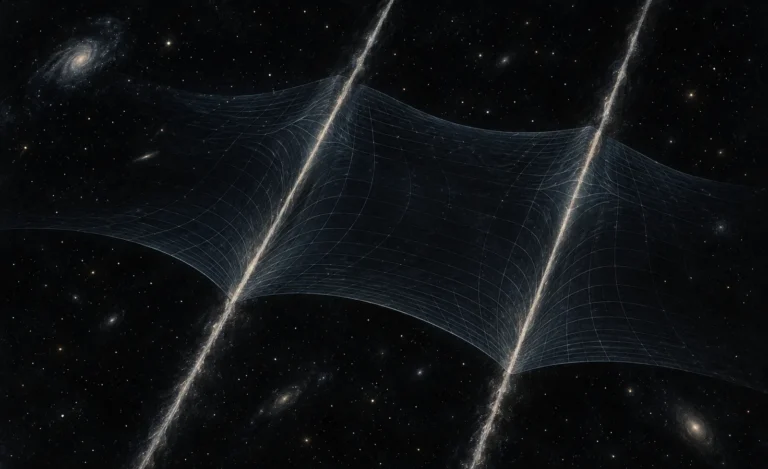
Space is often described as freezing, while the Sun is described as a furnace. Both descriptions can be true at the same time, but not in the simple way they sound. Space is not a giant room filled with cold air. It is almost a vacuum, and that changes how heat moves.
On Earth, air and water carry heat from one place to another. In orbit, there may be too few particles for that kind of transfer to matter. A spacecraft’s sunlit side can become extremely hot while a shaded panel radiates its heat toward deep space and becomes extremely cold.
Temperature belongs to matter, not empty space
Temperature describes the energy of particles in a material. A piece of metal has a temperature because its atoms are vibrating and moving. The nearly empty space between planets does not have a normal atmosphere whose temperature you could measure by placing a thermometer in it.
There is still radiation everywhere. The cosmic microwave background gives the universe a faint background temperature of about 2.7 kelvins, or roughly −270 degrees Celsius. But a spacecraft is not automatically at that temperature. Its own materials absorb sunlight, infrared energy from planets and heat made by electronics.
Three ways heat moves—and the one space removes
Heat can move by conduction through a solid, by convection through a moving fluid and by radiation carried by electromagnetic waves. A metal rail conducts heat. Boiling water carries heat by convection. The Sun warms Earth across empty space through radiation.
Vacuum largely removes convection. There is no surrounding air to flow past a spacecraft and carry heat away. Engineers must instead control conduction through the spacecraft’s structure and radiation from its surfaces.
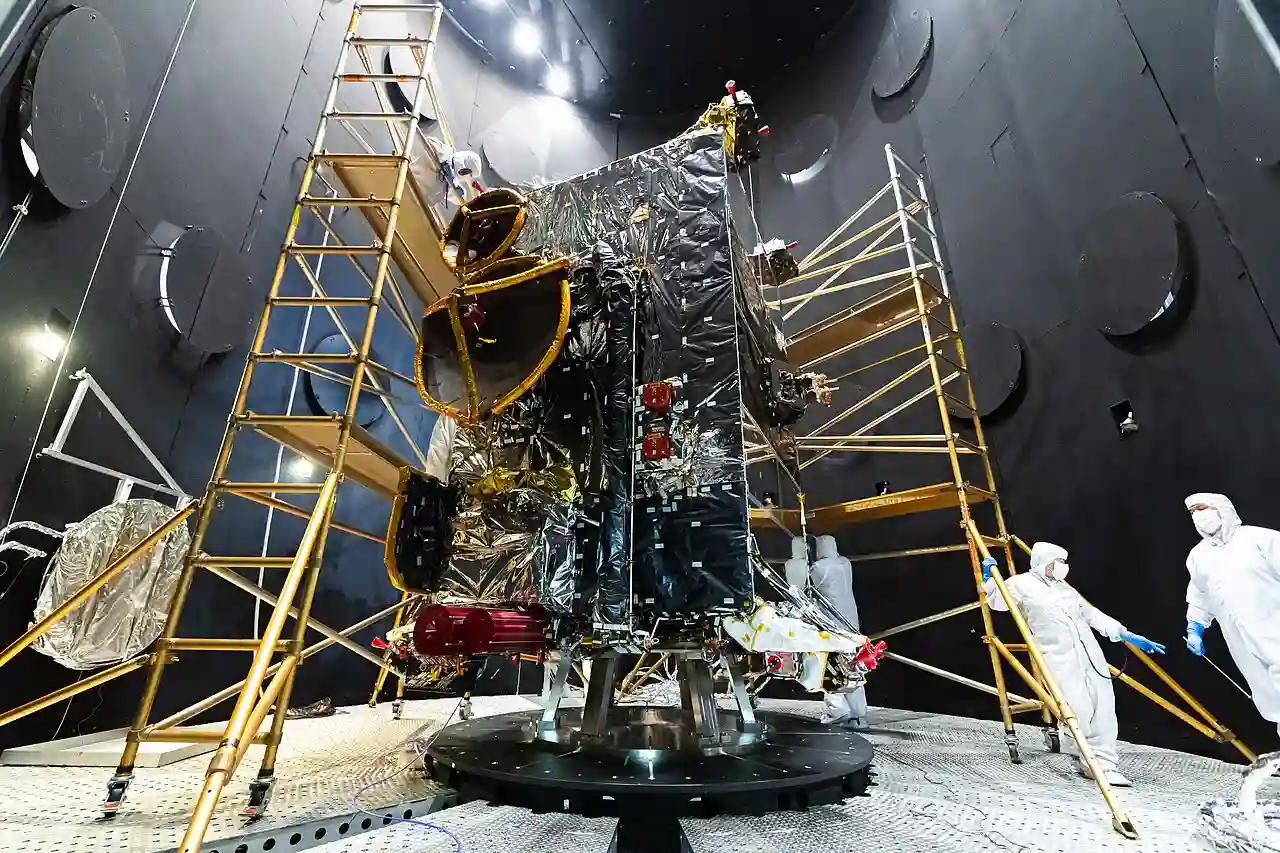
A black or dark surface usually absorbs more sunlight. A bright, reflective surface can reject more of that incoming energy. Radiators are designed to send heat away as infrared radiation. Insulation and multilayer blankets reduce unwanted transfers between hot and cold parts.
Why sunlight can make a spacecraft hot
Sunlight does not need air to travel. When it strikes a satellite, solar panel or spacesuit, some of its energy is absorbed and becomes heat. The closer the object is to the Sun, the stronger the incoming energy. A surface in full sunlight can become far hotter than the surrounding vacuum.
Move the same object into shadow and the incoming energy falls sharply. It continues to radiate heat away, but it is no longer receiving the same supply from the Sun. This is why spacecraft designers calculate the angle of every surface and plan for rapid changes when an orbit carries a vehicle into eclipse.
The European Space Agency describes spacecraft thermal control as a balance among sunlight, reflected light from a planet, heat produced inside the vehicle and heat rejected to deep space. A spacecraft is not simply “cold”; its temperature is the result of that balance.
Would a person freeze instantly in space?
No. The vacuum would create a medical emergency for other reasons long before a person froze. Heat loss through radiation is slower than the dramatic freezing effect shown in films, and there is no cold wind blowing across the body. A spacesuit’s life-support system also has to remove the heat produced by the astronaut’s body and equipment.
That is why the temperature of the environment and the temperature of an object are not interchangeable. A spacecraft can be in a very cold radiative environment while parts of it remain hot. The same principle is why a shadowed object can cool quickly while a nearby sunlit surface stays scorching.
It is also a useful companion to the question of why space looks black. Curiosmos has explored how the universe began; the darkness and the cold are related to the absence of air and scattered sunlight, but they are not the same physical thing.
Space is not a freezer waiting to pull heat from everything nearby. It is a near-vacuum where radiation becomes the main route between an object and the wider universe. That is why spacecraft thermal design is less about finding a single temperature than about managing a constant argument between sunlight, shadow and the black sky.