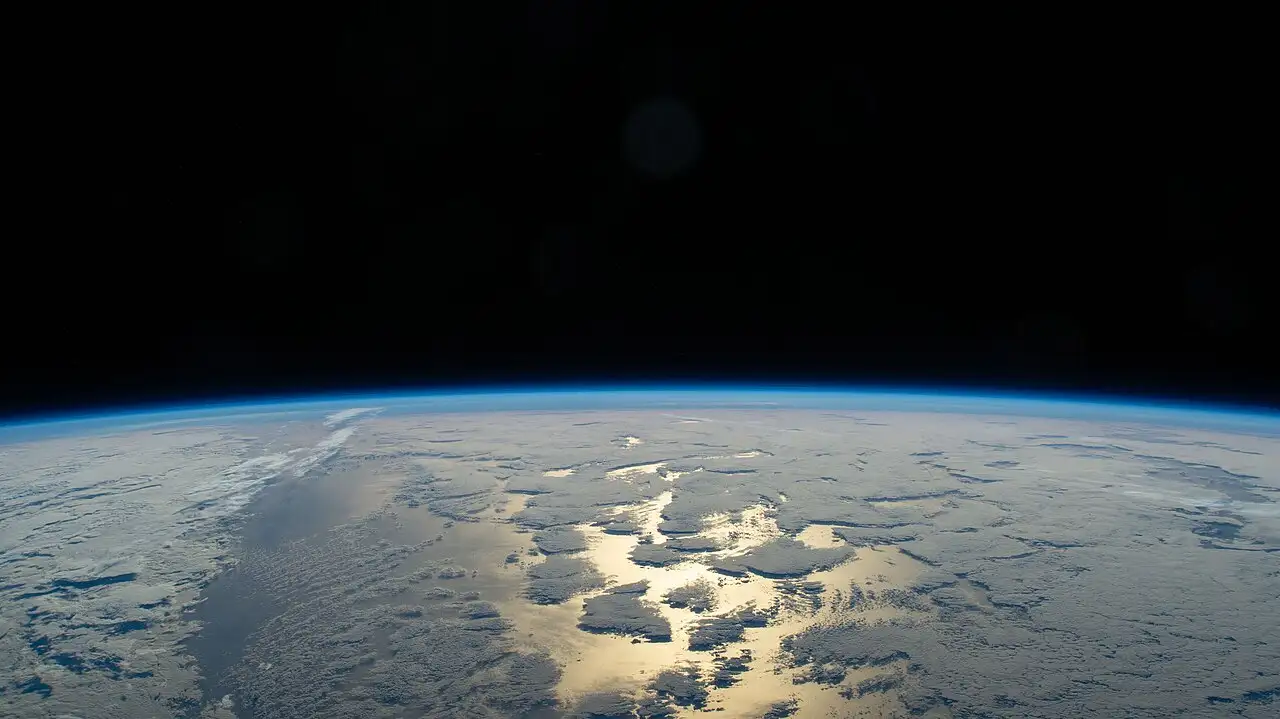
From the ground, the daytime sky seems to be a blue dome wrapped around Earth. Astronauts looking through a spacecraft window see something very different: a thin blue line at the planet’s edge, surrounded by black.
The Sun has not changed. The difference is the air between the observer and the light. Earth’s atmosphere scatters some wavelengths of sunlight in all directions. Space contains so few particles that sunlight usually travels in a straight line until it reaches an object.
Sunlight is a mixture of colours
Sunlight looks white, but it contains the visible colours of the spectrum. Each colour corresponds to a different wavelength. Red light has longer wavelengths; blue and violet light have shorter ones.
When sunlight enters Earth’s atmosphere, it encounters molecules of nitrogen and oxygen. Those tiny molecules scatter the shorter wavelengths more efficiently than the longer ones. Blue light is sent across the sky in many directions, so an observer can see blue light even when looking away from the Sun.
Violet is scattered even more strongly, but human eyes are less sensitive to it, and some violet light is absorbed higher in the atmosphere. The result is the familiar blue sky rather than a violet one.
Why sunsets turn orange and red
When the Sun is low, its light travels through more atmosphere before it reaches the ground. Much of the blue light has already been scattered out of the direct beam. The reds and oranges, with their longer wavelengths, are more likely to continue toward the observer.
Dust, smoke and other aerosols can alter the colours further. They scatter and absorb light in ways that can make a sunset pale, deep red or strangely muted. The basic cause remains the same: the atmosphere changes the path of sunlight before it reaches your eyes.
Why space looks black even in sunlight
Beyond the atmosphere there is almost no air to scatter sunlight sideways. If you look directly at the Sun, the light is blinding; if you look away from it, there is no blue glow filling the surrounding sky. The background stays dark because the light is travelling through a near-vacuum rather than being redirected toward you.
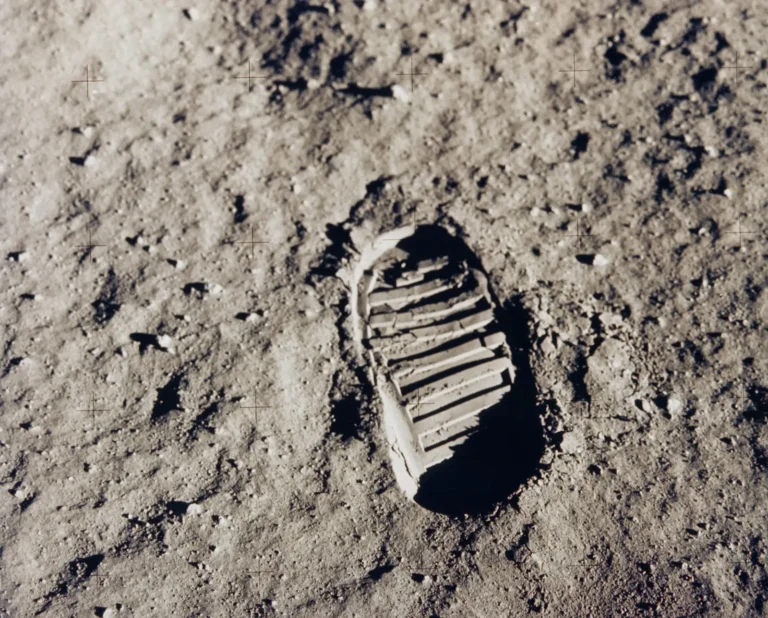
The Moon shows this clearly. Its surface can be brightly lit while the sky above it remains black. The Moon has a very thin exosphere, but not enough atmosphere to produce Earth’s blue daytime sky.
The effect also changes from world to world. NASA notes that Mars has a thin, dusty atmosphere that gives its daytime sky a different colour and can make sunsets appear blue near the Sun. A planet’s sky is a measurement of its atmosphere as much as it is a view.
The dark sky is connected to an older cosmic question
There is a second question hidden inside the blackness of space: if the universe contains so many stars, why is the whole sky not bright? That problem is known as Olbers’ paradox. The finite age of the universe, the expansion of space and the redshifting of distant light all matter to the answer.
Curiosmos has looked at how the universe began. The blue daytime sky is a local atmospheric effect; the darkness of the wider universe leads to a question about cosmic history.
Earth’s sky is blue because air turns a small part of white sunlight into a glow spread across the atmosphere. Space is black because, outside that thin envelope, the scattering largely stops. The colour of the sky is therefore not painted onto the universe. It is made between the Sun and your eyes.