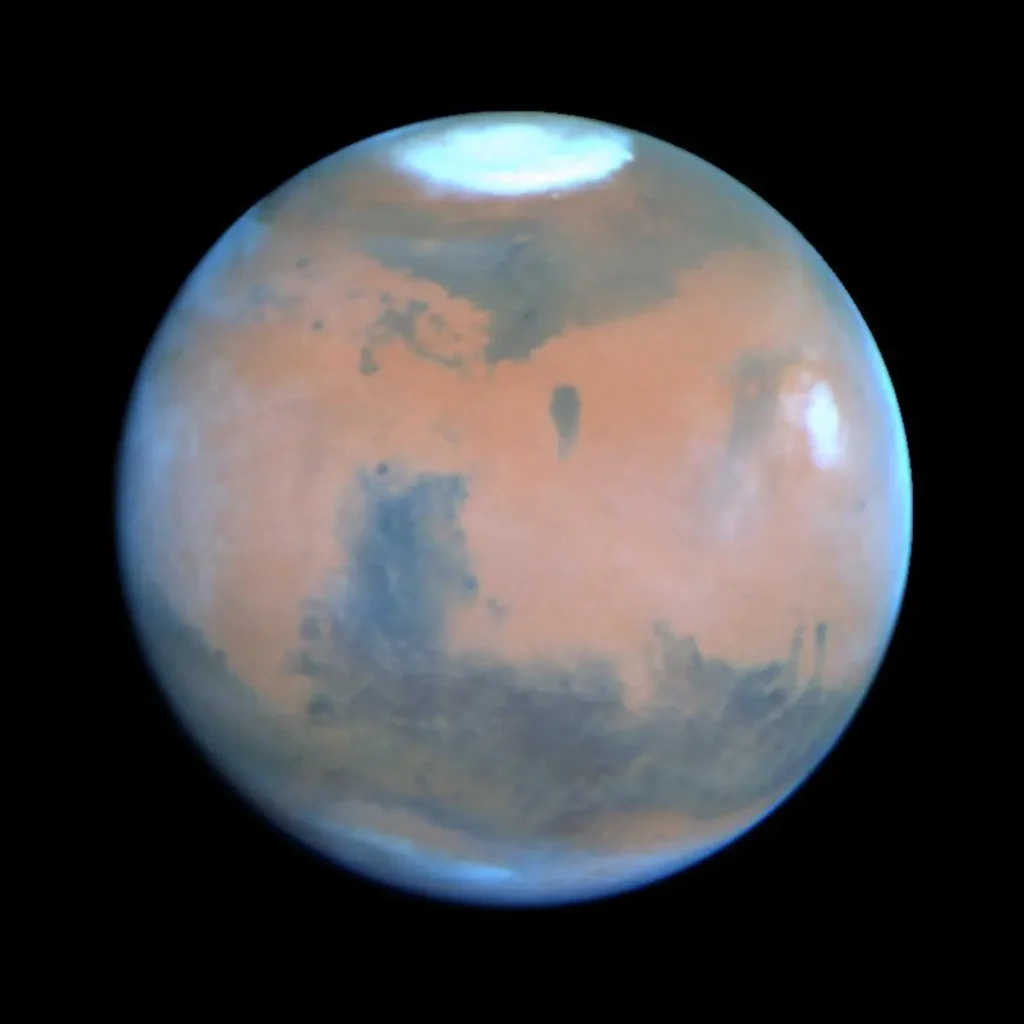
Mars looks red because its surface dust contains oxidised iron. The same broad chemical idea explains rust on Earth: iron reacts with oxygen or other oxidising agents and forms minerals that scatter reddish light. Mars’s version is spread across deserts, crater rims and the dust storms that can cover the planet.
The colour is simple to see and harder to explain in detail. Mars is cold and has a thin atmosphere, so the process that altered its iron did not happen in exactly the same way as rust forming on a bicycle. Scientists are still working out which minerals dominate the dust and when they formed.
Iron is common on Mars
Mars formed from the same broad family of rocky materials as Earth. Its rocks contain iron-bearing minerals. Over time, impacts, volcanic activity and the grinding of the surface created fine dust that could be moved around the planet.
That dust is small enough to remain suspended during global storms. Once the particles are spread through the atmosphere, they give Mars its overall orange-red appearance from space. A close-up view shows a wider range of colours, including dark volcanic rock, pale dust and mineral-rich outcrops.
The colour is easiest to understand when it is compared with what spacecraft have actually seen on the ground. Curiosmos’s archive of early Mars surface images shows how the same planet can shift from orange to brown, grey and blue depending on the camera and the dust in the air.
Oxidation without an Earth-like atmosphere
Earth’s rust usually involves liquid water and oxygen. Mars does not have a thick, warm atmosphere today, and its surface water is largely frozen or locked into minerals. Researchers have therefore considered several routes: reactions with ancient water, hydrogen peroxide produced by surface chemistry, radiation and the action of tiny grains exposed to the solar wind.
NASA reported in 2025 that the iron-rich mineral ferrihydrite may be an important contributor to Martian dust. Ferrihydrite forms in cool, water-rich conditions more readily than some other iron oxides. If it is widespread, the dust could preserve evidence of an earlier climate in which Mars had more surface water.
Curiosmos has covered recent questions raised by observations of objects crossing the Solar System; Mars offers a different kind of investigation, one in which the colour of a planet is a clue to its geological history.
What “rust” means on Mars
Rust is a useful comparison, but it should not be read as proof that today’s Martian surface is wet. The reddish minerals may have formed during an older, warmer period, through reactions involving thin films of water, or through chemistry driven by radiation and the solar wind. The dust can preserve that earlier reaction after the liquid water is gone.
That is why scientists compare samples from different ages and settings. A young volcanic plain, an ancient river delta and a dust-covered crater may carry different iron minerals. Their distribution can reveal whether the red colour was made locally or spread later by the planet’s global dust cycle.
Why the dust matters beyond appearance
Dust is part of Mars’s climate. It absorbs sunlight, warms parts of the atmosphere and can change the temperature of the surface. It also affects spacecraft: fine particles settle on instruments, coat solar panels and can interfere with moving parts.
Rovers and orbiters measure the dust with cameras, spectrometers and thermal instruments. By comparing the colour and chemistry of different regions, scientists can distinguish a thin layer of transported dust from exposed bedrock beneath it.
A wet past in a red landscape
Rivers, deltas, lake sediments and minerals found by Mars missions show that liquid water was present billions of years ago. The planet later became colder and drier as its atmosphere thinned and its surface water disappeared or froze. The red dust remained, carrying a chemical memory of the transition.
The colour does not prove that Mars was once Earth-like, and it does not tell us by itself whether life existed there. It is one piece of evidence that must be read with the rocks, atmospheric history and distribution of ancient water.
What a future sample could settle
Laboratories on Earth can test Martian dust with far more precision than a rover can carry. NASA’s sample-return plans have changed over time, but the scientific value remains: a sealed sample could reveal the exact iron minerals, their age and the chemical pathways that made them.
Until then, Mars’s colour is both familiar and unfinished. The planet is red because of altered iron, but the details of that alteration may tell us when water last moved across the surface.
Orbiters can already separate some of those clues by measuring how dust and rock reflect different wavelengths. A future laboratory sample could connect those spectral signatures to minerals with known ages. That would turn a colour seen from space into a dated record of Mars’s changing climate.