The Moon does have an atmosphere, but calling it air would be misleading. Its outer envelope is an exosphere: a scatter of atoms so thin that particles can travel long distances without colliding. There is no breathable layer, no weather system and no pressure that could support a person without a spacesuit.
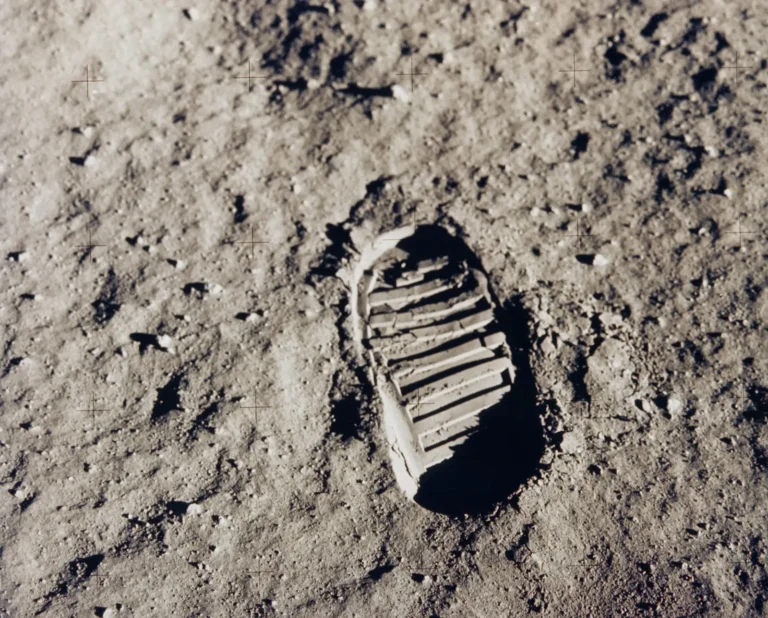
That almost-empty environment explains several familiar lunar features. Shadows can remain sharply cold while sunlit ground becomes dangerously hot, dust is easily disturbed by a landing engine, and footprints can persist for millions of years because wind and rain do not sweep them away.
What is the lunar exosphere made of?
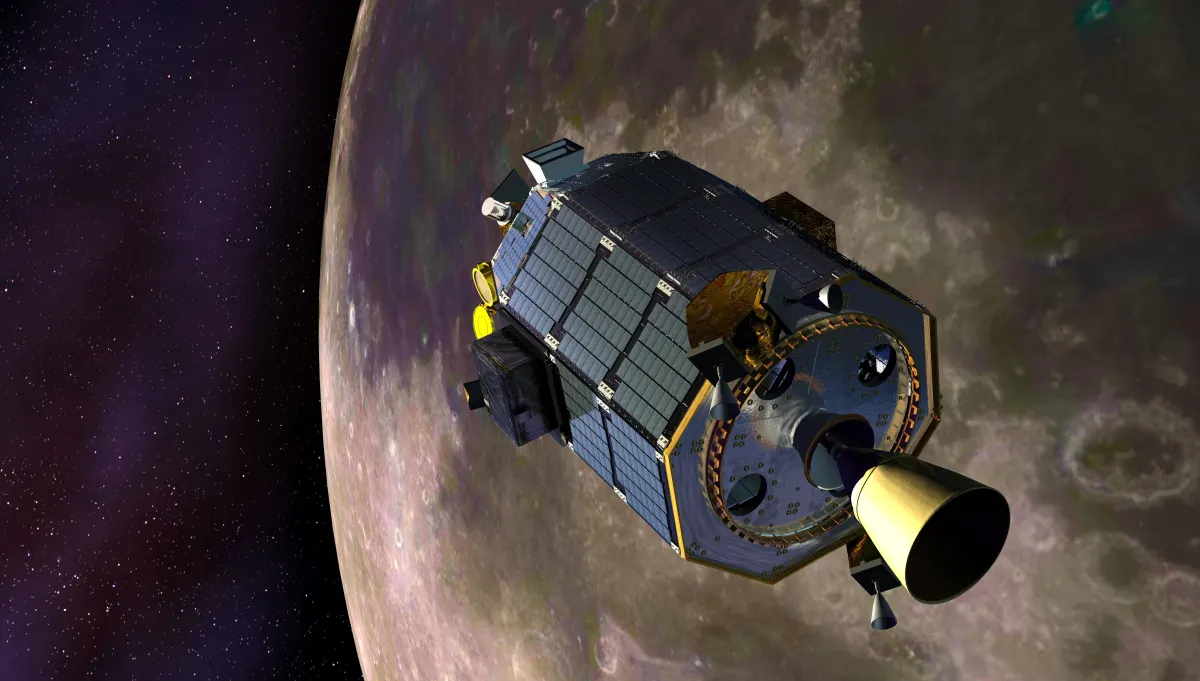
NASA measurements show that the Moon’s exosphere contains helium, neon and argon, along with smaller amounts of hydrogen, sodium and other particles. The mixture changes with location and time. It is not a smooth blanket wrapped around the entire Moon; it is a constantly shifting population of atoms near the surface.
The word “exosphere” describes the way the particles behave. On Earth, molecules collide frequently and move together as a fluid. Near the Moon, the atoms are so far apart that each follows its own path under gravity, sunlight and the solar wind.
Why the Moon cannot hold thick air
Gravity is the first part of the answer. The Moon is much less massive than Earth, so its pull is weaker. Gas molecules move at different speeds, and the fastest can eventually escape into space. Over geological time, that steady loss makes it difficult for the Moon to build and retain a dense atmosphere.
The Moon also lacks the active processes that replenish Earth’s atmosphere on a large scale. Our planet has oceans, volcanoes, a strong magnetic field and a living biosphere that move gases between the ground, water and air. The Moon has none of those systems operating at comparable strength.
The Moon’s weak magnetic protection matters as well. The solar wind constantly delivers charged particles and can help strip or rearrange material near the surface. NASA’s lunar-atmosphere overview describes the exosphere as a changing environment rather than a static layer.
Where the atoms come from
Micrometeorites strike the lunar surface throughout the year. Some impacts are too small to make visible craters, but they can knock atoms free from the soil. The solar wind adds hydrogen and helium, while sunlight can release sodium and other elements in a process called photon-stimulated desorption.
Water is part of the story too. Hydrogen delivered by the solar wind can interact with oxygen in lunar minerals, helping form water molecules or hydroxyl on the surface. The Moon’s exosphere carries some of those atoms away and redistributes others. It is a very thin cycle, but it is still a cycle.
Why landers can change the local environment
Rocket exhaust briefly adds water vapour and other gases to the area around a landing site. On Earth, an exhaust plume is quickly mixed into a thick atmosphere. On the Moon, the particles can travel across the surface or escape, making a lander’s chemical signature easier to detect.
That is why future missions need to measure the lunar environment before, during and after landings. Scientists want to distinguish natural particles from exhaust and other contamination, especially near permanently shadowed craters where water ice may be stored.
What the thin atmosphere means for explorers
A spacesuit on the Moon must supply pressure and oxygen, but it must also deal with radiation, abrasive dust and extreme temperature changes. The exosphere cannot carry sound like Earth’s air, so an astronaut standing a few metres away could not hear a voice without a radio.
The thin gas also means there is no familiar erosion. The Apollo footprints discussed in Curiosmos’s look at the Moon’s night sky remain because the surface is not reshaped by rain or wind. Small impacts will eventually alter them, but the process is slow.
Why the Moon has no blue sky
Earth’s blue sky is made by sunlight scattering from a dense atmosphere. The Moon has too few particles for that scattering to fill the sky, so the Sun and stars appear against black even when the ground is in full daylight. The same absence of air explains why a lunar horizon looks sharp rather than hazy.
There is no breeze to carry sound, either. An astronaut can hear a crewmate through a radio, but a shout cannot cross the open ground between them. Dust kicked up by a boot or engine follows a long ballistic arc instead of forming a drifting cloud, then settles back under the Moon’s weaker gravity.
Almost empty is not the same as empty
The Moon’s atmosphere is too thin to breathe, but it is scientifically valuable. Every atom records an interaction between the surface, sunlight, the solar wind and incoming debris. Understanding that delicate exosphere will help engineers protect instruments and interpret measurements as lunar exploration expands. The related question of what would happen to the Moon if Earth disappeared also depends on the same orbital and gravitational relationship.