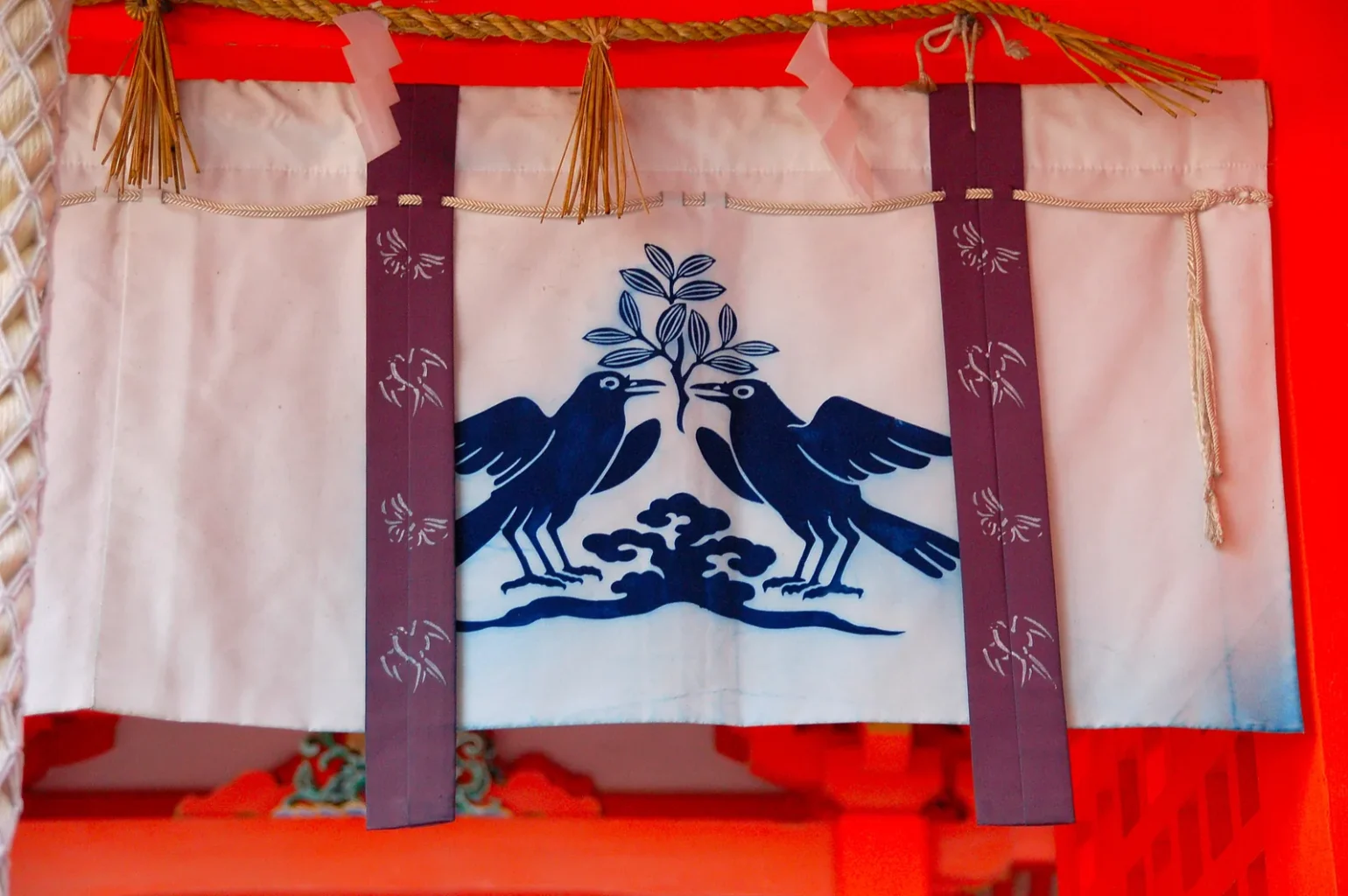
Japan’s football emblem has a bird with one more leg than nature usually supplies. The crow is Yatagarasu, a divine guide whose story leads into the mountains of Kumano, shrine talismans and an older Asian tradition of birds associated with the sun.
Its third leg is the feature most people notice first. It also provides a surprising way into the history: the early Japanese chronicles that tell the guiding-bird story do not describe that extra limb.
How did the crow acquire the shape we recognise today? The answer takes us through several stages of the image’s life, from a journey in a founding legend to a design chosen for a modern sporting organisation.
A guide through Kumano
The Japan Tourism Agency’s account of Miagatahiko-sha Shrine explains Yatagarasu’s role in the Kojiki and Nihon shoki. In these chronicles, the bird is sent to guide the legendary first emperor Jimmu from Kumano toward what is now Nara Prefecture.
This is a story about finding a route. A bird can move above terrain that slows people on foot, making it an effective image of guidance. Kumano’s wooded mountains give that image a particularly vivid setting.
The crow also has a local destination of its own. Tradition at Kumano Nachi Taisha says that, after completing the journey, it returned to Kumano, tucked its beak beneath a wing and became a stone. The Yatagarasu Stone remains part of the shrine’s sacred landscape. A bronze crow stands before Miagatahiko-sha, the subsidiary shrine dedicated to it.
The bird can therefore be encountered as an emblem, a sculpted figure and a named feature in the landscape. Each keeps the guiding story close to a particular place.
Where the third leg enters the story
Yatagarasu means “eight-span crow,” referring to the bird’s great size. According to the tourism agency, accounts written centuries after the early chronicles describe three legs. The guiding bird was already part of the story before the third leg appeared in these later accounts.
The Japan Football Association’s explanation follows another part of the history. It traces the three-legged solar crow to Chinese tradition, its transmission to Goguryeo on the Korean peninsula and its wider circulation in East Asia. In Japan, that image became associated with Yatagarasu.
The association acknowledges both strands in its emblem’s origin: the Japanese guiding bird and the solar crow described in Chinese texts. That is a richer history than the idea of an unchanged national symbol travelling directly from one ancient story onto a football shirt.
The third leg suggests that even a distinctive sacred image could change as stories travelled. A familiar bird acquired another tradition’s solar attribute. This documented route through East Asia adds context to connections between mythological traditions.
Three legs, several uses
Kumano Hongu Taisha gives the three legs a religious interpretation: heaven, earth and humanity. At the shrine, the bird joins those three parts of the world in a single image.
The same shrine describes a less widely known use of crow imagery. Its Kumano go’o-ho-in talismans carry writing whose forms are designed as crows. These were used in sacred vows and could be placed at a house entrance or in a rice-growing setting for protection.
Here a crow is doing something more elaborate than standing beside a written message. Its shape enters the message itself. The talisman brings together the recognisable animal, the authority of the shrine and the promise or protection sought by its owner.
That helps explain why a single creature can carry so much meaning without requiring every use to have the same explanation. A pilgrim seeking guidance, a household receiving a talisman and a supporter recognising a team badge encounter different parts of its history.
How it reached the football badge
The JFA records a decision to adopt a symbol in June 1931. In 1932, its national delegates approved sculptor Jitsuzo Hinago’s design for the association’s flag. The crow’s modern sporting use therefore has its own documented chronology.
The tourism agency also connects the choice with Nakamura Kakunosuke, who came from Katsuura in the Kumano region and helped introduce football to Japan, including translating its rules. This gives the emblem a local human connection alongside its legendary one.
There is room for both histories on the badge. The football organisation can identify a design and an adoption date; the shrine tradition gives the bird a sacred role; the older texts let us see how the image changed.
Next time that crow appears on a shirt, look beyond the extra leg. It carries a route through a mountain landscape, a solar image shared across Asia and a twentieth-century decision about how a team should represent itself.