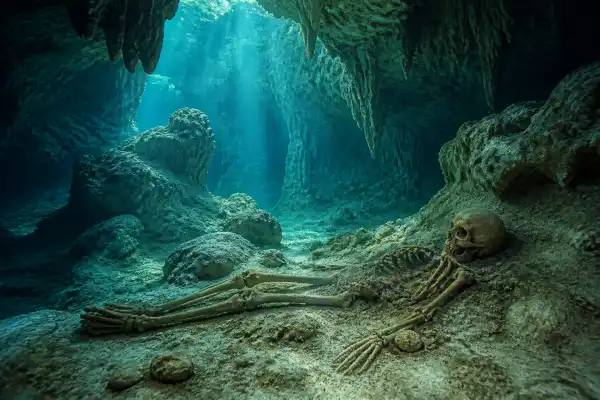
The skeleton was not found in an open-air cemetery. It was deep inside a cave, beneath several metres of water, far from the entrance and in a landscape that once looked nothing like the Yucatán Peninsula does today.
Archaeologists recovered the remains from a submerged cave near Playa del Carmen and Tulum. The cave lies about eight metres below the surface, with the skeleton roughly 200 metres from the entrance. Its location suggests that the person may have been placed there when the cave was still dry, at least 8,000 years ago, before rising water transformed the underground passage into part of the region’s flooded cave network.
That is a remarkable possibility. It is also a conclusion that needs to be stated carefully. The context points to great antiquity and a possible funerary deposit; the skeleton’s precise age and the circumstances of the burial require further study.
A cave that changed after people used it
The Yucatán is famous for cenotes and underwater cave systems, but the water is a relatively recent part of many of those environments. During the last Ice Age, sea levels were lower and the peninsula’s limestone caves were often dry. People could walk through passages that are now accessible only to trained cave divers.
As the climate warmed and ice sheets melted, groundwater and sea level rose. Large sections of the cave system flooded. Objects and human remains that had been deposited in dry chambers were sealed beneath the water, sometimes preserving a context that would have been disturbed on the surface.
The newly reported skeleton was found in that kind of setting. Its position deep inside the cave makes a modern accident less likely, but it does not by itself explain how the person got there. A body could have entered through a dry entrance, been carried by people, or moved within the cave before flooding. Archaeologists must examine the bones, sediments and surrounding deposits together.
Why the location is as important as the bones
An isolated skeleton can be difficult to interpret. A skeleton inside a cave, far from the entrance, raises a different set of questions. Was the person buried deliberately? Were caves being used as places of memory or ceremony? Did the community return to the same chamber? Was the body placed there before or after the passage began to fill with water?
The cave’s geography is part of the evidence. The remains were not reported from a shallow cenote where recent visitors could easily disturb them. They were found in a remote section of a submerged system, the kind of place that demands specialist equipment and careful mapping.
That does not turn the discovery into proof of an elaborate ritual. It tells us that the deposit deserves to be recorded in three dimensions, with the position of each bone, nearby stones and sediment layers preserved before anything is moved.
The people who lived on a dry Yucatán plain
The ancient environment would have been familiar to people who moved across a dry limestone landscape rather than to tourists swimming in today’s cenotes. Fresh water would still have mattered, especially during dry seasons, but it would have been found in different places and used in different ways.
The cave system may have offered shelter, a route through the landscape or a place apart from daily life. Archaeologists working in Mexican underwater caves have already documented human remains, extinct animals and other traces of early activity. Each discovery helps rebuild the period before the rise of Maya cities, when small communities were adapting to a changing climate and a difficult terrain.
The broader record also carries a warning. Submerged caves are not simply archaeological time capsules. They are fragile, dangerous environments. Untrained visits can dislodge bones, destroy sediment layers and remove the information that makes a discovery meaningful.
What still needs to be established
The reported context is strong enough to justify attention, but several questions remain open. Researchers need to determine the skeleton’s biological profile, assess any trauma or pathology, and test whether the bones can be directly dated. Sediment and associated material may provide independent dates. The team must also establish whether the cave was dry when the remains entered it and whether water movement altered the deposit afterward.
Those tests may confirm an early burial, or they may produce a more complicated history. The skeleton could have been moved through the cave before being trapped by rising water. A single date would not settle every question about the deposit.
That uncertainty is not a weakness in the discovery. It is the normal work of underwater archaeology, where the setting can preserve evidence and obscure it at the same time.
A human story beneath the water
The most striking fact is not that a skeleton survived in a flooded cave. It is that someone made a decision about that body thousands of years ago, and the landscape later changed around it.
The person belonged to a world before monumental Maya architecture, before written records and before the modern coastline took shape. The cave now hides the route that once led to the burial. With careful excavation and dating, archaeologists may be able to recover a small but unusually intimate piece of that world.
For now, the responsible description is also the most interesting one: a prehistoric human deposit in a submerged Yucatán cave, probably created when the passage was dry and possibly associated with funerary treatment. The evidence is waiting below the water, but it has to be read without turning a possibility into a certainty.