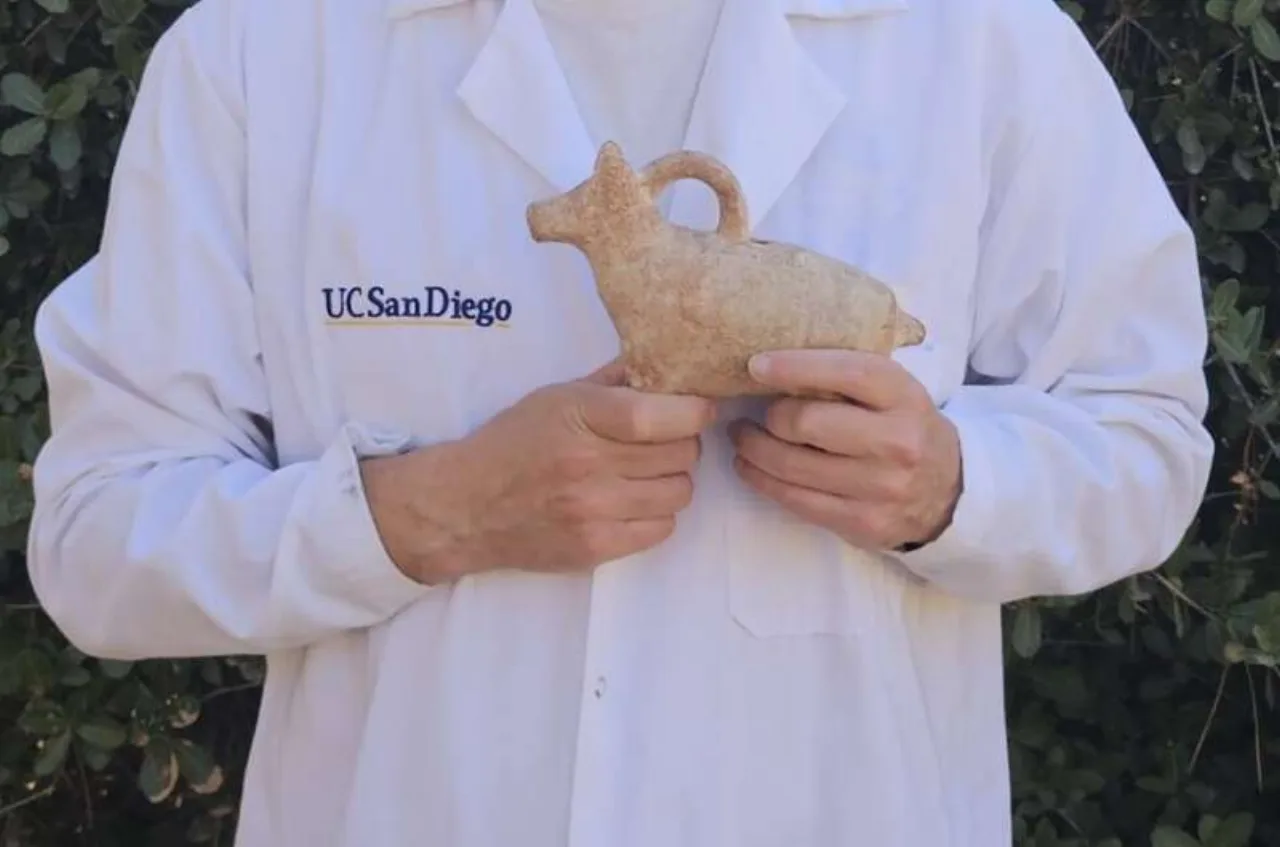
Archaeologists and museums may soon have a new way to test suspicious clay objects: a controlled heating experiment that separates pottery more than 1,000 years old from modern material. A team led by Yoav Vaknin at the Scripps Institution of Oceanography at UC San Diego reported on August 31 that it found that the difference lies in how tiny magnetic particles in fired clay change over time.
Pottery records the direction of Earth’s magnetic field when it cools in a kiln. That signal can survive for centuries, but another, weaker magnetic signal continues to change while the object sits in the ground or on a shelf. The new method measures the difference between those two signals rather than relying on direction alone.
Why the magnetic signal changes
The larger particles in fired clay tend to lock in the magnetic field present when the pot cools. Geoscientists call this thermal remanent magnetism. Smaller particles behave differently: their magnetic alignment can slowly shift as Earth’s field changes, creating what is known as viscous remanent magnetism.
That second signal can be erased by reheating the clay. The newer the pottery, the lower the temperature needed to remove it, while older objects retain it more strongly.
The researchers tested objects known to be thousands of years old, modern souvenirs from shops around Jerusalem and pieces already identified as fakes. They heated samples from 50°C upward in 10-degree steps and tracked when the newer magnetic component disappeared.
Why 112°C matters
In their experiments, samples more than 1,000 years old generally needed to be heated above 112°C before the viscous magnetisation was erased. Modern samples lost that component at lower temperatures.
The threshold is not a magic number that authenticates every object by itself. The method works as a physical test that can be combined with a pot’s clay composition, manufacturing traces, archaeological context and other evidence.
For years, the underlying magnetic behaviour was understood, but researchers lacked the computing power to model it in enough detail. The new micromagnetic simulations helped connect the laboratory results with the history of the particles inside the clay.
The team plans to apply the technique to disputed objects in museums and to cases involving the illegal antiquities trade. If it performs well on a wider range of material, a small heating test could give curators and courts a stronger way to challenge forged objects before they are accepted as evidence of the past.
That kind of testing is especially valuable when an object has no secure excavation record. As with the debate over inscriptions linked to Egypt’s lost city of Mesen, the history of where an artefact came from can be as important as the object itself.