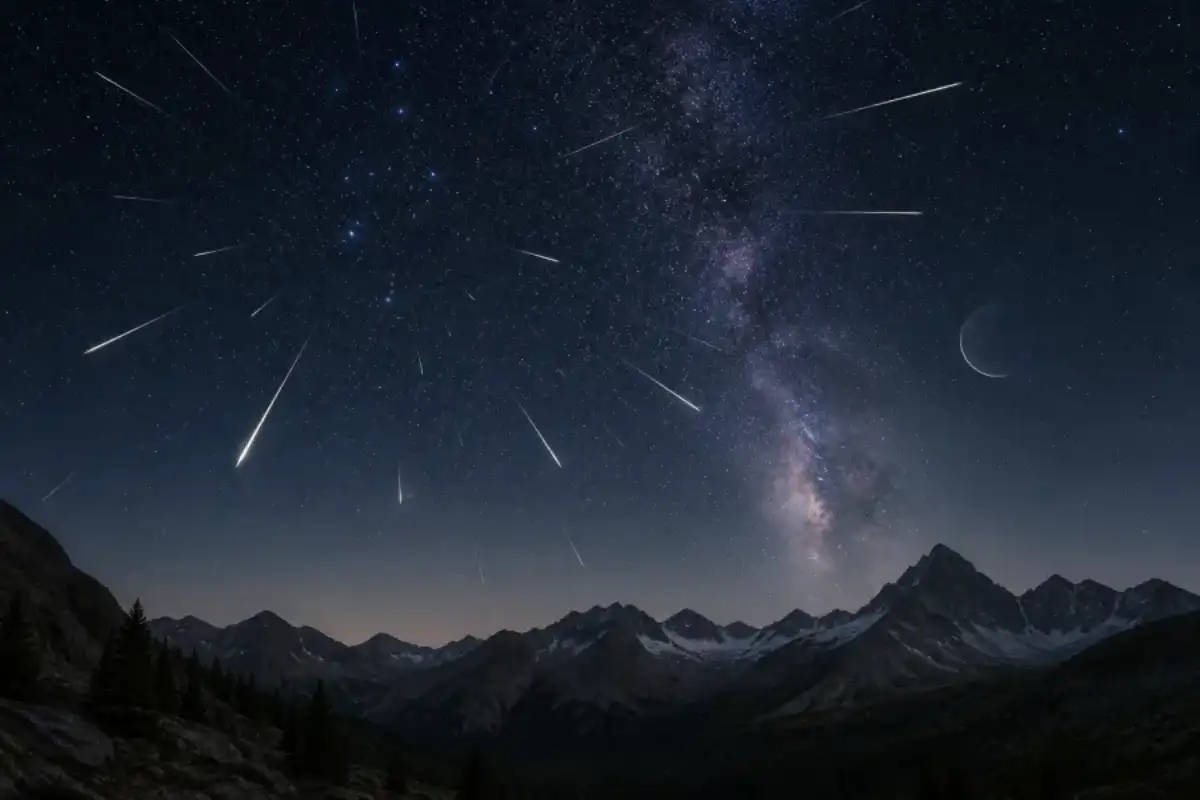
The Perseid meteor shower reaches its 2026 peak on the night of August 12 and into the morning of August 13. This year the timing is especially friendly to observers because the peak coincides with a new Moon, leaving the sky darker than it would be during a bright lunar phase.
The Perseids return every summer as Earth crosses the debris stream left behind by comet 109P/Swift-Tuttle. The comet’s dust and grit enter the atmosphere at high speed, heating the air around them and producing the brief streaks we call meteors.
When and where to look
The best viewing usually comes after midnight and before dawn, when the side of Earth beneath you is turning into the direction of the planet’s motion around the Sun. The meteors appear to radiate from a point near the constellation Perseus, but they can cross a large part of the sky.
You do not need to stare directly at Perseus. A spot about 45 degrees away from the radiant often gives a better view because the trails appear longer there. Lie back or use a reclining chair so your neck does not tire, and give your eyes at least 20 minutes to adjust to the dark.
How many meteors will you see?
NASA notes that the Perseids can produce roughly 50 to 100 meteors per hour under good conditions during the peak, but that number is an ideal rate rather than a guarantee. Clouds, light pollution, trees and the observer’s horizon all reduce the count.
Most of the shower is made of tiny particles, so many meteors are faint. A darker location is more valuable than a powerful telescope. Binoculars are not necessary either; their narrow field of view makes it harder to follow the broad display.
Simple ways to improve the night
Leave the city if you can, switch off phone screens and avoid white light. If you need a screen, use the dimmest red setting available. Check the local weather before driving to a darker site, and bring a jacket, water and something to lie on—summer nights can become surprisingly cold when you sit still.
The Perseids begin in July and continue through much of August, so a cloudy peak night does not end the opportunity. The nights immediately before and after August 12 can still produce good activity. The shower is a seasonal event worth returning to, not a single show that lasts only one hour.
For anyone new to meteor watching, the most useful equipment is patience. Find the darkest safe place available, let your eyes adapt and watch a wide section of sky. The next streak may appear anywhere above you.
The shower’s name comes from its radiant, the point in the sky from which the tracks appear to fan out. Perspective creates that effect: the particles are travelling along nearly parallel paths, but their trails seem to meet in the distance. Meteors close to the radiant look short, while those farther away can sweep across much longer arcs. Watching a broad patch of sky makes it easier to see both kinds.
There is no need to wait for a bright fireball to make the night worthwhile. Most Perseids are small grains that burn briefly, and the number visible to one person depends on the whole sky rather than on a single burst. A clear horizon, a dark site and a view away from streetlights will do more than expensive equipment. If clouds cover the peak, the same advice still applies on the surrounding nights while Earth remains inside the comet’s debris stream.
If you are watching the Perseids, Curiosmos’ guide to why stars twinkle while planets usually do not explains the atmospheric effect that shapes the view.