Stars do not actually switch their lights on and off when they twinkle. The flicker happens between the star and your eyes, as its light passes through Earth’s moving atmosphere. Planets are affected by the same air, but they usually look steadier because their light arrives from a small disk rather than a single point. The atmosphere is only one part of observing the sky; our light-travel explainer covers the other delay every telescope must contend with.
The atmosphere is always moving
Air is not uniform. Pockets with different temperatures, densities and humidity mix and move above the ground. Each pocket bends light by a slightly different amount. Astronomers call this refraction, and the constantly changing pattern is part of what they mean by atmospheric seeing.
When starlight enters one of these moving cells, the apparent position and brightness of the star shift by a tiny amount. Human vision reads those rapid changes as a shimmer. Near the horizon, the effect is usually stronger because the light travels through a longer, thicker path of atmosphere.
Why stars behave like points
Even the largest star looks like a point of light to the unaided eye. Its surface is enormous, but the distance is so great that the star’s visible disk is far smaller than the distortions produced by ordinary air turbulence. The light reaching your eyes is therefore vulnerable to each change along the path.
That is why bright stars can flash red, blue or white when they sit low in the sky. The atmosphere is bending different wavelengths by slightly different amounts. The star itself is not changing colour at that speed.
Why planets usually look calmer
Planets are much closer to Earth than the stars. Through a telescope, they have measurable disks. Even when they look like points to the naked eye, their apparent size is larger than the tiny point made by a distant star.
Light from one part of a planet’s disk may be bent one way while light from another part is bent differently. The effects overlap and partly cancel. Instead of one beam changing at once, your eye receives many slightly different beams. The planet can still shimmer, especially close to the horizon, but the strong rapid flicker is less obvious.
This is a useful observing rule, not a perfect test. Venus, Jupiter and other bright planets can appear to twinkle in turbulent air. A star high overhead can look steady on a very calm night. The difference is a matter of degree, not a switch that never fails.
What happens above the atmosphere?
From space, the familiar twinkle disappears. NASA notes that the atmosphere blurs ground-based telescope images and makes stars appear to shiver. Space telescopes avoid most of that moving air, which is one reason they can produce sharper views without waiting for a perfectly calm night.
Ground observatories have developed ways to fight the problem. Adaptive-optics systems measure the atmospheric distortion and rapidly reshape a telescope mirror to compensate. Long exposures can also record the average position of a star, although the image may still be blurred. Astronomers often describe the blur as “seeing,” a condition that limits how much detail a telescope can resolve.
Twinkling is not stellar activity
Stars can change brightness for real physical reasons. Pulsating stars expand and contract. Eruptions can release energy. Rotating starspots can move in and out of view. Those changes happen on their own timescales and can be measured with instruments.
Atmospheric twinkling is different. It is a local optical effect that changes from moment to moment as air moves above the observer. A space telescope may record the same star as steady while an observer on the ground sees it flash. The star has not received two different instructions; the light has travelled through two different environments.
A simple way to test it yourself
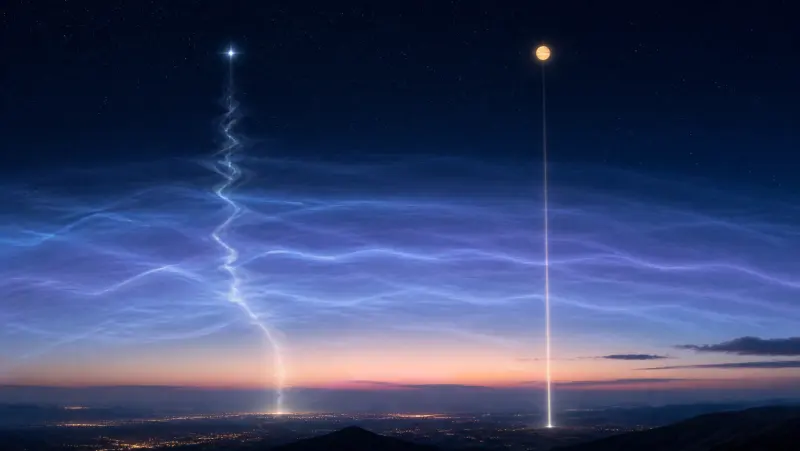
On a clear evening, compare a bright star with a bright planet when both are visible. Watch them near the horizon, where the air column is longest, and then again higher in the sky. The star will usually show the stronger colour changes and flicker. If the atmosphere is unsteady, the planet may shimmer too.
The next time a star seems to wink, the movement is telling you something about the air above your head. The light began its journey years ago, but the final sparkle belongs to Earth.