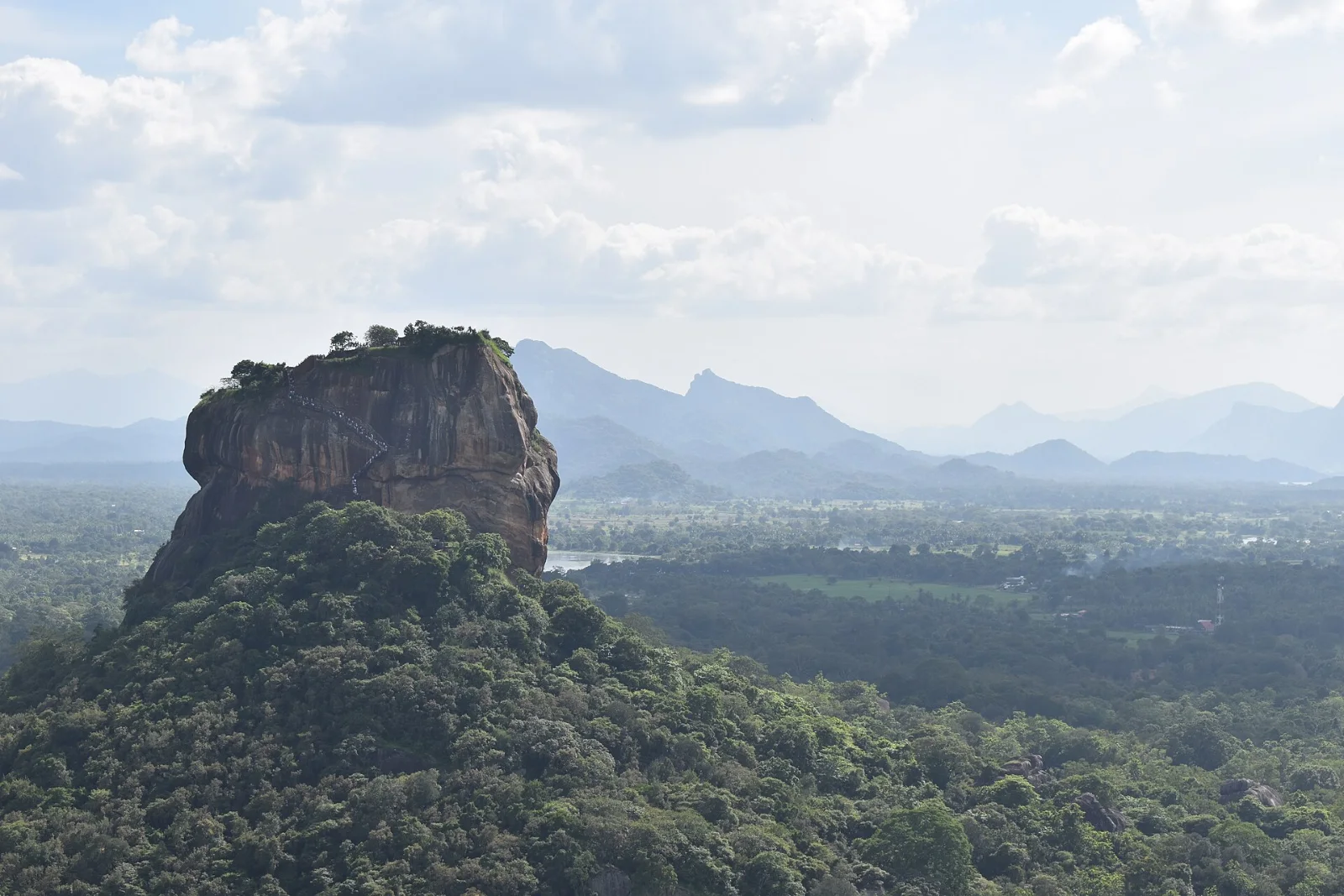
Sigiriya rises about 180 meters straight out of the forests of central Sri Lanka, a sheer column of granite with the ruins of a palace on its flat summit. For a few years at the end of the fifth century AD, this rock was the seat of a king. According to Sri Lanka’s chronicles, he had seized the throne by murdering his own father, and he spent his short reign waiting for his brother to come back and take revenge.
Today Sigiriya, the “Lion Rock,” is a UNESCO World Heritage Site and one of the best-preserved royal cities of the first millennium in South Asia. This guide covers how the rock formed, the king who built on it, the giant lion staircase, the painted women and the “mirror wall,” the gardens whose fountains still work, and what became of the site after its builder died.
At a glance
- Where: Matale District, central Sri Lanka, near the town of Dambulla.
- What: A royal citadel built on the summit of an 180-meter granite rock, with gardens, moats and walls at its base.
- When: Built under King Kashyapa I, who ruled from about AD 477 to 495.
- Best known for: The Lion Gate, fifth-century frescoes, the inscribed mirror wall and working water gardens.
- Status: UNESCO World Heritage Site since 1982.
A rock made by a volcano
Sigiriya is an inselberg, a hard outcrop left standing after the softer land around it wore away. The granite formed from magma that solidified inside a long-extinct volcano. Erosion stripped away the surrounding rock and left the plug standing about 180 meters above the plain, with its summit roughly 349 meters above sea level. Its nearest neighbor, Pidurangala Rock about a kilometer to the north, formed the same way, and today it offers the classic view of Sigiriya.
People were drawn to the rock long before any king. Excavations at the Aligala rock shelter, just east of Sigiriya, show the area was inhabited around 3000 BC, in the Mesolithic period. From around the second or first century BC, Buddhist monks lived in the caves around the base of the rock, and short dedications cut in early Brahmi script still mark the shelters donated to them.
Kashyapa, the king who killed his father
The story of the palace comes from the Culavamsa, the medieval chronicle of Sri Lanka’s kings. Kashyapa was the son of King Dhatusena by a consort who was not of royal birth. The rightful heir was his half-brother Moggallana. With the help of the army commander Migara, Kashyapa overthrew his father in about AD 477. The chronicle says Dhatusena was walled up alive.
Moggallana fled to South India and vowed to return. Kashyapa expected him, and moved his court from the old capital at Anuradhapura to the top of Sigiriya, where a palace could be defended from every side. In AD 495, Moggallana came back with an army. Kashyapa’s troops deserted him on the battlefield, and the chronicle says the king cut his own throat. Other versions of the story differ. Some credit the building work to Dhatusena rather than his son, and some recast Kashyapa as a pleasure-loving king rather than a paranoid one.
The Lion Gate
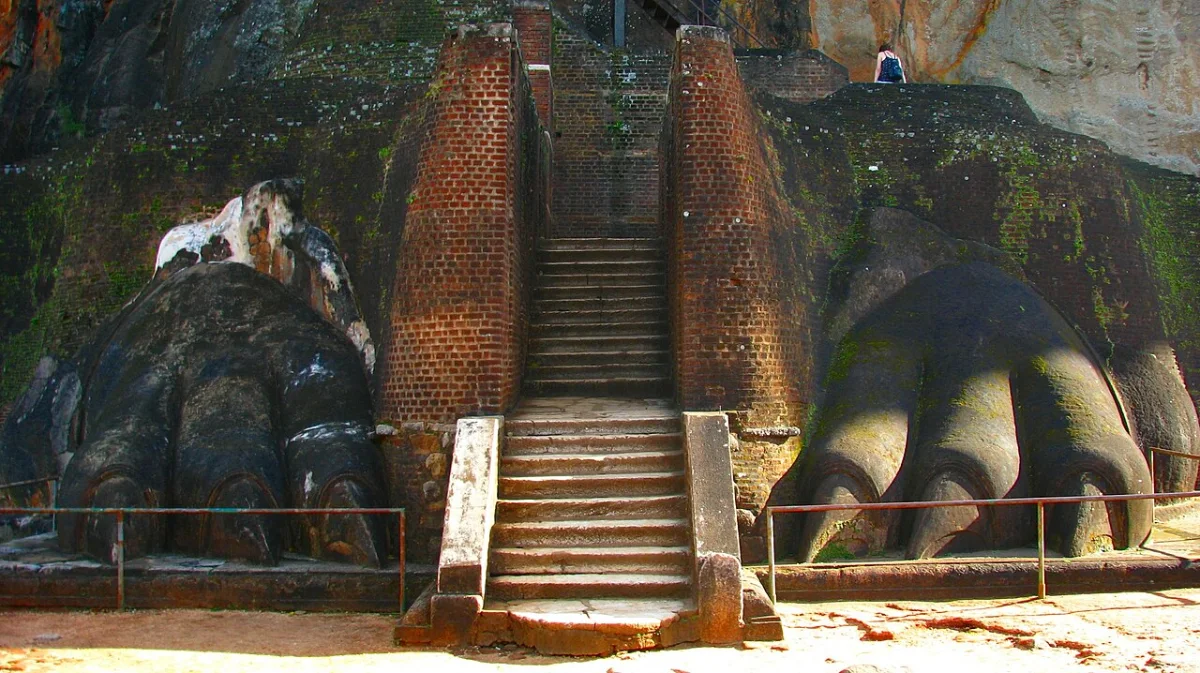
Halfway up the rock, a small plateau holds what remains of Sigiriya’s most famous feature. The final stairway to the summit once passed through the open mouth of an enormous brick-and-plaster lion, and it gave the site its name: Sinhagiri, the Lion Rock, later shortened to Sigiriya. The head has long since collapsed, but the two colossal paws, with their carved claws, still flank the steps that visitors climb today.
The painted women and the mirror wall
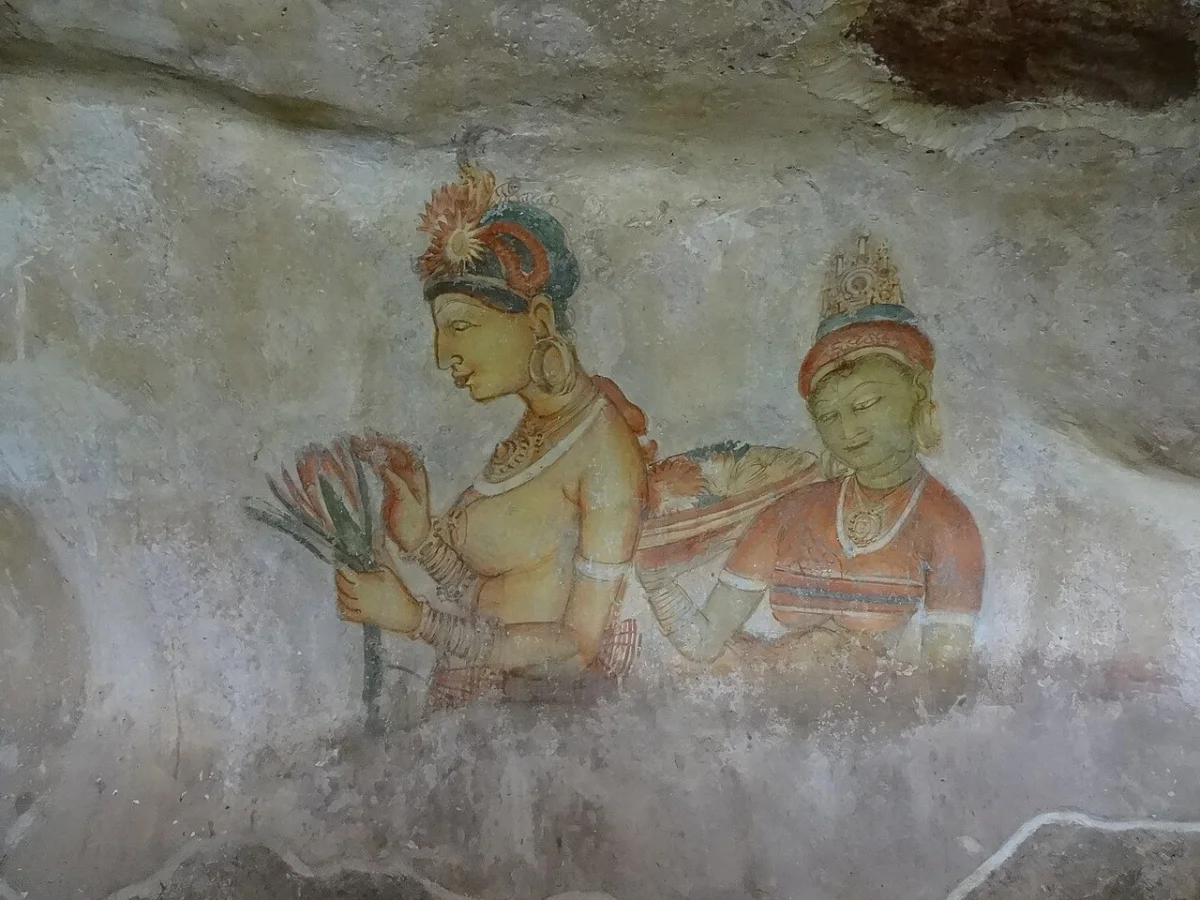
The western face of the rock was once covered with paintings across an area roughly 140 meters long and 40 meters high. Graffiti left by early visitors speak of 500 women painted on the rock. Only a small group survives, sheltered in a pocket in the cliff. The women are shown from the waist up, wrapped in clouds, holding flowers and wearing heavy jewelry. Scholars still debate whether they are celestial nymphs (apsaras), ladies of Kashyapa’s court, or the lightning and cloud goddesses of later poems. The frescoes have suffered in modern times. In October 1967 a vandal splashed paint across them, and restoration took until April 1968.
Below the paintings runs the mirror wall, a gallery wall of brick coated in plaster so highly polished that, according to tradition, the king could see his reflection as he walked beside it. From about the eighth century, visitors who climbed to see the paintings scratched poems into its surface. Most date from the ninth and tenth centuries. The archaeologist Senarath Paranavitana, Sri Lanka’s Archaeological Commissioner, deciphered 685 of these verses. They are among the earliest examples of written Sinhala poetry, and many of them are addressed to the painted women. Adding new writing to the wall is now banned.
Gardens with working fountains
The ground at the foot of the rock was laid out as a royal pleasure park. Moats, ramparts and three main water gardens run along the western approach in a symmetrical plan, with boulder gardens and terraced gardens closer to the rock. In the second water garden, shallow fountains made from circular limestone plates are fed by underground conduits. They still work, especially in the rainy season. For a hydraulic system about 1,500 years old, it is a remarkable survival, and it belongs to the same tradition of engineering that let ancient Sri Lankan kings build huge irrigation reservoirs. Ancient builders in other parts of Asia also turned water into power, as Angkor’s vast water network shows.
From palace to monastery
After Kashyapa’s death, Moggallana returned the capital to Anuradhapura. Sigiriya was handed back to the Buddhist clergy and became a monastery complex, which lasted until about the 13th or 14th century. In the 16th and 17th centuries it served briefly as an outpost of the Kingdom of Kandy, then faded into the jungle.
In 1831, Major Jonathan Forbes of the British Army, riding back from Polonnaruwa, saw the brush-covered summit and wrote about it. Small-scale archaeological work began in the 1890s, led by H. C. P. Bell, the first to study the site in depth. Large-scale excavation of the whole city began only in 1982 under Sri Lanka’s Cultural Triangle Project, the same year UNESCO added the “Ancient City of Sigiriya” to its World Heritage List.
Visiting Sigiriya
The climb to the summit is roughly 1,200 steps, past the frescoes and the mirror wall, then up iron stairways between the lion’s paws. Most visitors go early in the morning to beat the heat and the crowds. On the summit, the outlines of the palace, its cisterns and terraces still give a sense of how a fifth-century king lived on top of a cliff.
For more on ancient builders and their tricks, read about whether ancient builders knew how to earthquake-proof stone structures, or explore another hilltop capital, Monte Albán, the Zapotec city built on a mountain.