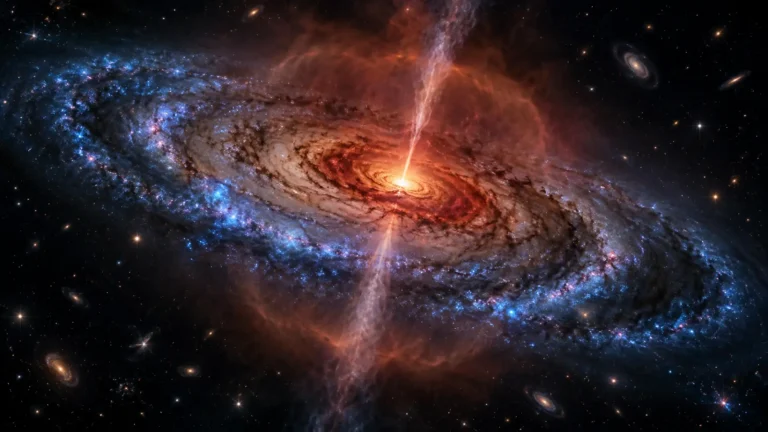
In October 2022, telescopes around the globe captured something truly unprecedented—a gamma-ray burst so luminous that it smashed all previous records. GRB 221009A, originating from a collapsing star 2.4 billion light-years away, emitted energy levels peaking at 18 teraelectronvolts, earning it the fitting nickname “BOAT” (Brightest Of All Time).
This wasn’t just another extraordinary cosmic event—it was a puzzle that defied long-standing astrophysical models. Current theories predict that gamma-ray photons with such high energies should not have been able to travel across the vast expanse of intergalactic space without being absorbed by the faint glow of the extragalactic background light (EBL). Yet somehow, these photons made it to Earth, leaving scientists baffled.
Could an Invisible Particle Hold the Answer?
To explain the anomaly, a team of astrophysicists led by Giorgio Galanti from Italy’s National Institute for Astrophysics (INAF) proposed an intriguing solution: axion-like particles (ALPs). These elusive particles, long predicted by string theory, could offer a missing piece in the search for dark matter—a mysterious substance that accounts for 85% of the universe’s mass.
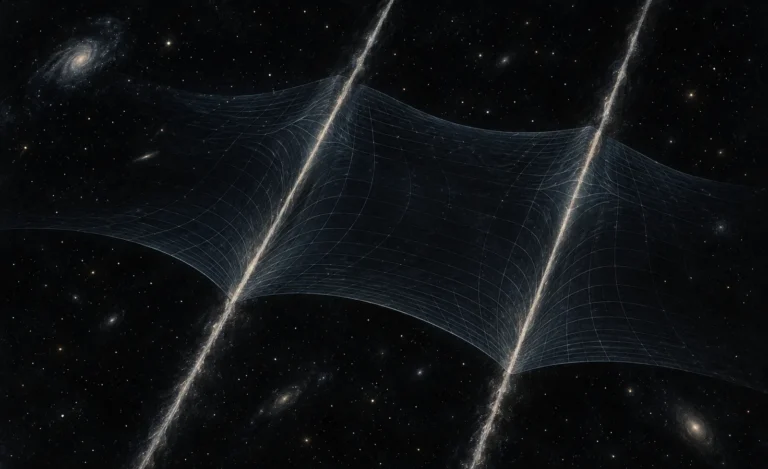
If ALPs exist, they could oscillate with photons, allowing high-energy gamma rays to bypass the expected absorption by EBL. In simpler terms, this interaction would make intergalactic space more transparent to such photons, explaining how GRB 221009A’s record-breaking energy reached us unscathed.
“The interaction between photons and ALPs could be the first indirect evidence of these particles, potentially offering a breakthrough in our understanding of dark matter,” Galanti’s team explained in their latest research presented at a prominent astrophysics conference.
The Ongoing Hunt for Dark Matter
Despite decades of research, dark matter remains one of the greatest unsolved mysteries in science. Scientists have long known that visible matter—stars, planets, and galaxies—makes up only a fraction of the universe’s total mass. The rest is attributed to dark matter, an invisible entity detected only through its gravitational influence.
Axions, or particles similar to them, have been at the forefront of dark matter research. Much like neutrinos, axions are theorized to interact weakly with normal matter, making them extremely difficult to detect directly. However, astrophysical observations, such as gamma-ray bursts and distant blazars, offer indirect methods of searching for these particles.
Galanti and his colleagues had already identified hints of ALPs in the light from distant blazars—hyperactive galaxies emitting intense radiation. The unprecedented brightness of GRB 221009A provided a new and unique testing ground for their theory.
Future observations
If future observations confirm the role of ALPs in reducing photon absorption, it could revolutionize how we study high-energy astrophysical phenomena and open new avenues in the quest to identify dark matter.
However much more work is needed to validate these findings. While this result is promising, further studies, especially involving neutron stars, could provide additional evidence of axion-like particles.
Astrophysicists are already planning new observations and experiments to explore this phenomenon further. With each discovery, we inch closer to answering some of the universe’s most profound questions. Could GRB 221009A be the cosmic clue we’ve been waiting for?