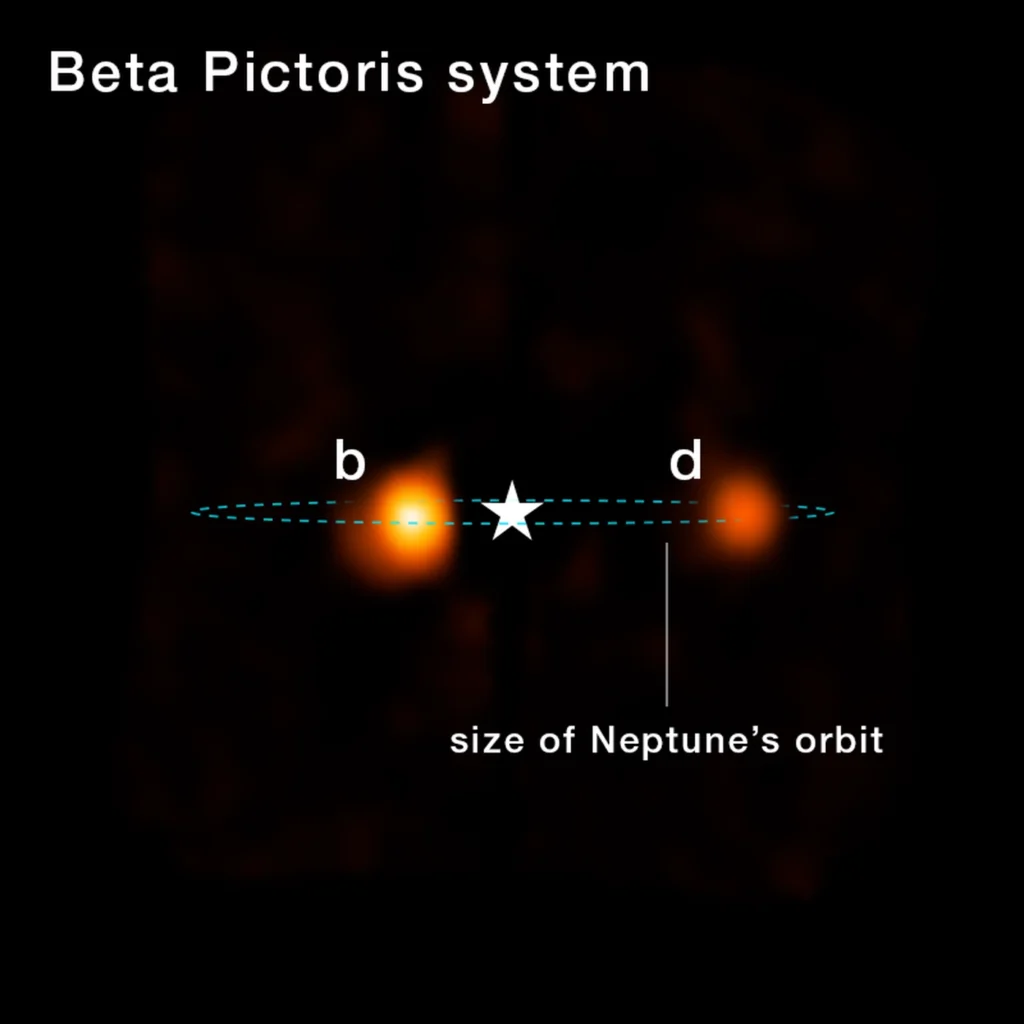
Astronomers have found a third giant planet around Beta Pictoris, one of the best-known young planetary systems near Earth. The discovery is striking because the planet was not first picked out as a bright dot in a telescope image. NASA’s James Webb Space Telescope found it in the spectrum of light coming from the system: a chemical pattern that revealed an atmosphere where an ordinary image had not supplied a clean answer.
The new world, Beta Pictoris d, makes the system only the second known to contain at least three directly imaged planets. It also gives astronomers a more useful lesson than a simple planet count. In dusty young systems, a planet can be present in the data without standing out visually. A spectrum can separate its atmospheric signal from the glare and confusion around the star.
A familiar star with a new companion
Beta Pictoris lies about 63 light-years away and is only around 23 million years old. That youth is one reason it has been studied so intensely. The system is surrounded by a broad disk of dust and debris left from planet formation, and two giant planets—Beta Pictoris b and c—were already known.
The newcomer is likely at least twice Jupiter’s mass. Modelling places it at roughly 30 astronomical units from its star, around the distance of Neptune’s orbit in our own Solar System. It is the widest-orbiting of the three known planets, although it still lies inside the inner edge of the debris disk.
Those details make Beta Pictoris a rare laboratory. The planets, the disk and the star are young enough that astronomers can watch a system still carrying the architecture of its formation. Each additional orbit helps test ideas about how giant worlds move, sculpt surrounding material and interact with one another.
The planet was found in a spectrum
Finding a planet beside a bright star is hard for the same reason it is hard to see a firefly next to a stadium floodlight. Direct-imaging instruments suppress or block starlight as much as possible, but scattered light and the glow of dust still remain. In the case of Beta Pictoris d, that visual clutter made a simple point-source discovery difficult.
Webb’s Near-Infrared Spectrograph, or NIRSpec, offered another route. Instead of asking only where the light was brightest, the researchers examined how the light was distributed by wavelength. Molecules in an atmosphere absorb and emit light in distinctive ways. The team identified a pattern they interpret as the planet’s atmospheric chemical fingerprint.
That phrase can sound more certain than it is. A chemical fingerprint here does not mean a sample bottle or a close-up photograph. It means a repeatable spectral signal that fits the presence of a warm, giant planet and distinguishes it from surrounding dust and the star. The technique is powerful because the planet does not have to dominate the image before it can leave a trace in the data.
Why the discovery method matters
Beta Pictoris b was one of the first exoplanets ever directly imaged. Its discovery helped prove that young, massive planets could be studied in their own light rather than only inferred from the pull they exert on a star. Planet d pushes that tradition in a subtler direction. It shows how spectroscopy can widen the search in systems where imaging alone is not enough.
That matters beyond this one star. Dusty disks are where young planetary systems tell much of their story, but dust also hides things. If astronomers can recognise atmospheric signatures embedded in the glow, they may be able to find planets that have been present in archived observations without being obvious as individual points.
It also changes what counts as a “direct” detection. The planet is still observed through its own light, rather than inferred only through a star’s wobble or a transit. Yet the decisive evidence came from the light’s composition, not from a neatly separated dot in a photograph. The distinction may sound technical, but it is exactly the kind of advance that opens an instrument to a new class of targets.
A system that keeps giving up clues
Beta Pictoris has been watched for decades because its disk was among the first debris disks discovered around another star. It is nearly edge-on from Earth, which makes its structure unusually visible. Features in the disk have long invited questions about unseen planets, collisions and the movement of material around the young star.
With three massive planets now identified, astronomers can test whether their orbits help account for the disk’s gaps, warps and asymmetries. The answer will not arrive from one observation. It will come from follow-up measurements that refine the orbit of planet d, measure its spectrum more closely and compare the planets’ positions with the disk’s changing features.
There is a sensible limit to what can be said today. Webb has not photographed an Earth-like world in the system, and the new planet is not a candidate for life as we know it. It is a young gas giant. Its value is different: it lets researchers study how a planetary system looks while much of its original debris still remains in view.
From a bright dot to a chemical clue
Exoplanet discoveries often arrive as a catalogue of numbers—mass, distance and orbital period. Those are useful, but the method can be the more enduring part of the story. Beta Pictoris d was hiding in a famous system that had already been observed with extraordinary care. Webb did not simply look harder. It used the information inside the light in a different way.
That is the promising part of this result. The next hidden planet may not be waiting at the edge of a telescope image. It may be present in a spectrum, mixed with dust and starlight, until an instrument and a research team know how to read it.
Sources
NASA: Webb discovers Beta Pictoris d
Astrophysical Journal Letters study linked by NASA