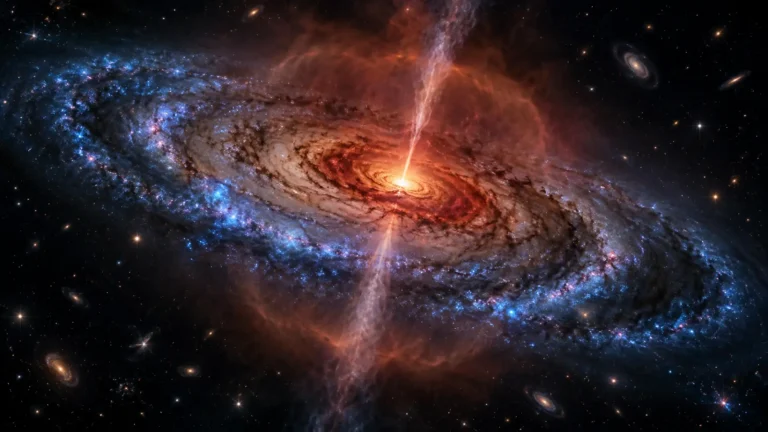
A star being torn apart by a black hole is already an unusual sight. In this case, the black hole was in an even stranger place: more than 30,000 light-years from the center of the galaxy that appears to host it.
NASA’s Neil Gehrels Swift Observatory helped confirm the event after an automated survey spotted a sudden flare in November 2025. The results, published in The Astrophysical Journal Letters and reported by NASA on July 27, point to a supermassive black hole with a mass of roughly a million Suns. It is not sitting in the bright nucleus of a galaxy, where astronomers normally expect to find one. It is out near the galaxy’s edge.
A flare that was too far from home
The first sign came from the Zwicky Transient Facility, which scans the sky for changing objects. Its system flagged an unusual flash in a galaxy about 750 million light-years away, in the constellation Cetus. Follow-up observations with ground-based telescopes and Swift showed that the flare had the telltale behavior of a tidal disruption event.
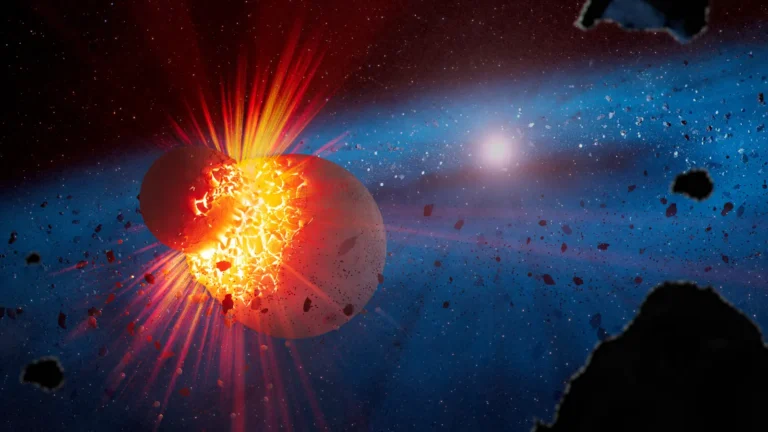
That name describes what happens when a star wanders too close to a black hole. The difference in gravity between the star’s near side and far side becomes so extreme that the star is pulled apart. Some of its gas escapes. Some falls inward, heating up and producing a short-lived blaze across ultraviolet, X-ray and other wavelengths.
NASA says this flare briefly outshone the entire host galaxy in ultraviolet light. Swift’s ultraviolet and optical instrument measured material at about 54,000 degrees Fahrenheit, while spectra taken from the ground helped rule out other explanations for the outburst.
Why the location is the real surprise
Nearly every large galaxy is thought to contain a supermassive black hole at its center. That expectation has shaped the way tidal disruption events are found: astronomers have usually searched close to galactic nuclei, where the black holes are presumed to be.
That search pattern began to change in 2024, when researchers identified a similar event 2,600 light-years from a galaxy’s center. The new case lies more than ten times farther out. It shows that some massive black holes may be wandering through the outskirts of galaxies, almost invisible until a passing star supplies a brief flash of light.
The find does not prove a single origin story. The NASA team outlines two possibilities. Several galaxies may have merged in the past, with gravitational interactions between their central black holes ejecting the lightest one outward. Or the black hole may belong to a dwarf galaxy in the process of being absorbed by the larger galaxy around it.
Both explanations make sense in a universe where galaxies grow by merging. Neither has been confirmed for this individual object. That distinction matters: the flare gives astronomers a clear event to study, but the history that placed the black hole there remains an active question.
A new way to find invisible objects
Supermassive black holes are easiest to identify when they are actively feeding. A quiet one can be extraordinarily hard to detect, especially outside a galactic center. Tidal disruption events offer a temporary beacon. NASA estimates that surveys find about 30 of them somewhere in the universe each year, after searching millions of galaxies.
The new result suggests that search programs should not limit themselves to galactic cores. That is where the next generation of surveys becomes important. NASA says the Vera C. Rubin Observatory will provide wide, deep views of the changing sky, while the Nancy Grace Roman Space Telescope is expected to extend the search farther into cosmic history.
The more of these off-center events researchers find, the better they can begin to answer a basic question: how many wandering black holes are there? For now, this one stands out because a dying star briefly illuminated a part of a galaxy that astronomers had not been watching closely enough.
What astronomers will look for next
The next observations will be aimed at the environment around the flare. A merger can leave faint streams of stars, a second galactic nucleus or other clues that distinguish one origin scenario from another. Each possibility makes a different prediction about the surrounding galaxy, so the black hole’s apparent isolation can be tested rather than simply assumed.
That is why a single tidal disruption event is so valuable. It turns an otherwise unseen object into a target that can be revisited with more powerful surveys and telescopes.
The discovery is a good example of astronomy working by combination: a sky survey noticed the flare, spectra identified its character, and ultraviolet measurements supplied the physical conditions. No single image revealed the black hole. The evidence accumulated because several instruments were pointed at the same unexpected source.