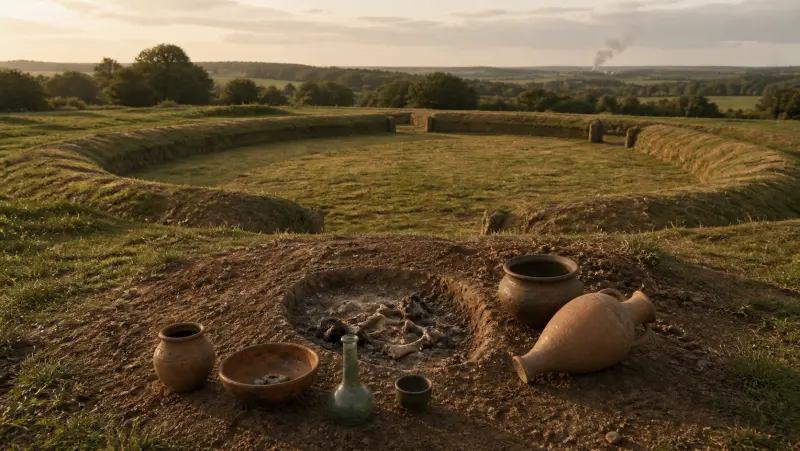
Near Chelmsford, archaeologists have been studying a large Iron Age cemetery that spans the years before and after the Roman conquest of Britain. The site contains more than 100 cremated individuals and five high-status burials furnished with imported and locally made objects. Together, the graves show a society with its own hierarchy, trade connections and burial customs at the moment Rome was becoming a local power.
The cemetery lies near Great Baddow. Its main enclosure is square and ditched, and most of the burials date to the first century AD. That places the site close to the change brought by the invasion under Emperor Claudius in AD 43, although the grave goods do not offer a simple story of one culture replacing another overnight.
Five burials stand apart
The richest graves contain glassware, amphorae and fine ceramics. These were not ordinary household items. Amphorae point to the movement of food or drink across long distances, while glass vessels were costly objects that could signal status at a funeral. The finds suggest that at least some people buried at the cemetery belonged to families able to command labour, wealth and connections beyond the local landscape.
Researchers are comparing the burials with so-called Welwyn-type graves and with better-known sites at Stansted and Stanway. Those comparisons are useful, but they should not be treated as proof that every wealthy grave belonged to a single political class. Burial customs can travel through imitation, trade and marriage as well as through direct political control.
A community at a political turning point
The cemetery’s date matters because eastern England was already connected to the wider Roman world before the invasion. Imported goods reached local settlements through trading networks, and regional leaders could use those goods to display influence. When Roman armies arrived, they entered a landscape that already had its own centres of power.
The graves therefore help fill in the years that are often reduced to a single military event. Some families may have resisted Rome, while others negotiated with it or found new opportunities inside the provincial system. The objects cannot tell us which individual made which choice, but they show that the population was not isolated from the political changes around it.
What cremation can tell us
Cremation destroys much of the skeleton, but it does not erase every clue. The size and condition of surviving bone fragments can reveal age and, sometimes, disease or injury. The placement of the remains, the construction of the grave and the objects arranged around it provide further evidence about the ceremony.
In a cemetery with more than a hundred cremations, differences between graves become especially important. A large enclosure, a carefully selected vessel or an unusual arrangement can mark a person out from neighbours. That pattern gives archaeologists a way to study social difference even when written sources are silent.
The cemetery also helps correct a familiar picture of the Roman conquest. Roman objects did not arrive only after an army marched through. Glass and amphorae could reach Britain through trade, diplomacy or elite gift exchange before a province was formally organised. Their presence in a grave is evidence of contact, but it is not a label for the person’s political loyalty.
That caution is important when archaeologists compare sites. A similar vessel or burial layout can point to shared fashion, a travelling craftsperson or a relationship between families. It does not automatically show that two communities belonged to the same kingdom. The strongest conclusions will come from combining the grave goods with the enclosure, the landscape and the biological evidence.
Why this cemetery is worth following
The site is not a royal tomb and it does not offer a single dramatic answer to the question of how Britain became Roman. Its value is quieter. It records ordinary funerary practice alongside a handful of conspicuously wealthy graves, allowing researchers to see how status was expressed within one community.
The Museum of Chelmsford is presenting some of the finds while the wider study continues. As specialists compare the objects and examine the cremated remains, the cemetery may help connect local lives to the larger political story of Roman Britain.