The Oort Cloud is one of the strangest places in the Solar System because it has never been seen directly. Astronomers infer its existence from the paths of long-period comets: icy bodies that spend most of their lives in deep space and only occasionally fall toward the Sun.
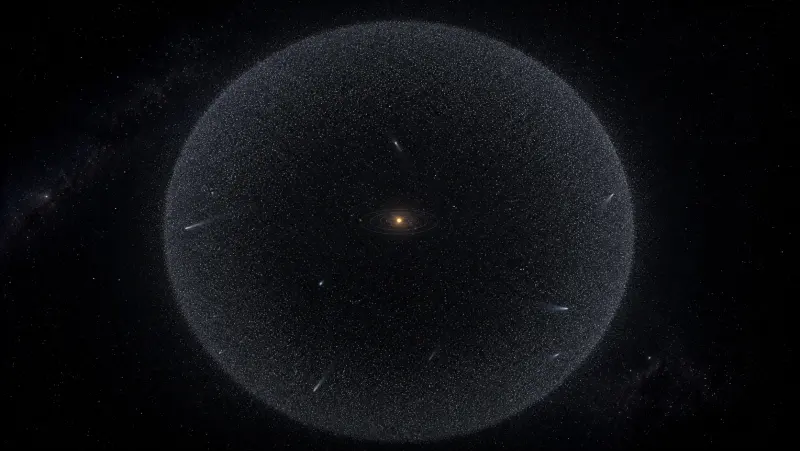
NASA describes the Oort Cloud as a vast, roughly spherical shell surrounding the Sun, the planets and the Kuiper Belt. It is not a ring like the asteroid belt, and it is not a second set of planets. It is a distant population of small, frozen objects moving through the outer reaches of the Sun’s gravitational influence.
Where is the Oort Cloud?
The distances are difficult to picture. NASA estimates that the inner edge may lie between about 2,000 and 5,000 astronomical units from the Sun, while the outer edge could reach somewhere between 10,000 and 100,000 AU. One astronomical unit is the average distance between Earth and the Sun.
For comparison, Pluto travels between roughly 30 and 50 AU from the Sun. Voyager 1 is moving outward at about a million miles a day, yet NASA estimates that it will take roughly 300 years to reach the Oort Cloud and perhaps 30,000 years to pass through its outer edge. Those figures are estimates, not a timetable for a mission: Voyager was not designed to study the cloud.
Why scientists think it exists
Long-period comets arrive from every direction rather than staying close to the flat plane in which most planets orbit. Their paths point to a source that is more spherical than the Kuiper Belt. Jan Oort proposed such a reservoir in 1950 after studying the orbits of comets that appeared to make extremely long journeys around the Sun.
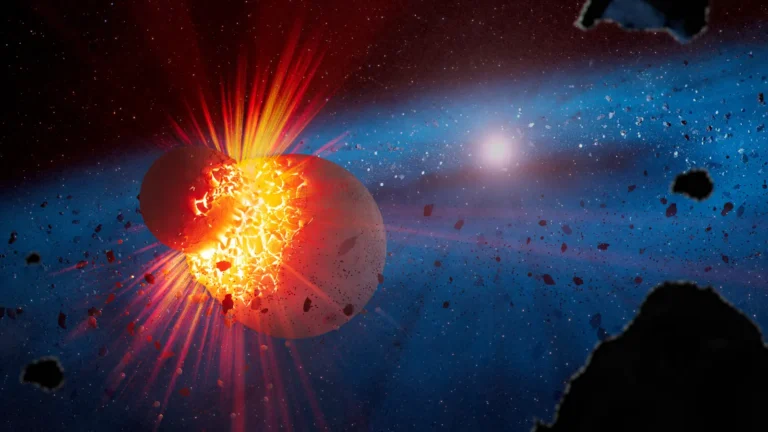
The leading formation model begins when the planets were young. The region around the newborn Sun contained countless icy planetesimals. Gravitational encounters with the giant planets, especially Jupiter, flung many of them outward. Some escaped the Solar System altogether. Others remained bound to the Sun in huge, elongated orbits.
At that distance, the planets no longer controlled every detail of an object’s path. The gravity of the Milky Way and passing stars could slowly reshape the orbits, leaving a loose cloud of bodies surrounding the Solar System. The model is strong enough to explain the comet evidence, but the cloud’s exact structure remains uncertain.
How does a comet leave the cloud?
A distant comet can spend millions of years in a cold orbit before a gravitational nudge changes its course. A passing star, the combined pull of the Galaxy or a shift in the outer Solar System can move the object onto a path that carries it inward.
Once the comet approaches the Sun, heat begins to turn surface ice directly into gas. Dust and gas stream away from the nucleus, creating the coma and tail that make the object visible from Earth. The comet was already present in the Oort Cloud; sunlight has simply transformed a dark frozen body into an active visitor.
Many long-period comets are seen only once in recorded history. Some take hundreds of thousands of years to return. Others may have passed through the inner Solar System before humans existed and will not come back until our descendants are gone.
Why we cannot photograph it
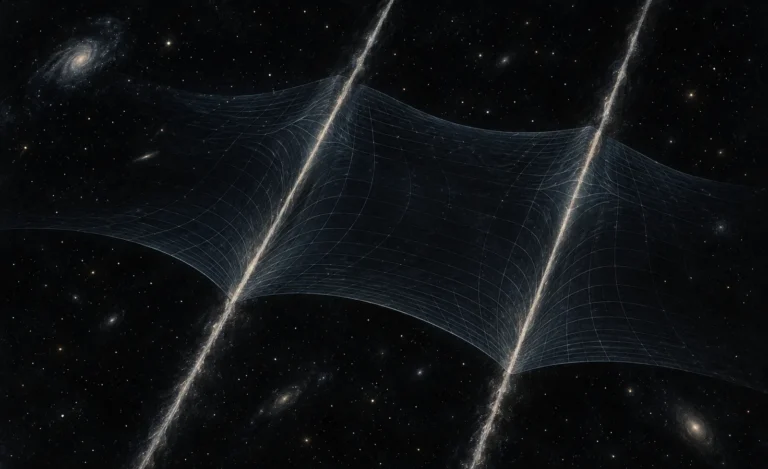
Individual Oort Cloud objects are small, dark and incredibly far away. They reflect very little sunlight, and their apparent positions change slowly. No telescope has resolved the cloud as a structure, and no spacecraft has reached it. The images used in books and news reports are models based on the comet orbits and on computer simulations.
That does not make the Oort Cloud imaginary. Astronomy often works by combining observations with the effects those objects produce. Neptune was inferred from the way its gravity disturbed Uranus before anyone saw the planet. The Oort Cloud is a more difficult case because the evidence comes from thousands of possible comet histories rather than a single nearby orbit.
A boundary, not a wall
The Oort Cloud does not mark a sharp edge where the Solar System suddenly ends. Its objects become more weakly tied to the Sun as distance increases, and the Galaxy gradually becomes a stronger part of their environment. The cloud is better understood as a broad transition between the Sun’s planetary neighbourhood and interstellar space.
That makes it both a reservoir of ancient material and a record of the Solar System’s early violence. The comets that enter our skies carry ice and dust from a time when the planets were still forming. We have not seen the cloud itself, but its occasional visitors allow us to study a place that may be the largest structure belonging to our Solar System.