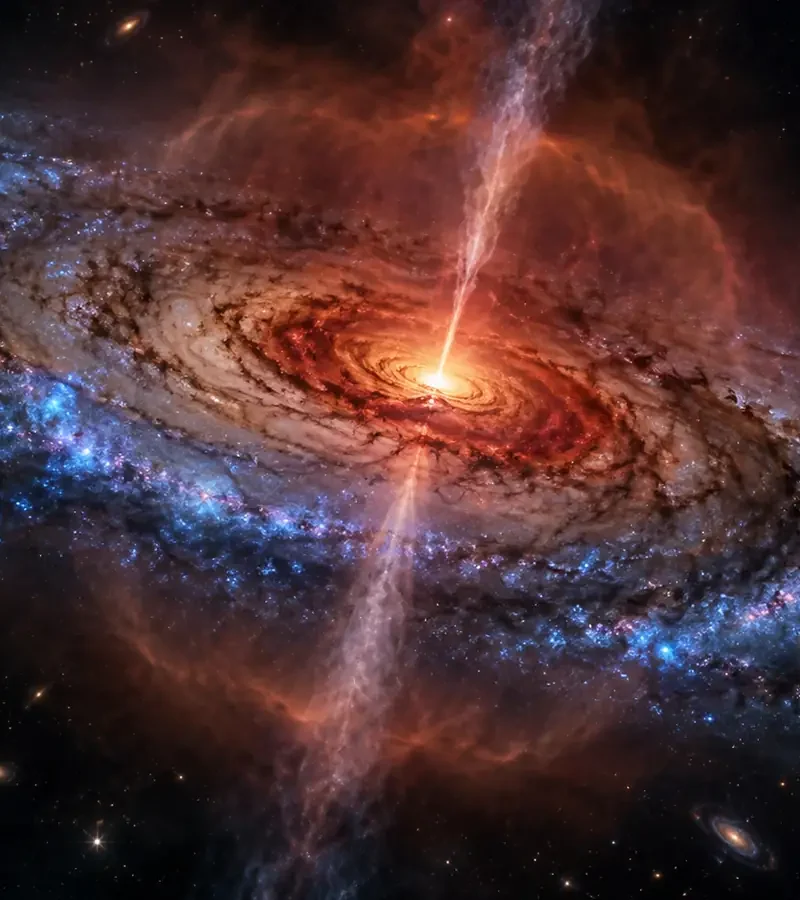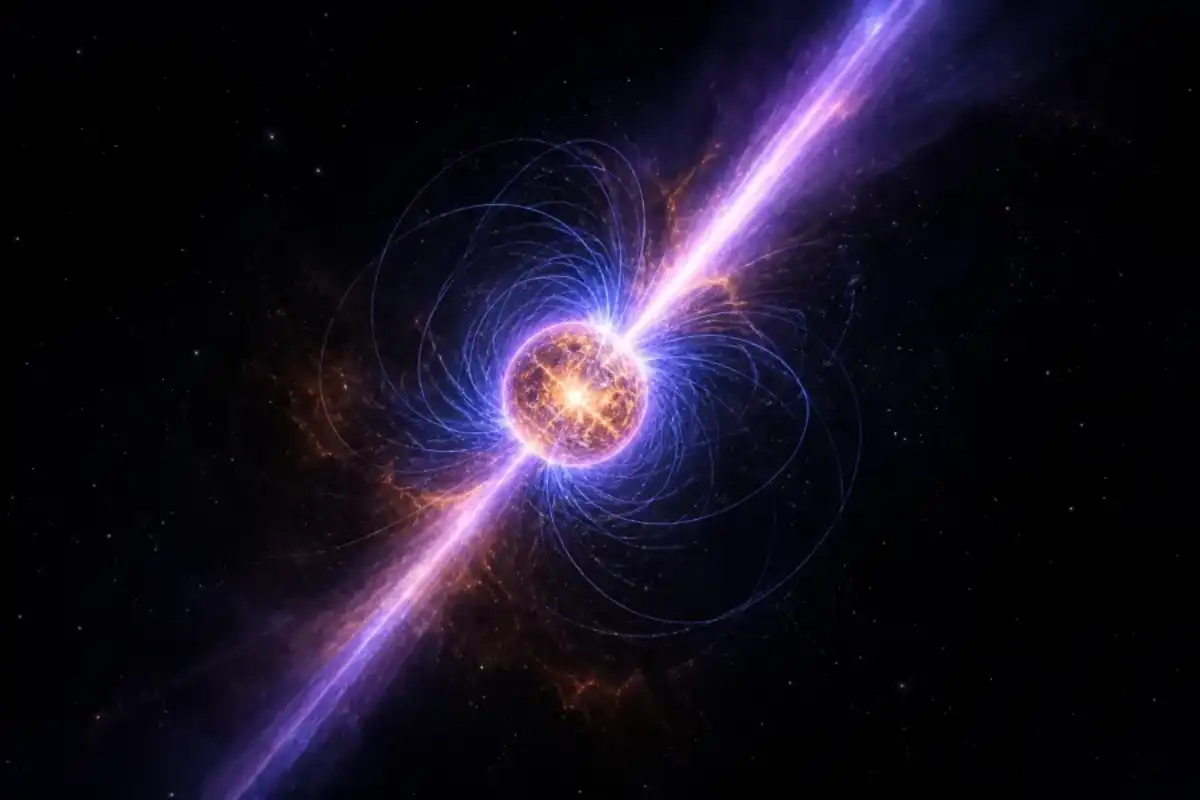
Empty space is not completely empty in the equations of quantum physics. Under an ordinary magnetic field, that distinction is impossible to notice. Near a magnetar—a neutron star with a magnetic field trillions of times stronger than Earth’s—space itself can alter the way light travels.
NASA’s Imaging X-ray Polarimetry Explorer (IXPE) has measured unusually strong polarization from the magnetar 1E 1547.0-5408. The result is consistent with a prediction made in 1936 called vacuum birefringence. It is not yet the last word on the effect, but it gives physicists a strong test in a place no laboratory on Earth can reproduce.
A neutron star with a magnetic field beyond any laboratory
Neutron stars are the compact cores left behind when massive stars explode. They pack more mass than the Sun into a sphere roughly the size of a city. Magnetars are a particularly extreme class of neutron star, with magnetic fields that can twist the behaviour of matter and radiation close to the surface.
Keep exploring
Continue with Curiosmos
The IXPE team observed 1E 1547.0-5408 for more than 140 hours in March and April 2025. The observations were coordinated with NASA’s NICER X-ray telescope and the Murriyang radio telescope in Australia. The star rotates once every 2.1 seconds, so the instruments could watch its X-ray and radio signals change through a full rotation.
Light arrives with an unexpected alignment
Polarization describes the orientation of a light wave. In the X-rays from this magnetar, the measured polarization was far higher than expected from standard models of radiation from a neutron-star surface. The X-ray and radio signals also appeared to come from offset regions rather than from the same simple magnetic geometry.
Those details point toward a more subtle effect. Quantum electrodynamics predicts that a very strong magnetic field can make the vacuum behave a little like a crystal. Light with different polarizations would travel through that altered vacuum in different ways, an effect known as birefringence. In practical terms, the field can act like a lens or prism even though there is no material between the star and the telescope.
Why the claim is still phrased carefully
IXPE has not photographed empty space changing shape. The evidence comes from the pattern of polarization, the star’s rotation and computer models of the magnetar’s surface and magnetic field. The team found that the observed signal is difficult to reproduce without vacuum birefringence, but further observations will be needed to rule out other combinations of surface emission and magnetospheric physics.
That caution is part of the result’s value. A magnetar is an extraordinary natural laboratory, but it is also a complicated one. Its hot surface, radio emission and magnetic field are all changing at once. Observing more magnetars with IXPE should show whether the same polarization pattern appears in other stars or whether 1E 1547.0-5408 has a special geometry.
A test of physics in an unreachable environment
Vacuum birefringence was proposed nearly a century ago as a consequence of quantum electrodynamics. The theory says that the vacuum can be polarised by an extreme field, producing effects that would be far too small to detect around ordinary stars. Magnetars offer the opposite situation: the field is so strong that the signature can travel across space and still be measured in X-rays.
If later observations confirm the interpretation, the result would give researchers a way to examine quantum physics under conditions that cannot be built on Earth. It would also improve models of how light escapes the surfaces of neutron stars.
For now, the IXPE measurement is best described as strong evidence rather than a final confirmation. The next observations will decide whether this magnetar has provided the long-sought glimpse of empty space behaving like an optical material.
For another extreme test of physics around compact objects, read Curiosmos’ look at the observations that revealed black holes through their surroundings.