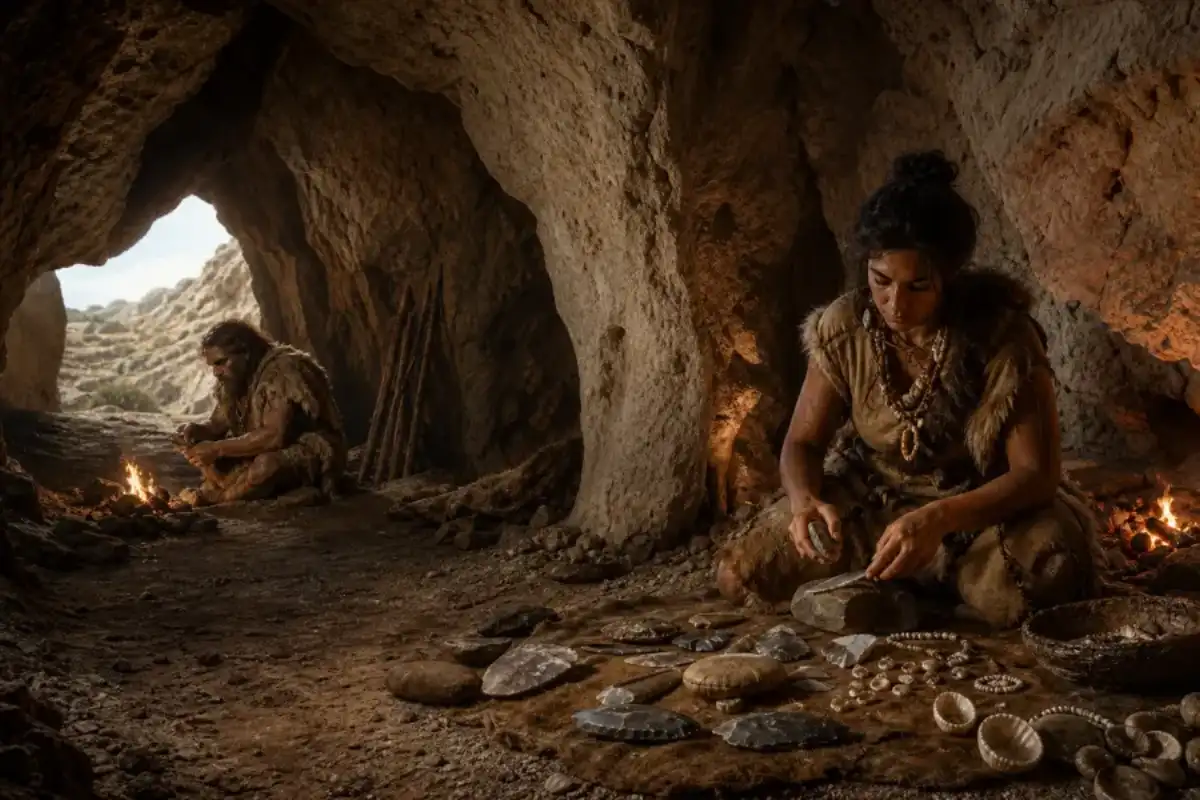
Neanderthals and modern humans did not simply occupy the same landscape and disappear from one another’s story. A study of Üçağızlı II Cave in southern Türkiye points to a longer period of cultural continuity in the northern Levant, where stone tools, shell ornaments and other remains appear across a sequence spanning more than 20,000 years.
The result does not prove that Neanderthals and Homo sapiens lived together in one large community. It suggests something more careful: traditions, techniques or ways of using the cave may have continued through the change in population. That possibility matters because the archaeological record rarely preserves the social world behind an object.
A cave on a route between Africa and Eurasia
Üçağızlı II lies on the Levantine corridor connecting Africa with Eurasia. People moving through this region could have encountered different groups, climates and landscapes as they travelled. The cave’s layers preserve part of that movement, including modern human fossils dated to roughly 50,000 to 60,000 years ago.
Those dates fall within a crucial period for the spread of modern humans beyond Africa. They also overlap with the later history of Neanderthals in the region. The researchers compared the cave’s sequence of objects and occupation layers rather than treating one artefact as proof of contact.
What cultural continuity looks like in the soil
Archaeologists look for repeated patterns: how stone was selected and struck, which shells were collected, how tools were shaped and where objects were left. A pattern that persists through several layers can reflect a local tradition. It can also result from people solving the same practical problem in similar ways, so the interpretation has to be tested against the whole assemblage.
At Üçağızlı II, the sequence suggests that some features of the material culture remained stable even as the human populations using the cave changed. The study describes that as a possible common culture rather than a single ethnic identity. In other words, the objects may record shared habits without telling us that the people who made them thought of themselves as one group.
Why the Neanderthal question is difficult
Neanderthals left no written account of their relationships with modern humans. Fossils can establish who was present, while DNA can reveal ancestry, but neither source explains how people learned a technique, exchanged an ornament or copied a design. Archaeologists therefore use the arrangement and history of objects to build a cautious picture.
The Levant is especially important because it was a meeting ground for populations moving between continents. Modern humans may have reached the region in more than one wave, and some fossils could belong to earlier migrations that did not contribute directly to people living today. That uncertainty does not weaken the site; it makes the evidence more useful for testing different models of movement.
A shared tradition is not the same as peaceful coexistence
The phrase “common culture” can sound more certain than the evidence allows. It does not tell us whether Neanderthals and modern humans lived side by side, met occasionally or inherited practices from an earlier population. Cultural continuity can travel through imitation, exchange or the movement of small groups.
What the study does show is that the transition between Neanderthals and modern humans was not a clean line in the ground. People used the same region for long periods, and some of the habits recorded in the cave outlasted the species usually associated with them. That is a more interesting story than a simple replacement.
The strength of the argument lies in the length of the sequence. A single layer can be disturbed, and a single object can be carried in from somewhere else. When similar choices recur through many dated layers, however, researchers can ask whether the pattern is local, accidental or part of a broader regional tradition. Üçağızlı II cannot answer every question about contact, but it gives archaeologists a place to test those possibilities with more than one line of evidence.
The study also puts a useful limit on the story we tell about human origins. Neanderthals and modern humans were not two sealed populations moving through an empty world. They occupied corridors, caves and coastlines that had histories of their own. Practices could persist even when the people who carried them changed, and the material record may preserve that continuity long after individual encounters have vanished.
Curiosmos has also examined what DNA can preserve from extinct human lineages, a useful companion to this archaeological record.