A long, curved beak is easy to recognise in an Egyptian painting. A seated baboon, with its hands resting on its knees, seems to belong to a different story. Yet both could represent Thoth, the god associated with writing, knowledge and the moon.
Why would the Egyptians give one deity such different bodies? Put the surviving objects beside one another and the question becomes more interesting. The animals, the things they wear and their position in a scene all contribute to the identification.
Thoth’s two forms let us follow the connections Egyptians made between keeping records, measuring time and maintaining order. A scribe counting grain and a priest following the lunar calendar had good reasons to call on the same god.
The ibis with a scribe’s tools
The Antiquities Museum at the Bibliotheca Alexandrina holds a bronze ibis on a wooden base, recovered at Tuna el-Gebel during excavations in 1942–1943. Its collection record dates it to Egypt’s Late Period, 664–332 BCE, and gives its height as 23.7 centimetres. This is a complete bird, rather than the familiar human figure with an ibis head.
Both arrangements were used for Thoth. In human-bodied depictions, a writing palette and pen can make his role especially clear. That equipment connects the divine figure with the practical world of Egyptian writing: someone has to record the result, whether the scene concerns an earthly account or a judgment after death.
The British Museum’s hieroglyphs exhibition guide offers a possible reason for the bird’s association with a moon deity. The ibis’s curved beak resembles a crescent. It describes this as a possibility, leaving room for more than one explanation of a symbol used over a long period.
Look at the outline and the comparison is easy to follow. A single curved feature could make the connection visible even in a small amulet. The resemblance helps explain the imagery, while the object’s context tells us how it was used.
A baboon small enough to hold in your hand
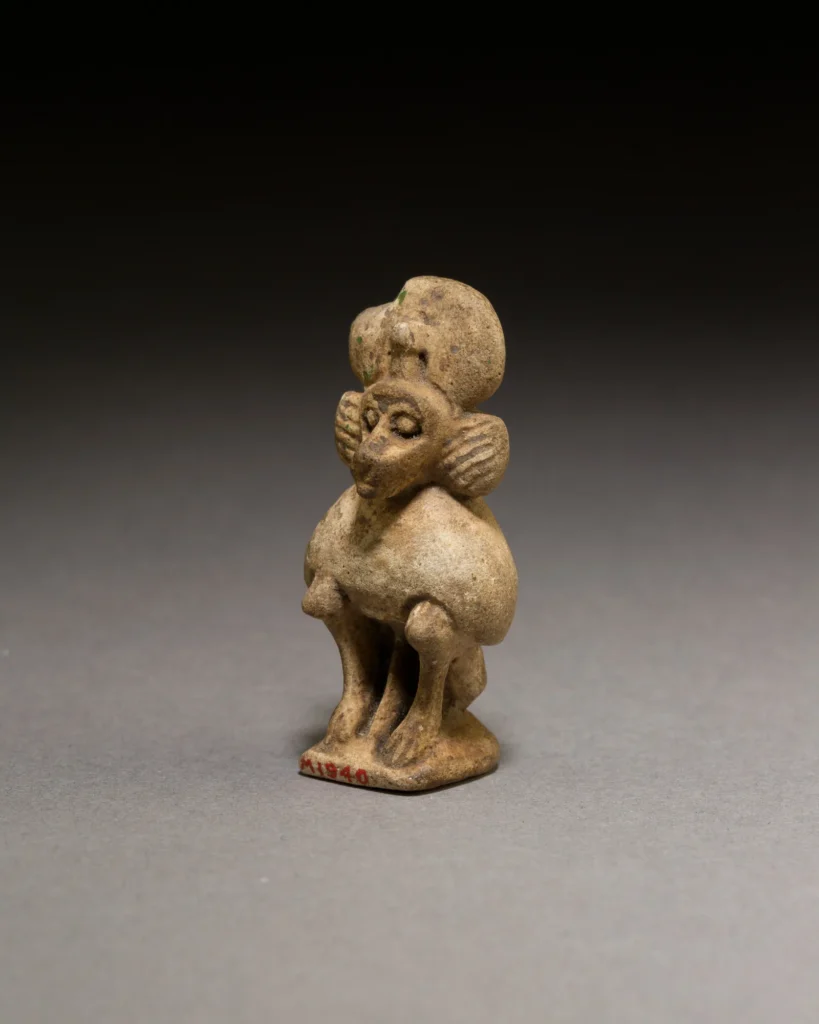
A faience figure in the Metropolitan Museum of Art shows the other form. Made in the Ptolemaic Period, 332–30 BCE, it stands only 4.6 centimetres tall. Its narrow muzzle and large cheek manes remain distinctive at that scale.
There is also a disk above its head, with a cobra, or uraeus, attached. Here the museum’s curators raise a useful question: is the disk lunar, solar or connected with another meaning? The absence of horns and the unusual cobra make a simple identification less secure.
That small detail changes how we read Egyptian objects. Once we recognise a baboon as Thoth, it is tempting to label everything on its head a moon symbol. This particular figure asks us to look again. On this tiny figure, even the disk leaves a question open.
The Hunt Museum’s account describes the more familiar seated baboon with a lunar disk and crescent, as well as examples bearing other crowns. Its own limestone baboon has a hole in the top of the head and may represent Thoth. A missing attachment can remove exactly the feature that would have helped identify a figure.
The same god could oversee the same task
The connection between the animals goes beyond their appearance. The Bibliotheca Alexandrina describes both forms watching over scribes. In scenes accompanying the Book of the Dead, an ibis-headed Thoth records the weighing of the heart. A baboon can instead appear above the scales.
Think about what that scene requires. There is a measurement, a comparison and a result to be recorded. Thoth’s association with knowledge suits all three. Changing his form does not necessarily change the work he performs in the image.
His lunar role also belongs in this company. The changing moon offers a recurring sequence that can be observed and counted. The museum connects Thoth with astronomy, mathematics and accounting through his regulation of time. Written records and the sky meet in the act of keeping track.
How to read the two forms together
A useful starting point is the whole object: its animal body, headgear, tools, material and place within a larger scene. Then compare it with objects whose identities are clearer. A bird on a base, a baboon amulet and a painted recorder at the scales can each tell us something different about the same deity.
The surviving images show an Egyptian god who could move between forms without losing his associations. The ibis makes one set of connections visible; the seated baboon makes others possible. The most intriguing questions often sit in the details—a disk, a missing crown or the position of a figure beside a scribe.
A missing crown can leave us guessing; a palette or a place above the scales can make the identification clearer. These are small clues, but they connect the animal image with the work Egyptians expected Thoth to do.