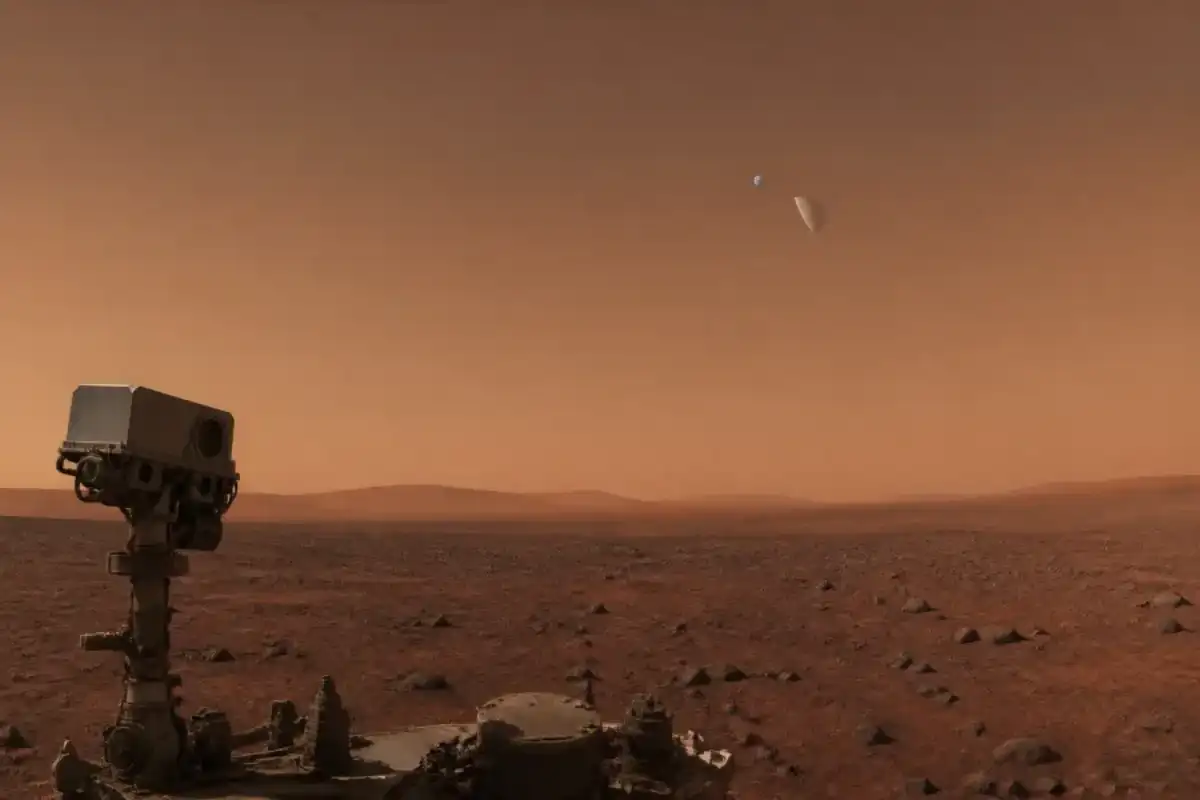
From the rim of Jezero Crater, Earth is only a bright point in the sky. On July 2, NASA’s Perseverance rover watched that point vanish behind Phobos, Mars’ larger moon, and recorded the event with its Mastcam-Z camera.
The sequence is the first time humanity has observed Earth disappearing behind an object from the surface of another planet. It is not an eclipse in the usual sense. The smaller-looking Phobos crossed in front of Earth from the rover’s viewpoint, creating an occultation.
A carefully planned alignment
Phobos crosses the Martian sky several times each day, while Earth remains visible for months. Even so, the two objects rarely line up from a particular location. At the time of the observation, Earth was about 314 million kilometres from Mars, while Phobos was only about 7,800 kilometres above the planet.
Those distances produce a strange view. Phobos is only about 27 kilometres across, but it appears large enough to cover Earth because it is close to the rover. Earth, meanwhile, is reduced to a pixel-sized point. In the composite, the planet moves across the sky as Phobos sweeps in from the opposite direction.
Occultation, eclipse or transit?
Astronomers use different words for objects crossing one another in the sky. An occultation occurs when a nearer body blocks a more distant one. An eclipse involves a shadow, such as the Moon passing through Earth’s shadow. A transit happens when a smaller-looking object crosses the face of a larger-looking one.
Perseverance has also watched Phobos and Deimos transit the Sun from Mars. Those events look like small, fast-moving shapes crossing the solar disk. The Earth–Phobos alignment was different: Earth disappeared behind the moon’s darkened edge and then reappeared.
What the observation tells scientists
The images are mainly a demonstration of geometry and camera planning, but they also help researchers refine models of Phobos’ orbit. The moon’s irregular shape and low altitude make its motion useful for testing predictions from the rover’s location.
For the public, the sequence offers a different view of Earth. From Mars, our planet is not a blue world filling the sky. It is a faint point that can be hidden by a small moon. The perspective is a reminder of how much the apparent size of an object depends on distance.
Perseverance continues to study rocks and sediment in Jezero Crater, but events like this are built into the mission when the geometry is right. The rover’s cameras can turn a carefully predicted alignment into a record that no telescope on Earth could make.
The observation was also a timing exercise. Earth and Phobos move against the Martian sky, and the rover’s position on the crater floor changes the line of sight by a small but measurable amount. Mission planners can calculate when the two bodies should overlap, point Mastcam-Z in the right direction and then let the camera record the sequence. The resulting frames show the planet as a point of light rather than as the familiar disk seen from lunar orbit.
That distinction is worth keeping in mind when the sequence is described as a first. The claim is about observing Earth disappear behind a natural object from another planet’s surface. Spacecraft have photographed Earth from far beyond the Moon, and Mars orbiters have watched Phobos cross the Sun. Perseverance’s view combines a different location with a different alignment, which is why the event is unusual without needing to be called an eclipse.
For a rover built to read the history of an ancient lake, the alignment is a brief change of subject. It does not replace the geology in Jezero Crater, but it shows how much the mission can see when its cameras are pointed at the sky. The same planning that records a moving moon can also help the team choose when a landscape, a dust devil or a passing cloud is worth a closer look.
For a sense of the distances involved in spaceflight, see Curiosmos’ explainer on how long it takes to reach the Moon.