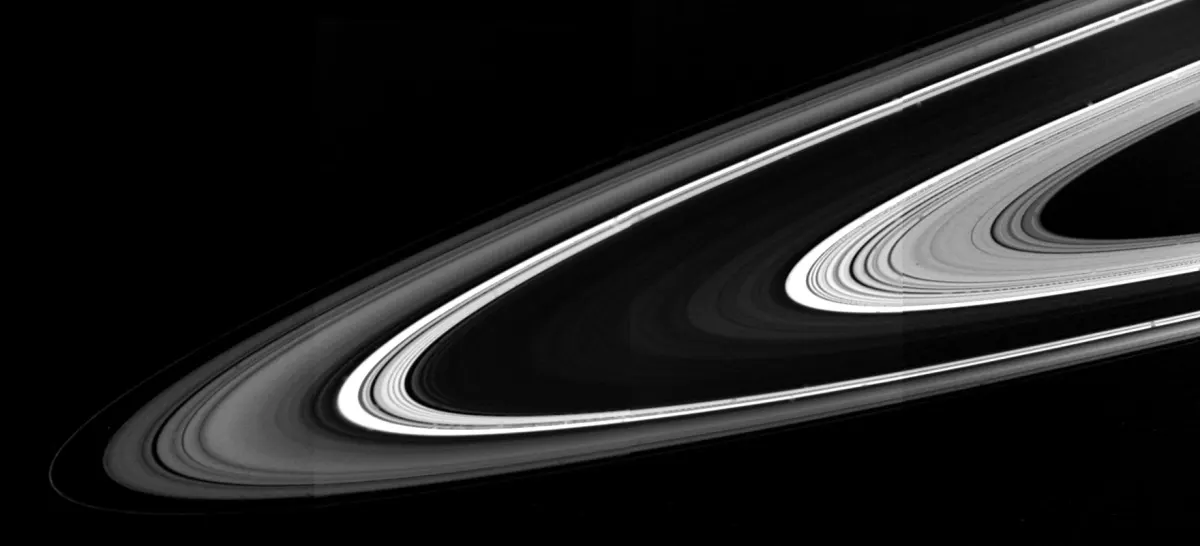
Saturn’s rings look like a solid disk from Earth, but they are closer to a vast, flat swarm of orbiting particles. Most of the material is water ice mixed with dust and rock. The pieces range from smaller than a grain of sand to objects as large as houses, with a few much larger fragments embedded in the system.
The rings are bright because ice reflects sunlight well. They are also surprisingly thin: NASA gives the main rings a typical vertical thickness of about 10 metres, even though the system stretches hundreds of thousands of kilometres across.
How the rings stay in place
Every ring particle follows its own orbit around Saturn. Particles closer to the planet move faster than particles farther away, just as inner planets orbit the Sun more quickly than outer planets. Gravity keeps the particles in the ring plane, while collisions and small moons help shape the edges and gaps.
The most familiar divisions are the A, B and C rings. The Cassini Division, a broad gap between the A and B rings, is not empty: it contains fainter material and is influenced by gravitational resonances with Saturn’s moons.
Where did Saturn’s rings come from?
Scientists are confident about the material’s composition, but the system’s age and origin are still being studied. One possibility is that a comet or moon moved within Saturn’s Roche limit, where tidal forces can tear a large body apart. Another is that the rings are remnants of material that never joined a moon.
NASA’s Saturn facts page describes the rings as pieces of comets, asteroids or shattered moons that were broken apart by gravity. That is a family of explanations rather than one final story. The ring system may also have formed through more than one event over time.
What the particles reveal
Ring scientists study more than the shape of the gaps. The way ice absorbs and reflects different wavelengths gives clues about contamination, age and the action of sunlight. A bright patch may contain fresher ice, while darker material can record dust delivered from outside the ring system or from Saturn’s moons.
Measurements of the rings’ mass are just as important as photographs. If the rings are light, a recent disruption is easier to imagine; if they are much more massive, they may be ancient leftovers from Saturn’s formation. Cassini’s close passes measured particles and gravity with a precision that Earth-based telescopes cannot match, but the age question is still open.
Moons sculpt the ring system
Saturn’s moons are not passive spectators. Small “shepherd” moons can confine ring edges, while larger moons open gaps or create waves in the particles. Pan, for example, helps shape the Encke Gap. Mimas is associated with waves and structures in the rings through repeated gravitational tugs.
Enceladus supplies material to Saturn’s faint E ring. Jets from fractures near the moon’s south pole spray water vapour and ice into space. Some of that material spreads along Enceladus’s orbit, connecting the moon’s geology to the planet’s ring environment.
That relationship is part of the wider Saturn system explored in Curiosmos’s guide to Titan and Saturn’s other puzzling moons.
Saturn’s rings also belong to the wider family of icy bodies that orbit beyond the planets. Curiosmos’s Voyager guide follows the spacecraft that first gave us close views of the outer Solar System.
What Cassini discovered
NASA’s Cassini spacecraft spent 13 years at Saturn, making observations impossible from Earth. It watched moonlets carve wakes, saw temporary spokes appear across the rings, measured their temperatures and observed the system during an equinox when sunlight struck the rings edge-on.
Those observations showed that the rings are active. Particles are exchanged between moons and rings; small clumps disturb the surrounding material; and sunlight changes the way charged dust behaves. The rings are not a frozen decoration attached to the planet. They are a working environment governed by gravity and time.
Why they look so bright
Water ice dominates the visible rings, and relatively clean ice reflects a great deal of sunlight. The rings also sit in a broad, open plane, so the shadows and gaps stand out in photographs. Their brightness does not mean the particles are large or solid. A thin layer of small reflective pieces can be visually dramatic when it surrounds a dark planet.
A system that will not last forever
Saturn’s rings are stable on human timescales, but they are not permanent. Material slowly falls into the atmosphere in a process known as ring rain, while moons and impacts continue to rearrange the system. Astronomers are still working out whether the rings formed early with Saturn or appeared much later.
That open question is part of the attraction. Saturn’s rings are easy to recognise and difficult to explain completely, a combination that has kept them at the centre of planetary science since Galileo first saw them through a telescope.