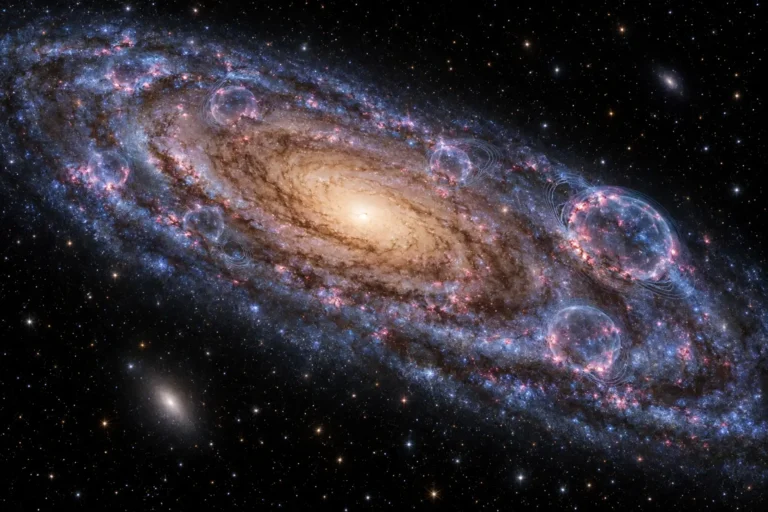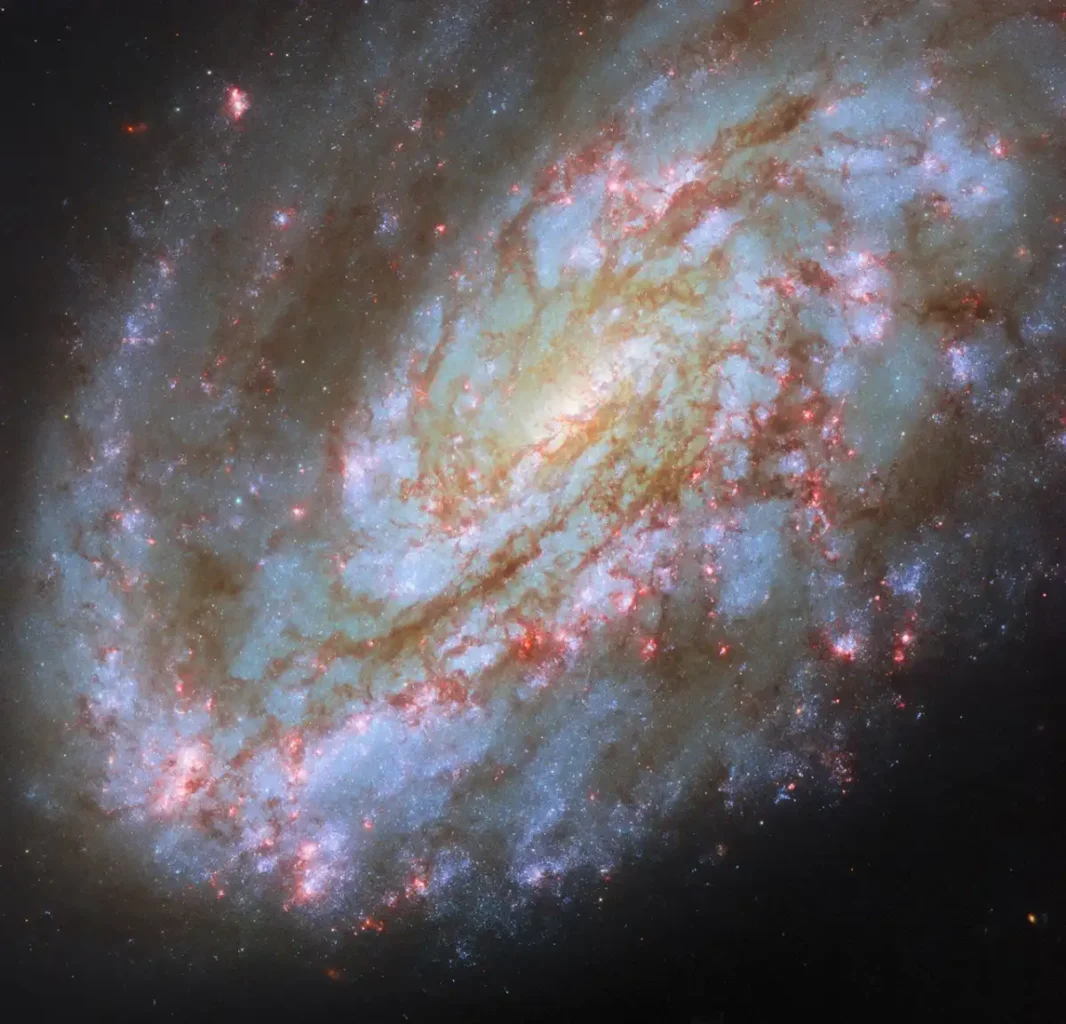
Spiral galaxies are often drawn as graceful pinwheels, with arms that curl around a bright centre in something close to balance. NGC 4654 is a one-sided spiral galaxy that does not fit that picture. In a new NASA/ESA Hubble image, one side of the galaxy has a rounded, sharply defined edge while the other trails away in a long tail of gas.
NGC 4654 lies about 72 million light-years from Earth in the constellation Virgo. It is an intermediate spiral galaxy, meaning it has a weak central bar but does not fall neatly into the barred or unbarred categories. Its uneven shape is not a visual accident. The galaxy is moving through the hot, thin gas that fills the Virgo Cluster, and that motion is stripping material from one side.
A galaxy moving through an invisible sea
Clusters of galaxies are not empty spaces containing only stars. They are also filled with a very thin plasma, called the intracluster medium. It is difficult to see in an ordinary photograph, but a galaxy travelling through it can feel the pressure.
As NGC 4654 moves through that plasma, gas at its leading edge is compressed while material behind it is dragged out into a tail. Astronomers call this process ram-pressure stripping. It is less like a collision between two solid objects and more like a wind acting on a cloud. The galaxy continues to move forward, but its cold gas—the raw material for new stars—is being rearranged and, in part, carried away.
Hubble’s image captures the bright regions where newborn stars are forming. Pink bubbles mark clouds of energised gas, appearing along the forward spiral arm, near the weak central bar and across parts of the disk. The galaxy is under pressure, yet it has not stopped making stars.
Why the stars are lopsided too
Ram pressure explains the gas tail, but it may not explain the entire shape. The stars in NGC 4654 are unevenly distributed as well. One spiral arm is rich in stars and gas; the opposite arm is noticeably poorer. That is unusual because stars are much harder to push around than gas.
Astronomers think a second event helped create that asymmetry. Around 500 million years ago, NGC 4654 may have passed close to another Virgo Cluster galaxy, NGC 4639. The two galaxies are far apart now, but a gravitational fly-by could have pulled gas from one side of NGC 4654 and changed where later generations of stars formed.
The two explanations fit together. An old gravitational encounter may have left the disk unbalanced. The galaxy’s current motion through the cluster may then be compressing one edge and peeling gas from the other. NGC 4654 is a snapshot of both a past interaction and an ongoing struggle.
It is still forming stars at a surprising rate
Galaxies that lose cold gas often see their star-formation rates fall. NGC 4654 has not reached that point. NASA says it is still forming close to two Suns’ worth of stars each year, a rate comparable to other galaxies of a similar size.
That continuing activity gives researchers a chance to watch the consequences of stripping while star formation is still taking place. The pink emission regions show where gas has collapsed into stellar nurseries. By comparing those regions with the distribution of older stars and neutral gas, astronomers can study how a galaxy responds when its fuel is moved faster than it can replenish it.
What Hubble is actually showing
The image combines Hubble observations from two programs that study the relationship between gas and star formation in nearby galaxies. The red emission does not mean the entire galaxy is glowing red. It highlights particular wavelengths produced by energised gas around young stars.
That is one reason colour in an astronomy image needs a little explanation. The finished picture is a map of light selected to reveal structures that would be faint or invisible in a normal colour photograph. Hubble’s view is beautiful, but its scientific value comes from the measurements behind the colour and from the comparison with other wavelengths.
The same principle is useful when reading images from newer observatories. The Nancy Grace Roman Space Telescope will survey huge areas of the sky, while Hubble can examine individual galaxies in detail. Different instruments reveal different parts of the same story rather than competing to produce one perfect picture.
A galaxy caught between two histories
NGC 4654 is not a galaxy being destroyed in a single dramatic event. Its shape records processes that operate on very different timescales: a close galactic encounter hundreds of millions of years ago and the steady pressure of the cluster environment today. The result is a spiral that looks one-sided because its gas and stars remember different parts of its past.
That is what makes the image more than a striking portrait. It shows how a galaxy changes when it is not alone. The Virgo Cluster is shaping NGC 4654 without swallowing it, and the galaxy is still making new stars while its outer gas is being pulled into space.
Hubble’s view does not freeze a galaxy in perfect isolation. It catches one in motion—travelling through a cluster, carrying the scars of an old fly-by and continuing to build stars under pressure.