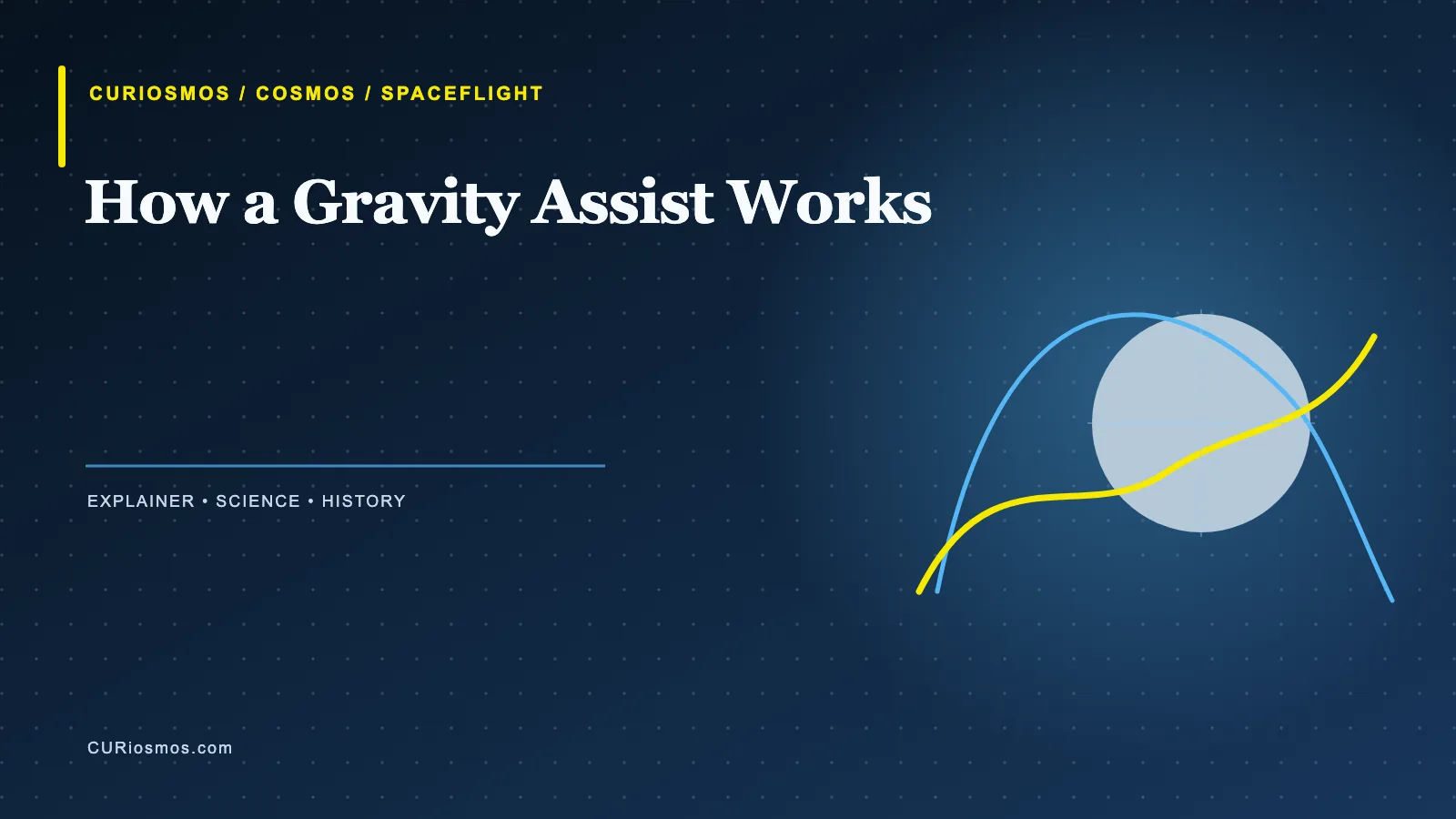
How does a gravity assist send a spacecraft farther into the Solar System? The spacecraft flies close to a moving planet or moon and uses the body’s gravity to bend its path. Seen from the planet, the spacecraft leaves with almost the same speed it had on arrival. Seen from the Sun, its direction has changed in a way that can add or subtract a large amount of orbital energy.
There is no violation of conservation of energy and no hidden engine in the planet. The spacecraft takes a tiny amount of momentum from the planet’s orbit. The planet slows by an immeasurably small amount, while the spacecraft gains enough speed to reach a destination that its launch rocket alone could not have reached efficiently.
The planet has to be moving
Imagine a ball bouncing off a moving train. Relative to the train, the ball may leave at about the speed with which it arrived, but relative to the ground its direction and speed can change dramatically. A gravity assist is the orbital version of that exchange, except the “collision” is a smooth turn produced by gravity rather than a physical impact.
The planet’s motion around the Sun is the crucial part. Jupiter carries enormous orbital momentum. A spacecraft approaching from behind can be pulled around the planet and leave with a greater speed relative to the Sun. If it flies in front of the planet, the exchange can reduce its solar-orbit energy and slow it for arrival or capture.
Voyager made the technique famous
Voyager 1 and Voyager 2 used Jupiter’s gravity to reach the outer Solar System. Voyager 2 then received further assists at Saturn and Uranus, allowing it to continue toward Neptune. The sequence depended on the relative positions of the planets. A launch window was not simply a date when the rocket was ready; it was a date when the planets would be arranged to make the route possible.
Cassini used a more complicated route to Saturn. The spacecraft flew past Venus twice, Earth and Jupiter before arriving at Saturn. Each encounter changed its trajectory and energy. The route took longer than a direct flight, but it reduced the propellant needed for a heavy spacecraft and made Saturn reachable with the launch vehicle available at the time.
It changes direction as well as speed
A gravity assist is often called a slingshot, but that word can hide the most important part. The spacecraft does not simply accelerate in a straight line. The planet’s gravity turns the trajectory. Because the planet is moving, the new direction can give the spacecraft more Sun-relative speed, less speed, or a change in orbital inclination.
Mission designers calculate the encounter years in advance. A difference of a few kilometres at closest approach can alter the final path. The spacecraft must also protect itself from radiation, communicate during the flyby and make course corrections before and after the encounter. The planet supplies the momentum exchange, but navigation makes the exchange useful.
Launch windows are part of the manoeuvre
A gravity assist begins long before the flyby. Engineers search for launch dates that place the spacecraft on the correct side of the planet at the correct speed. The window may last only a few weeks, and a missed opportunity can delay a mission for months or years while the planets move into a better arrangement.
The same exchange can slow a probe. A spacecraft travelling toward the inner Solar System can pass in front of a planet and give up a small amount of Sun-relative energy. That loss is useful when a mission needs to approach the Sun or enter orbit around a target. A flyby is not automatically an acceleration; it is a controlled change in the spacecraft’s orbital energy.
Small worlds can provide a large help
Jupiter is not the only useful body. Venus, Earth, Mars and large moons can all bend a spacecraft’s path. A moon can help a probe enter orbit around a planet, while a close pass by Earth can redirect a mission toward a new target. The best body depends on the mission’s mass, launch energy, destination and timing.
Gravity assists turn the Solar System into a moving set of tools. Spacecraft do not cross it by pointing a rocket at a planet and holding the engine on. They follow paths shaped by the gravity of worlds that are already in motion. That is why a well-planned flyby can be worth more than tonnes of extra propellant.
The engineering choices behind those routes are easier to appreciate alongside Curiosmos reports on testing hardware for a Mars aircraft and the Voyager mission’s long journey beyond the planets.
Sources and further reading: NASA: A Gravity Assist Primer; NASA: Cassini gravity assists.