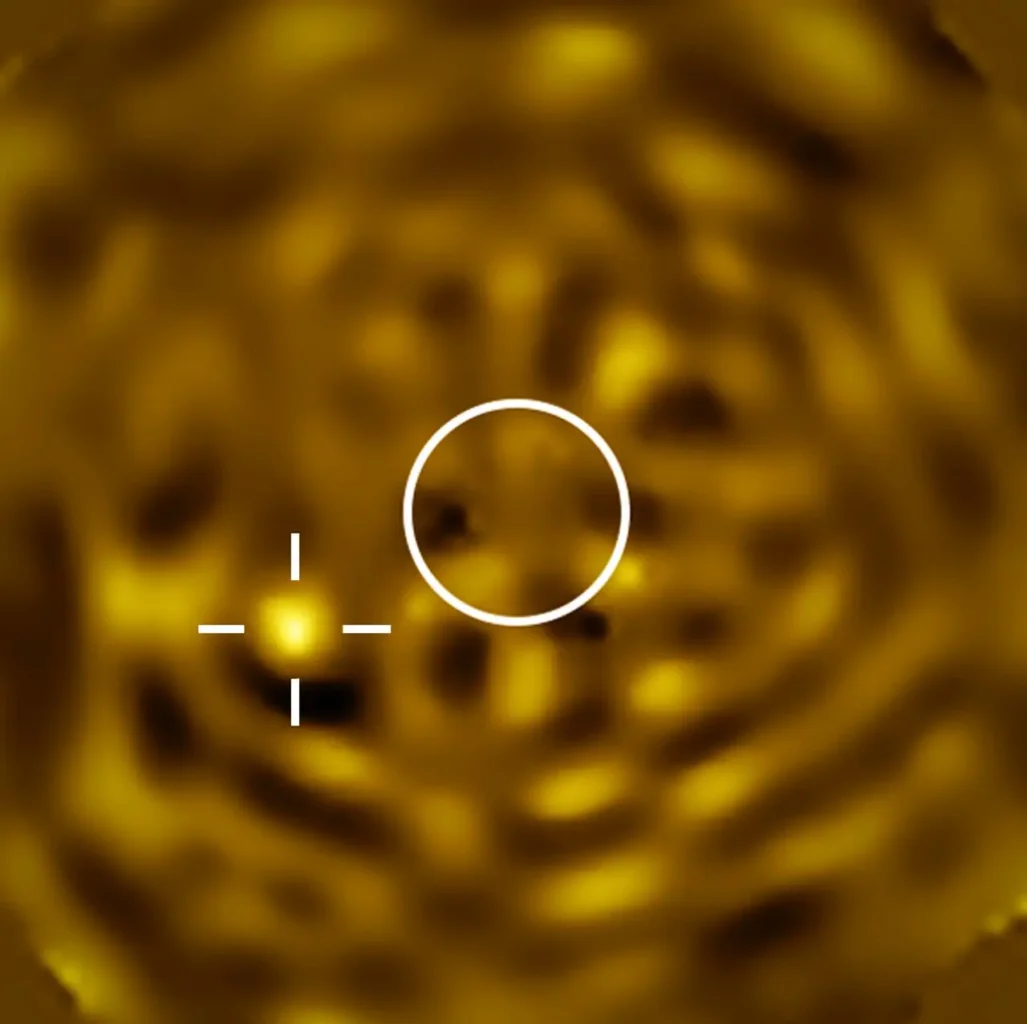
Betelgeuse has been watched for thousands of years, but the red star still had one secret that refused to give itself up. Astronomers had long suspected that a fainter companion was circling the supergiant. Now the European Southern Observatory has released the clearest image yet of what is likely that companion.
The object has been given the practical name Betelgeuse B. A team led by Miguel Montargès used the SPHERE instrument on ESO’s Very Large Telescope in Chile to capture the star in December 2024, when the companion was expected to be at its widest separation from Betelgeuse as seen from Earth. Months of processing followed.
ESO describes the result as the strongest evidence yet that Betelgeuse is not alone. The word “likely” still matters. The team wants to observe the object again in about a year, on the opposite side of Betelgeuse, before treating the orbit as completely secure.
Why Betelgeuse B was so hard to see
Betelgeuse is a red supergiant: enormous, bright and close enough to stand out to the naked eye in the constellation Orion. A companion star orbiting such an object would be hidden in its glare. The task is similar to trying to see a candle next to a searchlight, except that the searchlight is a turbulent stellar surface many times wider than the orbit of the inner planets.
Brightness is not the only problem. Betelgeuse’s atmosphere changes, and dust around the star scatters and absorbs light. The companion’s position also shifts as it moves around the supergiant. A good chance to see it comes when the two stars appear farthest apart in the sky, which is why the December 2024 observation was so important.
SPHERE was designed mainly to find faint companions and planets beside bright stars. Its coronagraph blocks much of the central glare, while adaptive optics corrects the blurring caused by Earth’s atmosphere. Advanced image processing then separates the residual light from the signal of a nearby object.
A heavier companion than expected
Earlier estimates suggested that Betelgeuse’s companion might be roughly as massive as the Sun. The new observations point to a heavier star, with about two to three solar masses. That makes the detection more surprising: a companion brighter and more massive than the Sun had remained hidden beside one of the best-known stars in the sky.
Direct imaging means that the team detected light from the companion itself, rather than inferring its existence only from a wobble or a change in Betelgeuse’s brightness. There had been previous hints, including a possible detection with the Gemini North Telescope, but ESO says this is the clearest image and the strongest evidence so far.
The next observation is a crucial check. If the faint point moves as expected for an object orbiting Betelgeuse, the case will become much stronger. A background star would not follow the same path. Repeating the measurement is how the team can separate a true companion from a coincidental point of light or a processing artefact.
Did the companion cause Betelgeuse’s famous dimming?
Betelgeuse drew global attention when it became visibly fainter in late 2019 and early 2020. Some people wondered whether the red supergiant was about to explode. ESO-backed observations later showed that a cloud of dust had passed in front of part of the star, making it appear dimmer from Earth.
That episode is different from the new companion detection. The faint star may help explain some of Betelgeuse’s long-term variations, but it was not identified as the cause of the 2019 dimming. The dust cloud remains the established explanation for that particular event.
Curiosmos has previously written about Betelgeuse among the brightest stars visible from Earth. Its familiar orange-red colour and changing brightness make it an easy object to recognise, but the companion is too faint to see without a serious telescope and careful processing.
What the companion could change
Betelgeuse is expected to end its life in a supernova, although nobody can say when. That could be thousands of years from now or much longer. The presence of a companion gives astronomers another variable to include in models of the red supergiant’s future.
When two stars orbit one another, they can exchange mass and angular momentum. The effect depends on their separation and on how much material Betelgeuse loses through its stellar wind. A companion can alter the shape of that wind, change the material around the system and influence what remains when the massive star eventually collapses.
It would be premature to claim that Betelgeuse B will determine the supernova’s appearance. The orbit is not yet fully mapped, and the companion’s physical properties need more observations. What ESO has shown is that the system is more complicated than a solitary red supergiant.
A century-long search reaches its most convincing stage
The search for a companion began because astronomers noticed that Betelgeuse’s brightness changes might have more than one cause. For decades, the suspected star stayed beyond the reach of direct imaging. The VLT observation is the payoff from choosing the right instrument, waiting for the right orbital geometry and processing the data carefully.
It is also a reminder that a famous star is not necessarily a fully understood one. Betelgeuse is close enough to study in detail, bright enough to observe without a large telescope and old enough to have been recorded by people for millennia. Even so, an important part of its system was hiding in plain sight.
The next image may be less dramatic than the first. It may show only a small shift in a faint point beside the star’s glare. That movement would be the evidence that turns a compelling picture into an orbit—and a suspected companion into a well-measured member of the Orion system.