In empty space, light travels at exactly 299,792,458 meters per second. That is about 300,000 kilometers per second, or 186,282 miles per second. It is the fastest speed at which matter, energy, or information can travel through the universe.
The number is so large that it is easy to treat light as instantaneous. Across cosmic distances, it is anything but. Light takes eight minutes and 20 seconds to reach Earth from the Sun, more than four years to arrive from the nearest other star, and millions or billions of years to cross the gaps between galaxies.
What the speed of light means in everyday space
Light travels about 300,000 kilometers in one second. A radio signal sent to the Moon takes roughly 1.3 seconds to make the trip one way. Signals between Earth and Mars can take several minutes, depending on where the planets are in their orbits.
On the scale of a human journey, those numbers are hard to feel. In one second, a beam of light could circle Earth more than seven times. It would still need about 100,000 years to cross the Milky Way from one side to the other. The speed is enormous; the distances are simply larger.
That delay matters whenever a spacecraft is far from Earth. Engineers cannot steer a rover on Mars with a joystick in real time. They send commands, wait for them to arrive, and then wait again for the spacecraft to report what happened.
Why light slows in glass and air
The exact value of 299,792,458 meters per second applies to a vacuum. In air, water, glass, and other materials, light travels more slowly because the electromagnetic wave interacts with the material it is passing through.
That slowing is why lenses can bend and focus light. It also explains why a straw appears to bend in a glass of water. The light has changed speed as it crossed from one material into another, changing the path it takes.
Why nothing with mass can reach c
Einstein’s special theory of relativity links motion, energy, space, and time. As an object with mass is accelerated closer to the speed of light, the energy required to increase its speed rises dramatically. Reaching the speed of light would require an infinite amount of energy for any object with mass.
Particles with no rest mass, such as photons, travel at c in a vacuum. Objects with mass can move extremely fast, but they cannot be accelerated through that limit.
Does the expansion of space break the speed limit?
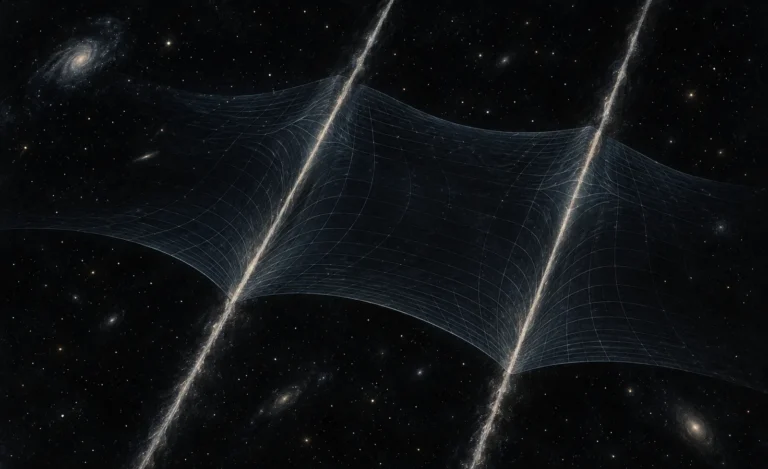
Very distant galaxies can appear to recede from us faster than light because space itself is expanding between us and them. That is not the same as a spacecraft or a signal moving locally through space faster than light. No observer near the galaxy would measure a nearby object passing them at more than c.
This distinction becomes important when thinking about the size of the observable universe. The light from a distant object can have traveled for billions of years while the space between the object and Earth expanded along the way. Curiosmos has explained that distance problem in its guide to the universe’s 93-billion-light-year observable diameter.
Light is fast, but the universe is vast
The speed of light sets a hard limit on communication, travel, and what information can reach us. It also gives astronomers a way to measure distance and read the past. Every clear view of a star or galaxy is a message that began its journey long before the light entered a telescope.