Black holes are invisible until something gives them away. A disk of hot gas can light up around one. A jet can cross a galaxy. And, in the most violent cases, a black hole can tear apart a star and turn the destruction into a beacon visible across the universe.
NASA’s Nancy Grace Roman Space Telescope is being designed to find those events when they happened billions of years ago. A study described by NASA suggests Roman could detect tidal disruption events—TDEs—in black holes that existed when the universe was much younger, offering a new way to investigate how the first supermassive black holes grew.
Roman is currently on track to launch on August 30, 2026. Once it begins its surveys, its High-Latitude Time-Domain Survey will repeatedly scan the same regions of sky, covering about 18 square degrees—an area roughly equivalent to 90 full Moons. That repeated cadence matters because a tidal disruption event changes over time rather than appearing as a permanent object in a single image.
Keep exploring
Continue with Curiosmos
What happens when a black hole catches a star
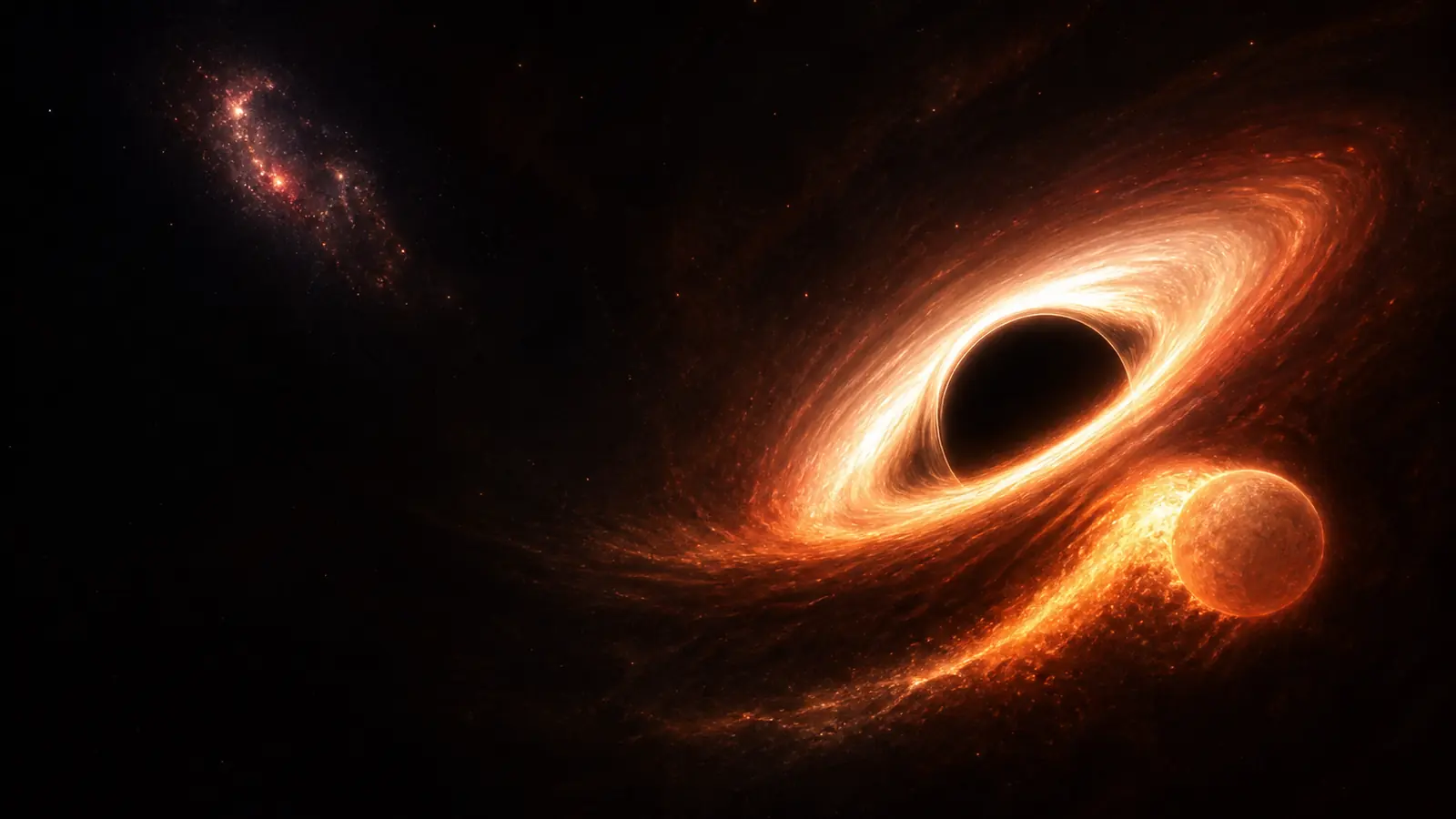
A TDE begins when a star passes too close to a black hole. The black hole’s tidal gravity pulls more strongly on the near side of the star than on the far side, stretching the star until it is torn apart. Some of the stellar material escapes. The rest forms a hot stream and eventually feeds the black hole.
For a short period, the region around the black hole can brighten enough to outshine its host galaxy. That flash gives astronomers a way to locate a black hole that would otherwise be too faint to see.
The effect is most useful for black holes in a certain mass range. A very massive black hole may swallow a star whole before the star is disrupted outside the event horizon. Lighter supermassive black holes—roughly 100,000 to 100 million times the mass of the Sun—can shred a star first, producing the flare that telescopes can detect.
Why Roman’s infrared view matters
Roman will observe near-infrared light. Light from a distant event is stretched toward longer wavelengths as the universe expands, a phenomenon called cosmological redshift. Roman’s instruments are therefore suited to TDEs whose light has travelled for eight to eleven billion years.
Those distances take astronomers into a crucial period of cosmic history. Star formation reached its peak around eleven to twelve billion years ago, a period sometimes called cosmic noon. Galaxies were merging more often, their centres were crowded with stars, and black holes were being fed by large supplies of gas.
The research team modelled how often Roman should find TDEs as a function of distance and cosmic time. Their forecasts suggest Roman could record as many as 100 such events per year. The number matters, but the distribution matters more. Counting how the events change with redshift could show whether early black holes began as the remnants of massive stars or formed through the direct collapse of enormous gas clouds.
Those two ideas are often described as light seeds and heavy seeds. In the first, black holes begin with only a few hundred solar masses and grow through mergers and accretion. In the second, they are born much larger, perhaps from the collapse of a dense gas cloud, and need less time to become the billion-solar-mass objects seen in the early universe.
Roman will not work alone
Roman’s strength will be repeated infrared imaging across a wide field. The Vera C. Rubin Observatory will scan much larger areas in visible light, finding thousands of closer transients. Webb can then examine selected events in far greater detail, while other telescopes can add X-ray and spectroscopic information.
The combination is important because no single observatory can answer every question. Roman may find the distant flare. Rubin may catch a nearer version. Webb or an X-ray telescope can help identify the host galaxy and measure the conditions around the black hole.
The method also gives astronomers a way to study black holes that are not actively feeding all the time. A quiet black hole can remain hidden for millions of years. A shredded star briefly switches on the surrounding gas, turning a dark object into a time-stamped event.
A new window on an old problem
Astronomers already know that enormous black holes existed surprisingly early in cosmic history. The difficulty is explaining how they grew so quickly. Roman’s TDE survey will not photograph the first black holes directly, but it could reveal the smaller population that came before the giants.
That is the real promise of the mission. Instead of looking only for the brightest quasars, astronomers can build a census of smaller black holes by watching for the stars they destroy. The pattern of those events across cosmic time may tell researchers whether early black holes grew gradually, merged rapidly, or were born massive.
Curiosmos has also explored how the first black-hole images were assembled and why distant observations are a way of looking into the universe’s past. Roman’s survey will add a different kind of record: not a still image of a black hole’s shadow, but a catalogue of stars that did not survive their encounters with one.
Sources
- NASA, “NASA’s Roman Telescope Will Spot Distant Black Holes That Shred Stars,” July 14, 2026: https://www.nasa.gov/missions/roman-space-telescope/nasas-roman-telescope-will-spot-distant-black-holes-that-shred-stars/
- The Astrophysical Journal study linked from the NASA release.