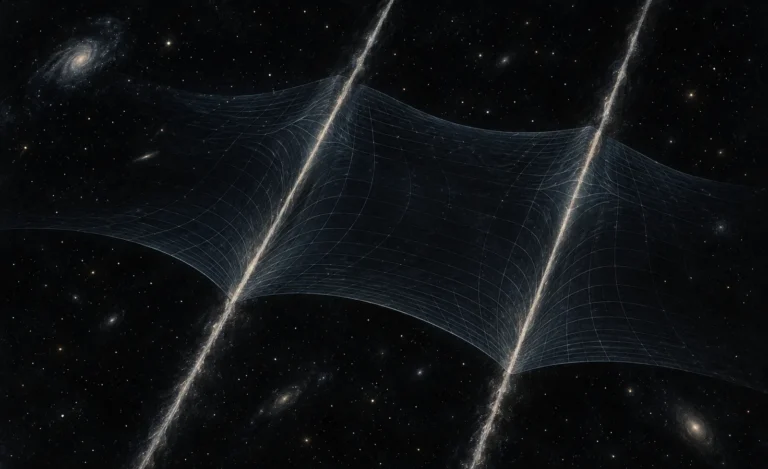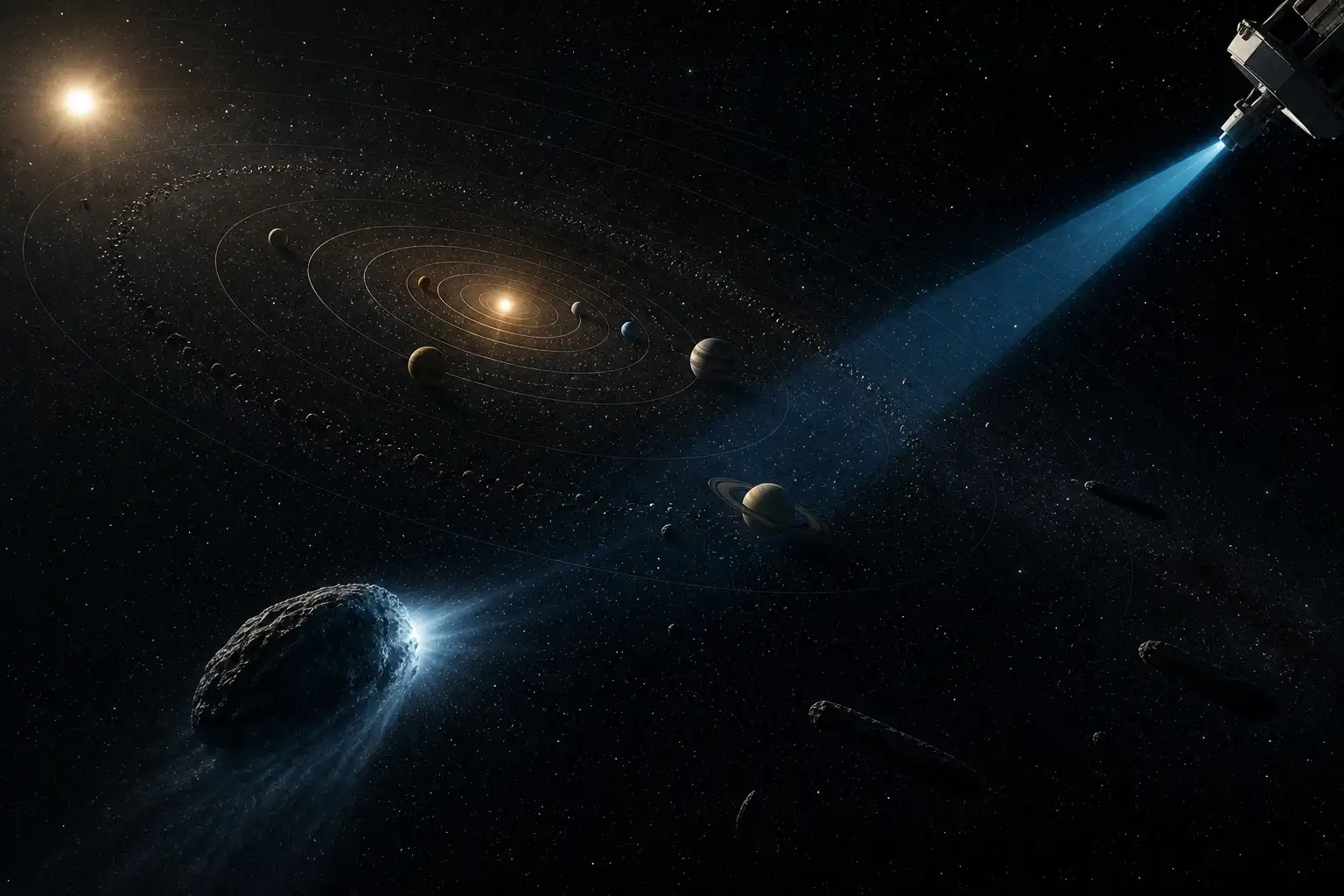
Astronomers have confirmed three visitors from beyond the Solar System: 1I/‘Oumuamua, 2I/Borisov and 3I/ATLAS. It is tempting to treat that trio as a small sample of the population crossing through the Galaxy.
But the three objects may tell us just as much about our telescopes as they do about interstellar space.
A recent perspective by Omer Eldadi, Gershon Tenenbaum and Avi Loeb argues that interstellar-object research is shaped by survivorship bias. The objects in our catalog are the ones that survived the journey through a detection system: they were bright enough, large enough, active enough and positioned well enough for a survey to notice them. The objects that failed those tests left no entry in the database at all.
That does not mean the known visitors are unimportant. It means we should be cautious about treating them as representative.
Three discoveries, three different stories
‘Oumuamua was the first confirmed interstellar object, found in 2017 after it had already passed the Sun. It appeared unusual and showed no obvious cometary tail. Borisov, discovered in 2019, looked much more like a conventional comet, with a visible coma and tail.
3I/ATLAS, discovered in 2025, was brighter and more active than either of its predecessors. Observations found a substantial coma around a relatively small nucleus, which helped it cross the threshold of a survey designed to find near-Earth objects and comets.
The diversity is scientifically valuable. It also creates a statistical trap. Three objects can look varied while still being a very poor guide to the full population, especially when every object had to pass through a different set of observational filters before it could be counted.
The objects our surveys struggle to see
The easiest interstellar object to discover is not necessarily the most common one. A dark object reflects little sunlight. A small object is faint. A fast object crosses the field of view quickly. An inactive object does not produce a bright cloud of dust and gas around its nucleus.
Geometry matters as well. A visitor approaching from the direction of the Sun can be hidden in daylight glare. One travelling through a part of the sky that a survey observes infrequently may never leave enough images for its path to be recognised. An object that arrives when a telescope is closed by weather or technical work can disappear without anyone knowing it was there.
Those are not minor imperfections. They define the sample. If a survey can only find the bright and conveniently placed objects, then the catalog will naturally over-represent brightness, activity and favourable trajectories.
Why this is survivorship bias
The phrase comes from a wartime statistics problem. Engineers studied bullet holes on aircraft that returned from combat and planned to reinforce the areas with the most damage. The statistician Abraham Wald pointed out that the missing aircraft mattered more: hits to areas without bullet holes may have been fatal, because those planes never returned to be counted.
The interstellar-object analogy is not exact, but the logic is useful. We are studying every confirmed object we have, yet the objects we cannot detect are absent before the analysis begins. There is no hidden catalog waiting to be corrected with a better average. The population has to be found with different observing conditions.
The authors of the perspective estimate that current instruments sample only a very small part of the plausible range of size, reflectivity, speed and activity. That estimate is a research argument, not an established census of missing objects, and the perspective was submitted for peer review. Its strongest point is simpler: the unknown population is likely much broader than the three objects in the catalog.
What would improve the search?
The answer is not just a bigger version of the same survey. Astronomers need observations at different wavelengths, wider sky coverage and better ways to connect detections from separate nights. Infrared telescopes could help with dark objects. Faster image processing could identify a faint point moving against the stars. Radar, dedicated follow-up and data from space-based surveys could fill gaps left by ground-based observing.
The Vera C. Rubin Observatory should expand the number of small bodies detected in the Solar System, although its ability to find interstellar visitors will still depend on brightness and geometry. A future population of objects will be more informative if surveys record not only what they found but also what they could have found under the conditions of each observation.
That “survey completeness” work is less dramatic than a new visitor, but it is what turns a list of discoveries into a population estimate.
A small catalog can still change the question
Three interstellar objects are enough to establish that material from other star systems passes through ours. They are not enough to tell us how common each type is, how many arrive each year or whether the Galaxy is filled mostly with comets, dark rocks, fragments or something more unusual.
The next discovery may be more valuable because it is unlike the first three—or because it reveals what the first three had in common. Until surveys begin finding the faint, dark and badly positioned visitors as well as the bright ones, the safest description of the known sample is not “typical.” It is “detected.”
Sources and further reading
**Internal links:** 3I/ATLAS and the anomalies we cannot ignore, the Oort Cloud, why the Universe is 93 billion light-years across.