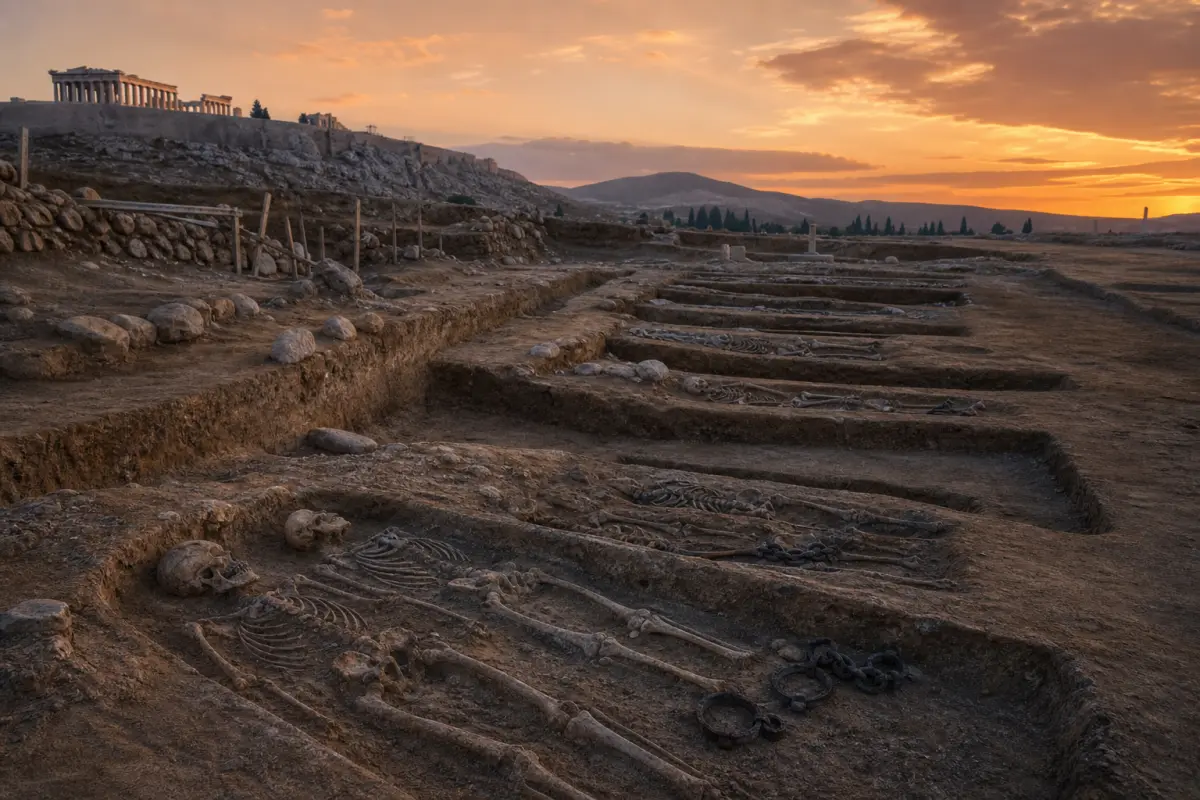
At first glance, the three mass graves at Phaleron seem to tell a story about outsiders. The men were buried together in the ancient Attic cemetery, many of them with iron shackles still around their wrists. Since the graves were uncovered in 2016, archaeologists have asked whether the dead were pirates, invading soldiers, political prisoners, or criminals brought in from elsewhere.
A new study points in a different direction. The men were not mostly strangers to the region. Chemical evidence preserved in their teeth suggests that the overwhelming majority grew up in Attica, the territory around ancient Athens. That does not identify them, and it does not settle the question of why they were killed. It does, however, make a foreign-invasion explanation much harder to sustain.
What the Phaleron graves contain
The Phaleron Burial Ground was used during the seventh and sixth centuries B.C.E., a period when Athens and the surrounding communities were still moving through the political changes of the Archaic age. Three graves contained 79 adult men. Many had been placed on their backs with metal shackles binding their arms, while others were arranged in ways that suggest a large, organised act of burial rather than an ordinary cemetery ritual.
Keep exploring
Continue with Curiosmos
The unusual treatment led to competing interpretations. Some researchers proposed that the men were prisoners captured in war. Others suggested that they had taken part in a failed uprising, or that they were people executed by the state and buried together as a warning. The physical evidence alone could not distinguish between those possibilities.
That is why the new chemical work matters. Researchers analysed the teeth of 163 people from Phaleron, including 66 of the 79 men in the three mass graves. Tooth enamel forms during childhood and normally preserves the chemical signature of the geology, water, and food of the place where a person grew up. Strontium isotope ratios can therefore offer a broad indication of whether someone was local or had spent their early life elsewhere.
The chemical evidence points to Attica
The result was striking. Sixty-four of the 66 shackled men tested—96.9 percent—had isotope signatures consistent with local origins in Attica. The wider sample produced a similar result: 156 of 163 individuals, or 95.7 percent, were classified as local.
The numbers do not tell us who the men were. Isotope analysis cannot name a prisoner, identify a political faction, or prove the circumstances of a death. It can show that the most popular outsider scenarios do not fit the evidence very well. The men in the graves were, overwhelmingly, part of the local population.
That leaves several possibilities. They could have been caught on the losing side of a struggle for power. They could have been executed after a failed coup, or punished as local criminals. The researchers describe the violence represented by the graves as something directed inward, toward people who belonged to the social and physical landscape of Attica.
What the study does—and does not—prove
It would be easy to turn the result into a tidy answer, but the evidence is more useful than that. The study narrows the field without closing it. We still do not know whether the men were rebels, prisoners, or victims of another episode of organised violence. The graves may even contain people caught up in more than one event.
Their local origin does show that early Athenian society could turn its coercive power against its own population. That is an important distinction. A mass burial filled with outsiders would tell us about war or raiding. A mass burial filled with locals raises questions about authority, punishment, and the political tensions inside the community itself.
Phaleron is one of the places where archaeology can test the assumptions that grow around a dramatic discovery. The shackles remain the most visible clue, but the quieter evidence in the men’s teeth has changed the story. Before anyone decides who the dead were, it is worth asking where they came from.
For broader context, see our coverage of archaeological enigmas from ancient Greece and the ancient Mediterranean networks that connected distant communities.