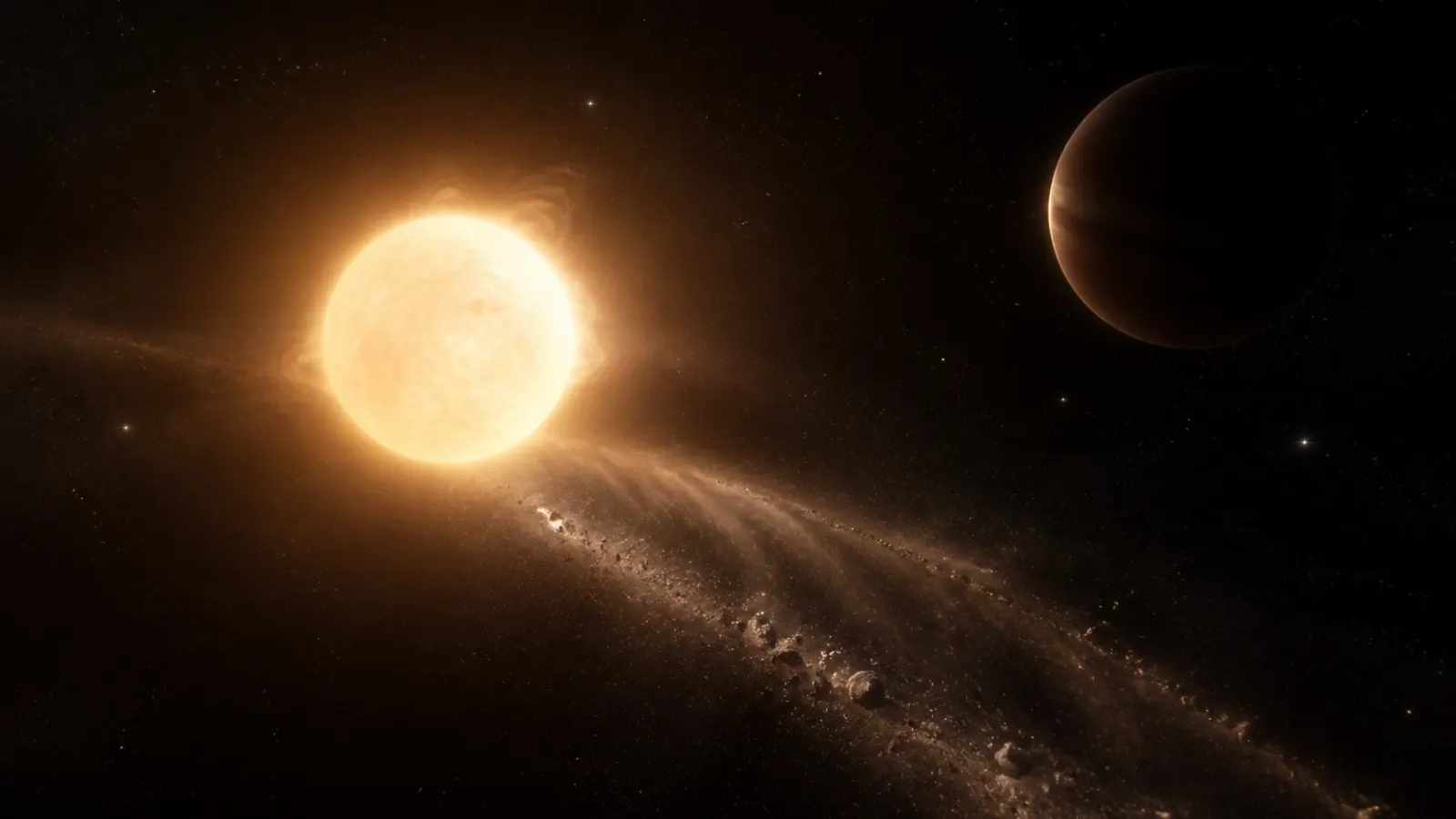
Boyajian’s Star may have a large companion orbiting it, according to a new study of the system’s motion. The best estimate puts the object at about 9.4 times the mass of Jupiter, but the uncertainty extends well into brown-dwarf territory. That places it near the uncertain boundary between a very large planet and a brown dwarf.
The result does not solve every part of the star’s strange behaviour. KIC 8462852 became famous in 2015 when citizen scientists noticed irregular drops in its brightness, some far deeper and longer than the dimming caused by a normal planet crossing a star. The new companion could help disturb comets or smaller bodies, but it does not pass in front of the star often enough to produce all of the famous dips itself.
A star that refuses to dim in a simple pattern
Most exoplanet discoveries begin with a regular pattern. A planet crosses its star at the same point in each orbit, creating a repeating, predictable dip in the star’s light. Boyajian’s Star did something very different. Its brightness fell by varying amounts, sometimes for days, and the pattern did not repeat like a normal planetary transit.
The strange data came from NASA’s Kepler space telescope. At first, some people suggested that a huge artificial structure might be blocking the star, an idea that became widely known as the “alien megastructure” explanation. Later observations made that interpretation increasingly unlikely. Dust, comets or fragments of a disrupted planetary system remain more plausible explanations, although the system is still difficult to model.
How the hidden companion was found
The new study did not rely on another dramatic dip in brightness. Instead, Cristina Madurga-Favieres and her colleagues looked for the star’s tiny back-and-forth motion under the pull of an orbiting object. This is the radial-velocity method.
When a star moves toward and away from Earth, the lines in its spectrum shift by a small amount. A sufficiently massive companion creates a repeating pattern in that motion. The researchers combined radial-velocity measurements from four large telescopes with a smaller TESS dip recorded in 2019. That dip lasted about 21 hours and was around 1.1 percent deep, consistent with a large object taking several years to orbit the star.
The combined data point to an orbit lasting between roughly 1,030 and 1,368 days. The team’s best estimate for the companion’s mass is 9.4 Jupiters, but the uncertainty is large enough that the object could be several times heavier. Astronomers often use about 13 Jupiter masses as a rough dividing line between planets and brown dwarfs, although the boundary is not a perfect rule based on appearance.
Could its gravity be sending comets inward?
The companion’s orbit is close to circular, with an estimated eccentricity of about 0.09. That makes it less likely to be directly responsible for the huge, irregular dips recorded in 2015. It would not cross the star’s face often enough, and its own transit has only been seen once in the available data.
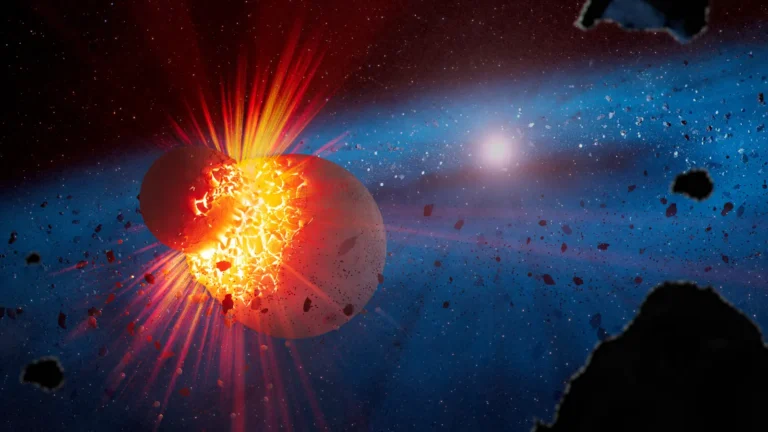
Its gravity could still matter. A massive body can push smaller planets, comets and fragments into new orbits. Some of those objects might break apart or release dust as they move closer to the star. Dust clouds could then block part of the starlight, producing dips that do not repeat in a neat schedule.
That idea is still a possible explanation, not a solved answer. The companion’s modest orbital eccentricity limits how strongly it can disturb the rest of the system, and the observations contain long gaps. Earlier companion transits may have happened during those gaps or at the same time as the larger dimming events, making them difficult to identify.
The object cannot currently be photographed directly beside the star. If it is a brown dwarf, its own heat might eventually make direct detection easier, but the glare from Boyajian’s Star remains a serious obstacle. More radial-velocity measurements should narrow the mass estimate and show whether the orbital signal remains stable.
For now, the study changes the question rather than ending the story. Boyajian’s Star is not evidence of an alien structure, and the new companion does not automatically explain its light curve. It gives astronomers a massive piece of the system to track, which may help reveal how comets, dust and planets are moving around one of the most unusual stars in the sky.