Imagine turning a piece of ancient wood toward the light and finding the faint remains of someone’s handwriting. What did that person need to say? And how could we place their message on a calendar almost two thousand years later? Ancient inscriptions bring those questions together. Their words can preserve a royal decree, a business transaction or a private request, while their surfaces carry clues to how and when the message was made.
Epigraphy—the study of inscriptions—connects the writing with the object and the place where it was found. A useful way to understand the process is to follow three different clues: the marks themselves, the language, and the evidence for a date.
Light can bring shallow writing into view
At the Bloomberg excavations in London, Roman wooden writing tablets preserved faint cuts left by a stylus. The writing surface had originally held wax. Traces cut into the underlying wood gave specialists another chance to recover the text.
Keep exploring
Continue with Curiosmos
Oxford’s Centre for the Study of Ancient Documents describes Roger Tomlin’s examination using low-angle light, microscopy and photographs illuminated from different directions. The centre also used a 128-light dome for reflectance transformation imaging, or RTI. This technique records how a surface responds to changing illumination, helping a researcher examine its texture on screen.
The practical question is wonderfully simple: what becomes visible when the light moves? A shallow groove may stand out from one direction and almost disappear from another. Comparing those views gives the reader more to work with than a single photograph.
A familiar language can unlock an unfamiliar script
The Rosetta Stone offers a different kind of comparison. The British Museum’s object record identifies a priestly decree concerning Ptolemy V, dated to 196 BC. It was inscribed in hieroglyphic, Demotic and Greek scripts.
These are three scripts, but two languages: Egyptian and Greek. As the museum’s account of its decipherment explains, scholars could read the Greek, giving them a route into the Egyptian versions. Other surviving copies of the decree helped supply parts missing from the broken stone.
That is the power of comparison. A damaged inscription can become more readable when it is studied alongside another text with related wording. Epigraphers also compare letter shapes, spelling and abbreviations across examples.
Language provides another clue. Words enter and leave use, and official formulas can change over time. Researchers compare the inscription with other texts from the same region, but they also have to allow for local speech and individual mistakes. An unusual spelling is not automatically a new language; it may be a regional form, a phonetic spelling or a damaged line.
The object and the place matter just as much as the letters. A dedication found in a sanctuary tells a different story from a name scratched into a household wall. A text reused as building material may be older than the structure around it. The Ramesses II inscription linked to Egypt’s lost city of Mesen is meaningful because its wording and archaeological setting can be studied together, with the carved names providing clues that the surrounding remains can help explain.
How a message acquires a date
The London tablets provide a concrete example. MOLA’s publication summary reports eight explicitly dated documents among the finds, including a financial document from 8 January AD 57. The archaeological sequence places most of the texts within the AD 50s to 80s.
Those are two different routes to time. A date in a document can identify a particular day; the excavation context can place a text within a broader period. Together they connect individual transactions with the changing settlement around them.
Dating an inscription can involve several methods. The style of the letters may provide a range. The stone, pottery or metal object may have a known production period. The layer where it was found can establish a minimum or maximum date. If the text names a ruler or official, that information may help, but reused monuments and copied formulas mean that names must be tested against the rest of the evidence.
The London finds show what a recorded excavation adds. MOLA could connect the tablets with successive phases of occupation, placing individual messages within the city’s early history. That context gives even an undated fragment a place in the sequence. A documented findspot and excavation record can therefore be as valuable to the interpretation as a clearly preserved word.
Translation is another stage where caution matters. Some words have no exact modern equivalent. A religious title may carry social and political meanings that disappear in a single English word. A responsible translation therefore explains uncertainties rather than smoothing every difficult phrase into fluent but unsupported prose.
Reconstructing the world around the words
The best reading is a conclusion built from several lines of evidence. Letter forms, language, material, findspot, associated objects and later reuse should point in the same direction. When they disagree, the disagreement is part of the result and should remain visible.
Ancient inscriptions are valuable because they connect people, places and institutions across time. They can name a deity, record a tax, mark a burial or preserve a private request. Their meaning does not come from the words alone. It comes from reconstructing who made the inscription, where it stood, who could see it and what happened to it afterward.
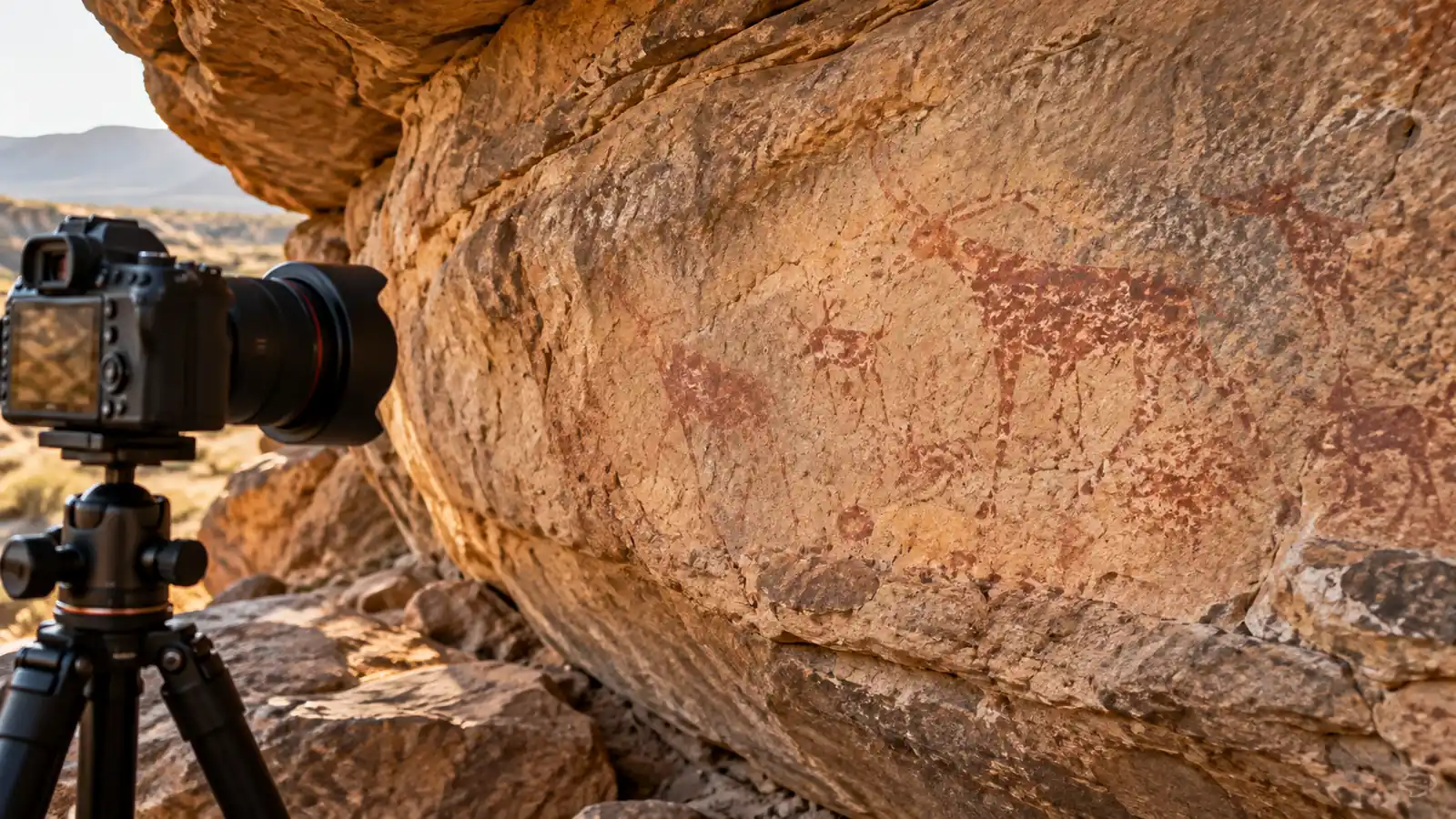
The visual side of this work also connects with how image enhancement helps researchers examine faded rock art. In both cases, documenting the surviving surface is the beginning of a much larger investigation.