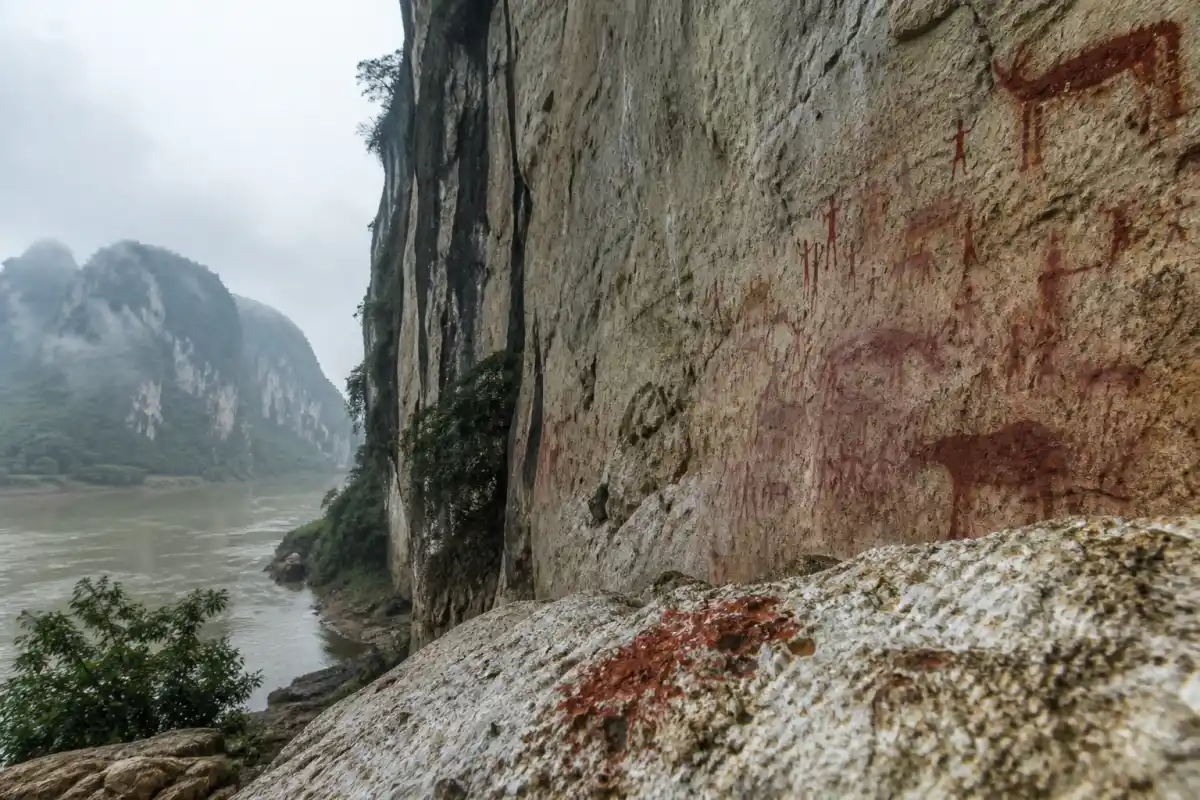
What if a rock face that looks empty to us is still carrying a faint memory of paint? A digital photograph can preserve tiny differences between pigment and stone even when a visitor sees only a weathered surface. Image enhancement gives those differences room to speak.
The result can be startling: a line appears, a figure separates from the background, or a patch of color suddenly becomes visible. But the most interesting part is the process behind the image—how researchers decide which signal belongs to the painting and which belongs to the way the photograph was processed.
How can a photograph reveal what the eye misses?
A color photograph stores information in separate channels. On a reddish rock face, the background and a fading red pigment may vary together so closely that the two become difficult to distinguish. Decorrelation stretch changes the relationship between those channels and expands differences that were compressed into a narrow range.
That is why the method can make an apparently bare surface look busy with marks. It is not inventing a painting from nothing. It is making small differences in a recorded image easier to inspect.
One widely used version of the approach is available through the DStretch program. A NASA technology feature traces the technique to remote-sensing work developed at the Jet Propulsion Laboratory and describes how Jon Harman adapted it for archaeological images in 2005.
What did the technique reveal at Angkor Wat?
The NASA feature discusses paintings identified at Angkor Wat during work carried out between 2010 and 2012. These were not discoveries made this September. They are a useful example of the method’s promise: surfaces that look almost blank in ordinary light can still contain visual information preserved in the photograph.
That possibility changes the first question an archaeologist asks. Instead of deciding that a wall has nothing left to show, researchers can ask whether the remaining signal is too subtle for unaided vision—and whether a careful treatment can separate it from the stone.
Why do the enhanced colors look so strange?
A bright blue, green or purple patch in a processed image does not necessarily describe the color an ancient artist used. The colors are often a visual map of differences in the photograph. They help the eye notice a boundary, a brushstroke or a region where pigment survives, rather than reproducing the original palette.
That is also why two enhancements of the same panel can look different. The selected color space, the channels included and the settings used for the transformation all affect the result. A dramatic image still needs to be read alongside the unprocessed photograph and the details of how it was made.
A closer look can reveal more than one treatment
A whole rock-art panel may contain a broad range of colors, shadows and weathering. A faint detail can disappear when the entire image is processed as one large unit. A 2026 study of localised decorrelation stretch explores a different approach: it processes overlapping windows and then combines them, so smaller regions can be examined without being overwhelmed by the rest of the panel.
The team’s method documentation reports improved visibility of fine details in densely painted areas. This is a practical insight with a larger implication. The best view of an ancient image may not come from one spectacular treatment, but from several carefully chosen views of the same surface.
What can a clearer image tell us about the past?
Enhanced imagery can help researchers map surviving pigment, compare motifs and decide where a physical surface deserves closer study. It can also guide conservation by showing where a mark survives and where the rock has simply changed color through weathering.
The image alone still leaves important questions open. A newly visible outline does not, by itself, identify its maker, explain what it represents or date the painting. Those answers come from context, comparison and—when suitable material survives—dating evidence connected to the painting, such as the methods discussed in our guide to radiocarbon dating in archaeology.
Nor can a processing program recover a motif that left no recorded signal in the original photograph. That is why a useful publication keeps the original beside the enhanced version, identifies the settings and points to the particular feature under discussion. Readers can then see what the camera captured and what the treatment made easier to notice.
The next time an image of ancient rock art bursts into impossible colors, the real question is not whether the wall was once painted purple or green. It is what faint trace survived, how the photograph preserved it, and what careful enhancement allows us to see for the first time.