Tiny mineral grains inside an Antarctic meteorite may preserve the oldest evidence yet of a magnetic field in the young solar system. MIT researchers measured the grains’ remanent magnetization and estimate that the field surrounding the newborn Sun reached about 150 to 600 microteslas—roughly three to 12 times stronger than Earth’s magnetic field today.
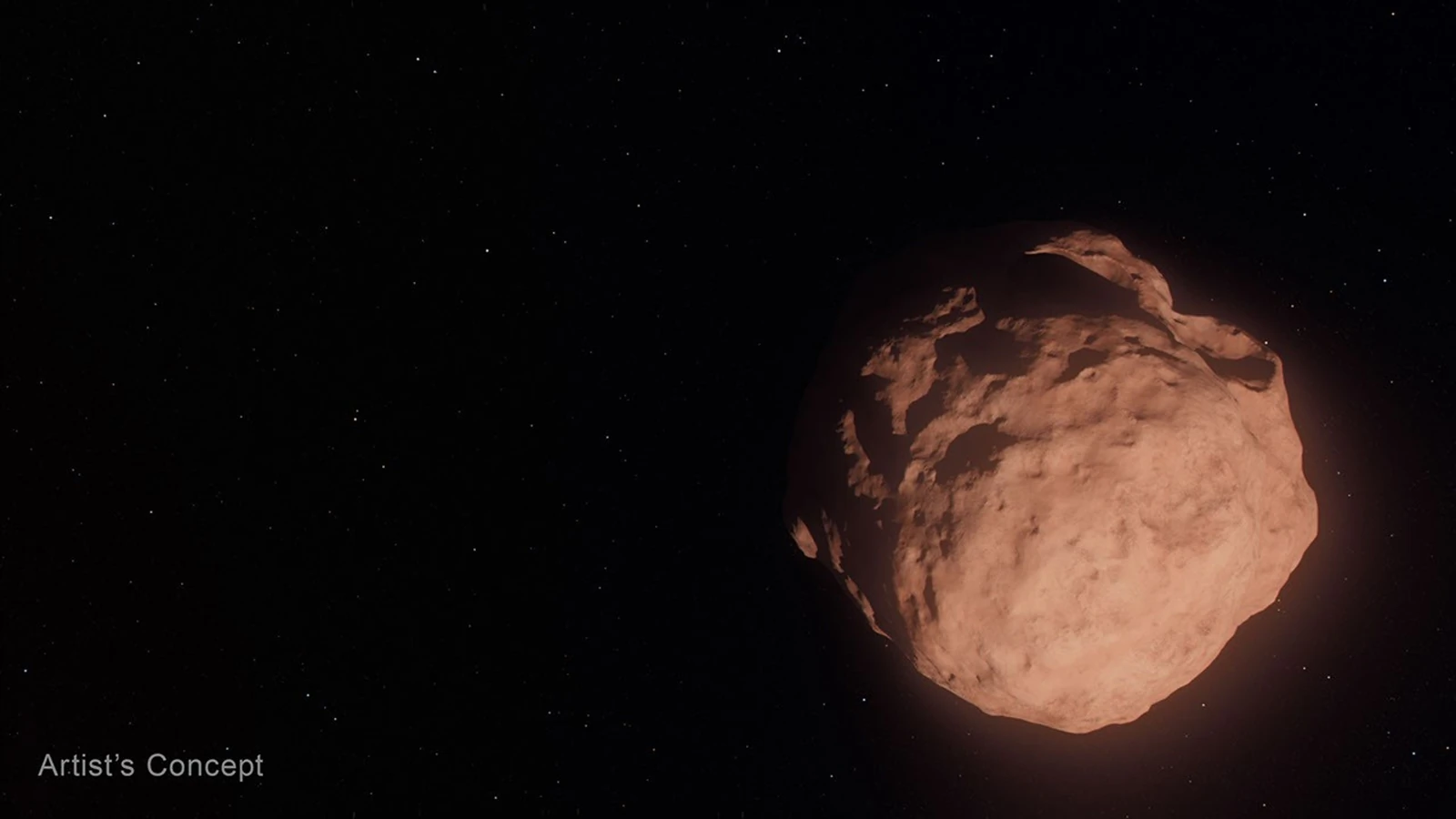
The result comes from DOM 08006, a meteorite found in Antarctica’s Dominion Range in 2008. It is unusually primitive: the rock appears to have escaped many of the chemical changes that altered other meteorites after they formed. That makes it a rare archive of the solar nebula, the rotating cloud of gas and dust from which the Sun and planets emerged.
Most meteorites are not such clean time capsules. Their parent bodies may have been heated, soaked in water, broken apart or mixed with material from elsewhere in the asteroid belt. DOM 08006 experienced far less alteration, so its mineral grains still resemble the material that condensed near the beginning of solar-system history. That is why researchers chose it for a search for magnetism that could have been erased in more heavily changed rocks.
Keep exploring
Continue with Curiosmos
The team focused on calcium-aluminum-rich inclusions, or CAIs. These millimetre-scale minerals formed during the first 200,000 years of solar-system history and are among the oldest solid material scientists can study. Some contain magnetic minerals that could have locked in the strength and direction of the field around them as they cooled.
That record matters because the early solar system did not begin as a flat planetary system. It started as a roughly spherical cloud. As the cloud collapsed, it spun faster and flattened into a disk. Gravity clearly drove much of that transformation, but charged particles moving through the disk could also generate magnetic fields. Those fields may have helped move gas inward toward the growing Sun and influenced how the first solid material was gathered.
To test the idea, the researchers isolated small CAI grains from DOM 08006 and identified ones containing iron-bearing minerals. They then measured the magnetism that survived inside the grains. The field strength they inferred is consistent with a strong magnetic environment during the earliest stage of solar-system formation, before the Sun had fully settled into its present form.
The signal is called remanent magnetization. When a magnetic mineral forms or cools in a magnetic field, its microscopic domains can retain a memory of that field. Measuring such a memory billions of years later is difficult: the grains are tiny, CAIs are chemically complex, and even a small amount of later heating could alter the record. The team therefore selected only grains whose composition and history supported the interpretation.
The finding does not remove gravity from the story. The researchers describe magnetism as an additional ingredient in the process that turned a cloud of gas and dust into a star surrounded by planets. Earlier measurements had already found evidence for a magnetic field a few million years after the system began, when the Sun was in place and planets were starting to assemble. The new measurements push that evidence closer to the beginning.
The timing matters because the first stages of collapse set the architecture of everything that followed. A magnetic field can couple charged gas to the spinning disk, influence how material moves inward and affect how quickly the disk loses energy. The study does not claim that magnetism alone built the Sun or the planets. It shows that a model based only on gravity leaves out a field that was already present when the first solids were forming.
That early timing could help explain how matter was redistributed before planets existed. It also gives astronomers a way to compare the history recorded in meteorites with the disks they observe around young stars today. Curiosmos has previously explained the difference between a meteor, meteoroid and meteorite, and examined what unusual young planets reveal about rocky-world formation. This new result adds a physical record from our own system’s first moments.