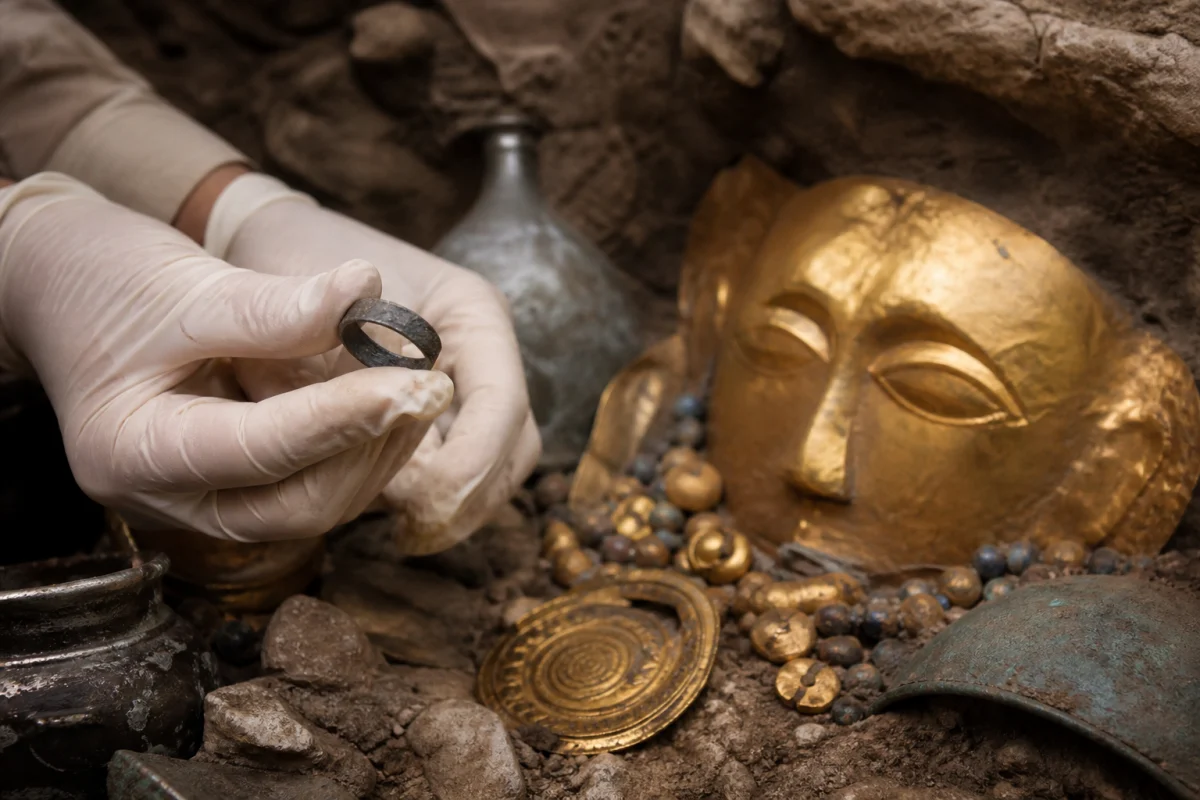
Long before iron ore was smelted on a large scale, a different kind of iron could fall from the sky. Meteorites supplied rare metal to people who had no furnace capable of extracting iron from rock. A new chemical study suggests that this “sky iron” was used for jewellery in the Minoan and Mycenaean worlds, where rings made from meteorite metal may have marked power and social rank.
The result adds a specific chapter to the history of meteoritic iron. Curiosmos has previously covered ancient objects made from this unusual material, including Tutankhamun’s dagger. This study asks a narrower question: why does the strongest chemical signal appear in rings rather than in weapons or tools?
A survey of 91 artefacts
Researchers examined 91 iron objects from 33 archaeological sites. The artefacts are held in 19 museums and include tools, weapons, jewellery, and other objects from the Bronze Age and Early Iron Age. Portable X-ray fluorescence allowed the team to measure their chemical composition without cutting into fragile museum pieces.
Nickel was the key clue. Iron meteorites usually contain much more nickel than iron produced from terrestrial ore. Thirteen objects had nickel concentrations high enough to raise the possibility of a meteoritic origin. The researchers judged nine very likely to be meteoritic and one more quite likely, while three require additional testing.
The pattern was striking: all 13 nickel-rich objects were finger rings. Most came from richly furnished tombs, alongside gold, silver, amber, bronze, or decorated seals. Several combined dark iron with precious metals in one piece. The contexts make the rings look less like ordinary equipment and more like objects meant to display rarity.
Why meteorite metal mattered
In the second millennium B.C.E., producing iron from ore required high temperatures and specialised knowledge that were not yet widespread in the Aegean. A meteorite offered a limited alternative because its iron was already metallic, even if the fragment was difficult to find and shape.
The researchers suggest that some raw material may have moved through networks linking the Aegean to Egypt and the eastern Mediterranean, where desert landscapes make meteorites easier to recover. That is a plausible route, not a proven supply chain. The study does not identify the source of every fragment, and no surviving text names the people who collected or traded the metal.
Most of the rings came from tholos or chamber tombs associated with elite contexts. One exception was found on the finger of a man interpreted by excavators as a high-ranking priest at the Anemospilia sanctuary on Crete. The setting cannot tell us exactly what the ring meant to its owner, but it is consistent with a material that carried social and perhaps ritual importance.
A fashion that faded as smelting spread
The rings also belong to a changing technological landscape. Most date to the Late Bronze Age. Smelted iron began to appear more regularly in the Aegean around the end of the palatial period, and the use of nickel-rich iron seems to decline at roughly the same time.
That change may reflect more than fashion. The collapse of the Mycenaean palace system disrupted trade, administration, and the movement of specialised goods. As smelted iron became more practical, the older material may have lost some of its exclusivity. A meteorite ring could still be unusual, but it no longer represented the only way to possess metallic iron.
The evidence does not show that every ancient Greek ring was made from a meteorite. It shows something more precise: a small group has a chemical signature consistent with sky metal, and those rings repeatedly appear in contexts connected with wealth and authority. Their owners may have worn pieces of a fallen stone because the material was useful, rare, or because its origin gave it meaning.
Read our earlier background on ancient iron from meteorites and other artefacts made from sky metal.