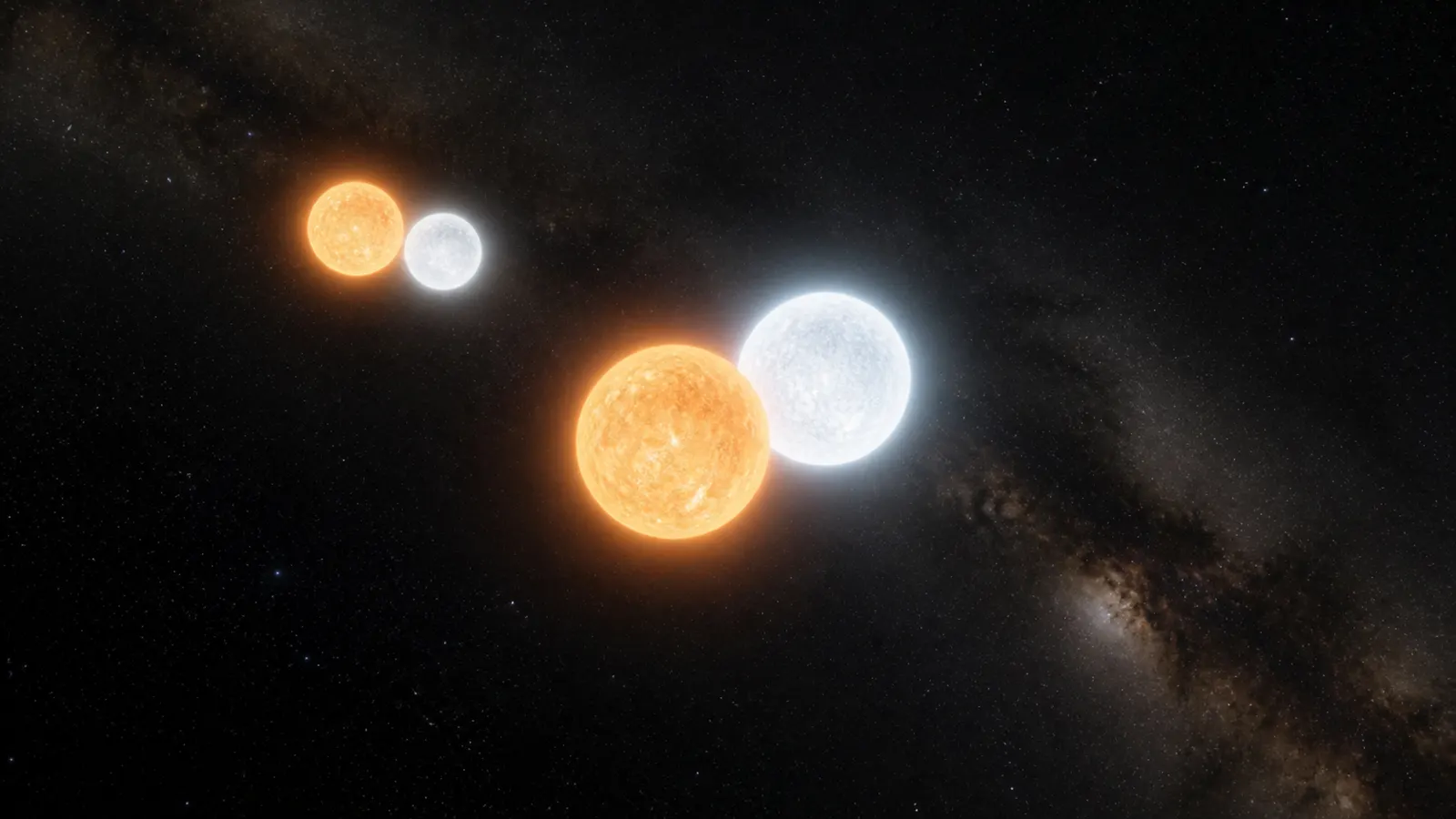
Astronomers have identified a four-star system whose geometry produces a sequence of eclipses unlike anything previously confirmed. TIC 433545934 is made of two close pairs of stars, and the two pairs orbit each other at a much greater distance. From Earth, one pair periodically blocks the light from its partner pair, creating a mutual eclipse on top of the ordinary eclipses within each binary.
That arrangement gives researchers an unusually complete view of a system that normally would be difficult to disentangle. Instead of studying one binary at a time, they can compare the timing, depth, and shape of several different eclipses and use them to test how multiple stars exchange energy and angular momentum.
Two binaries inside one wide orbit
The inner pairs are compact. One completes an orbit in about 2.07 days, while the other takes roughly 1.41 days. Those short periods mean each pair regularly passes in front of its partner, producing the familiar dips in brightness that reveal an eclipsing binary.
The two binaries themselves take about 224.5 days to travel around their common centre of mass. During that wider orbit, their paths line up from our perspective often enough for one pair to move across the other. The result is a second layer of dimming: the light of one binary is partly hidden by the other binary as a whole.
The system is estimated to be about 580 million years old. Its stars are close enough for gravity to matter over long timescales, but not yet so close that they have clearly begun sharing material. That makes the system a useful snapshot of a stage that many close binaries may pass through before their evolution becomes more violent.
Why the light curve matters
An eclipse is more than a darkening in a graph. As one star crosses another, the exact shape of the dip records the sizes of the stars, their temperatures, their orbital inclination, and the amount of light each contributes. In TIC 433545934, the outer mutual eclipse adds a measurement of how the two binaries are oriented relative to one another.
The team used the repeating pattern in the light curve to establish that the outer event is a genuine crossing between the binaries, rather than a second unrelated pair in the same line of sight. The distinction is important: four stars appearing close together in an image does not prove they are gravitationally bound, but coordinated eclipse timing does.
The system also lets astronomers test models that predict how quadruple stars form. One possibility is that a collapsing cloud broke into two pairs that remained bound. Another is that separate binaries met inside a young stellar group and became a long-lived quartet. Precise orbits and the stars’ chemical properties can help distinguish those histories.
A possible future change
The stars may not stay in their present arrangement forever. Tidal forces can remove orbital energy from close pairs, and one of the binaries could eventually expand until a star reaches its Roche lobe—the boundary beyond which gas can flow toward a companion. If mass transfer begins, the system could develop a very different pattern of brightness and orbital periods.
The most dramatic outcomes are still possibilities, not predictions of an imminent event. The current observations establish the unusual architecture; they do not show that a merger or supernova is about to happen. Continued monitoring will reveal whether the eclipse timings drift as the stars exchange energy and whether the inner pairs begin to interact.
TIC 433545934 therefore offers something rare in stellar astronomy: a natural laboratory in which four stars can be watched through several nested orbital clocks. By measuring how those clocks keep time, astronomers can test the physics that shapes binaries, quadruples, and the stellar explosions that some of them may eventually produce.
The system’s geometry complements Curiosmos explainers on how astronomers find exoplanets and how telescopes turn light into measurements: in each case, a change in observed light becomes a measurement of an object we cannot resolve directly.