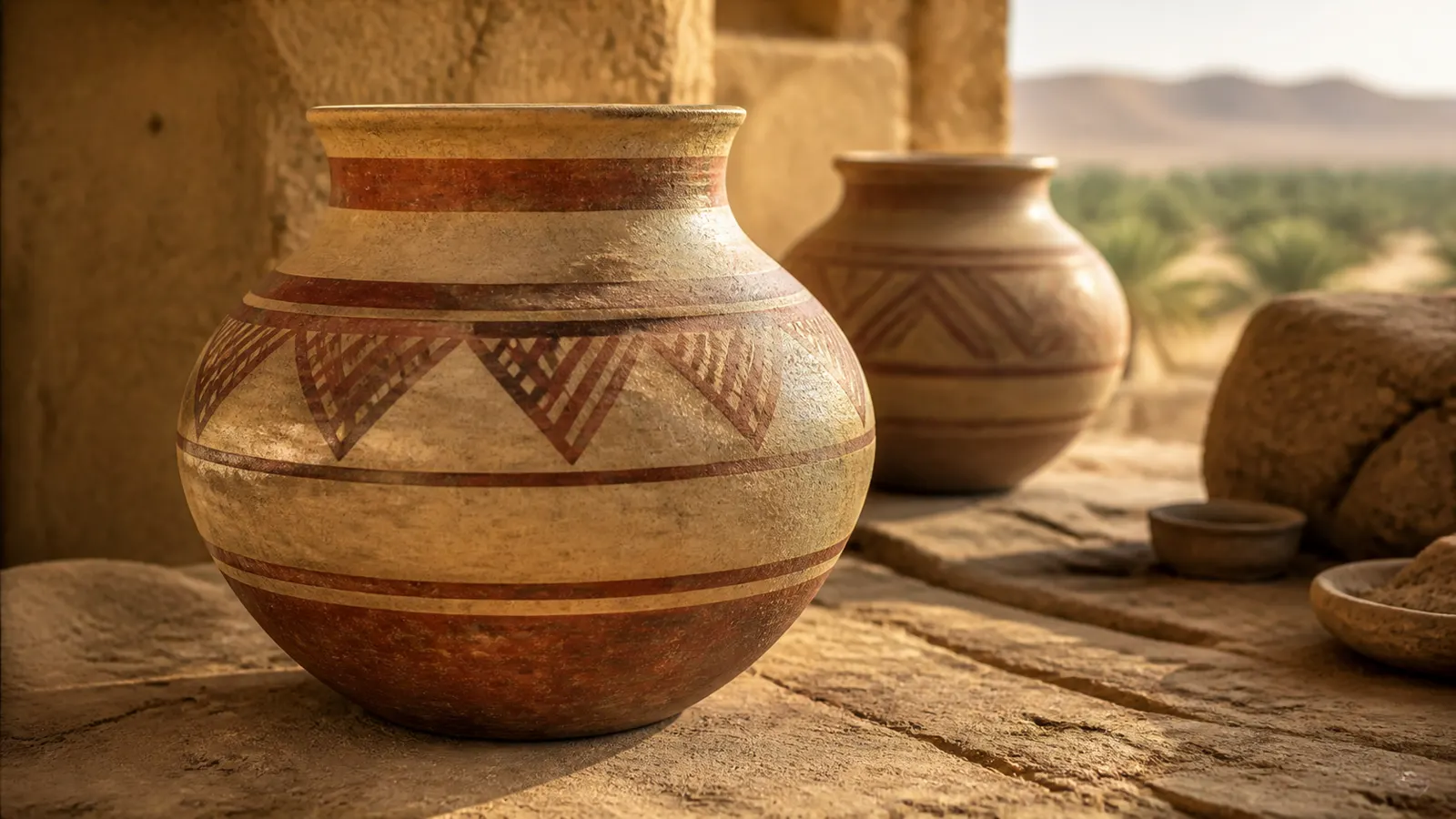
More than 3,000 years ago, potters in northwest Arabia were producing vessels with a look people could recognise far from the workshop. Their painted designs were made in a limited range of colours, repeated across many pots, and transported hundreds of kilometres from the Qurayyah oasis. New research argues that the pottery behaved in some ways like a brand—an identity that signalled origin and attracted buyers.
The comparison does not mean Bronze Age traders had modern advertising departments. It means that a recognisable visual style was tied to a place, a production system, and a reputation. The evidence comes from Qurayyah Painted Ware, or QPW, a ceramic tradition found across the northwestern Arabian Peninsula and in parts of the southern Levant.
A distinctive style from an oasis
Qurayyah sits in a landscape where wells and seasonal water made long-distance movement possible. Archaeologists have found pottery with standardised two-colour designs, often using dark paint against a lighter surface. The motifs vary, but the vessels share enough technical and visual features to be recognised as a related tradition.
Analyses of the clay and pigments point to production at or near the oasis rather than to dozens of unrelated local workshops. The research also identifies a central kiln or organised production zone, suggesting that the pottery was made in quantities large enough to move through exchange networks.
The vessels travelled. Examples have been found hundreds of kilometres from Qurayyah, and other communities produced local imitations. Imitation is one of the strongest clues that a style had meaning beyond decoration: people copied the appearance because the original had become desirable or familiar.
When pottery becomes a signal
The earliest stages of the tradition began around 3,600 years ago. By roughly 3,200 years ago, the designs appear to have become sufficiently standardised and widely distributed to function as a recognisable identity. QPW continued into the first millennium B.C.E., with changes in shape and decoration over time.
The objects were not all luxury goods. Some were ordinary serving or storage vessels, while others entered elite burials. That mixture matters. A style can become powerful when it moves between everyday use and high-status settings, carrying the same visual signal into different parts of society.
Researchers are careful with the word “brand.” A modern brand is supported by legal ownership, advertising, and a market built around a named product. None of those institutions can be assumed for Bronze Age Arabia. What the archaeological record shows is a repeated design, a consistent manufacturing tradition, a distribution network, and evidence that other potters tried to reproduce the look.
Those details reveal an economy that was more connected than a map of isolated settlements suggests. The oasis was not simply a place where people made pots for themselves. It was part of a system in which materials, styles, and expectations travelled between communities.
What the pots cannot tell us
The painted designs do not preserve the names of their makers or the words buyers used for them. Archaeologists cannot yet say whether a single workshop controlled the entire tradition, whether several producers shared a recipe, or whether the style spread through apprentices who moved between sites.
Nor can the vessels prove that every distant example was an export. Local imitations may have been made by potters who had seen an original, traded for one, or learned the technique directly. Chemical sourcing, kiln studies, and careful mapping of finds are needed to separate imported QPW from copies.
Even with those limits, the tradition changes the picture of early Arabian trade. People were not moving only raw materials and finished goods; they were moving visual identities. A vessel could tell a customer where it came from and place its owner inside a network that stretched across the desert.
The story fits Curiosmos coverage of a Bronze Age shipwreck and Mediterranean trade and why an ancient object’s findspot matters. Qurayyah Painted Ware gives that network a human scale: a potter’s repeated brushstrokes became a message that travelled with the vessel.