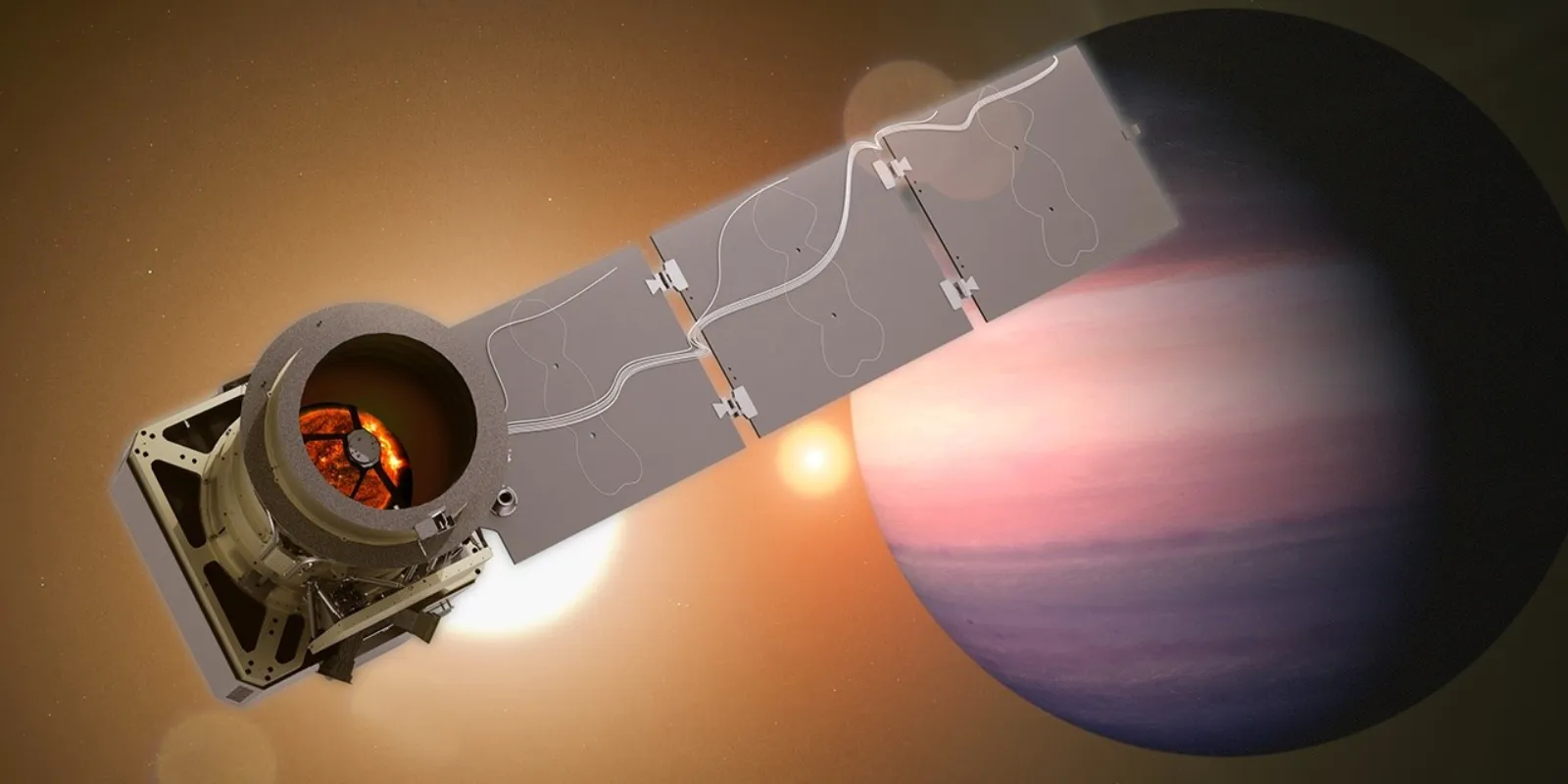
NASA’s small Pandora satellite has begun its science mission, taking repeated visible and near-infrared measurements of exoplanets and the stars they orbit. Over its primary year of observations, Pandora is scheduled to study at least 20 worlds. The goal is straightforward but difficult: determine which features in a planet’s spectrum belong to its atmosphere and which come from a restless star.
Astronomers learn about an exoplanet’s atmosphere when the planet passes in front of its star. A little starlight travels through the planet’s air before reaching a telescope. Molecules such as water absorb particular wavelengths, leaving fingerprints in the light. The signal is tiny, and it is mixed with the light of the much brighter star behind it.
The star can make that measurement misleading. Starspots are cooler and darker than the surrounding surface, while faculae are hotter and brighter. Both change as the star rotates. If those regions are mistaken for a planetary signal, a spectrum can suggest a molecule that is not actually in the planet’s atmosphere—or hide one that is.
Keep exploring
Continue with Curiosmos
Pandora was built to watch both sides of the problem at once. Its roughly 18-inch (45-centimetre) aluminium telescope records visible light from the host star while its near-infrared detector measures the system. The satellite can hold a target for a long observation, something large, heavily booked observatories cannot do for every transit. NASA says Pandora will observe each target around ten times, with a transit included in each long-duration visit.
The mission’s infrared sensor is a spare originally developed for the James Webb Space Telescope. Pandora is not a replacement for Webb. Its measurements are meant to give Webb and other observatories a better estimate of how much of a spectrum comes from the star’s surface, making atmospheric results easier to interpret. Curiosmos has already explained how astronomers detect exoplanet atmospheres and why Webb uses a distant orbit.
The first targets are known planets, not objects Pandora is expected to discover from scratch. By combining the visible record of the star with the infrared view of the planet during a transit, the team can model the star’s spots and brightness patterns. That information should narrow the uncertainty around atmospheric composition, especially for worlds where clouds or hazes weaken the signal.
Pandora’s results will arrive alongside data from Webb and ground-based observatories. The satellite’s science archive is available through NASA’s Exoplanet Archive, allowing other researchers to compare the observations with their own models. The mission is a small spacecraft, but its long, repeated looks address a problem that affects the interpretation of much larger telescopes.
The outcome will not be a catalogue of life-bearing planets. It will be a cleaner way to decide what an exoplanet’s atmosphere actually contains. That step is essential before astronomers can judge whether a distant world has the chemistry and conditions that make it worth studying in greater detail.
The observing strategy is especially useful for active stars. A starspot can rotate into view, fade, or be replaced while a planet completes several transits. By following the star for a full day around each event, Pandora can track those changes instead of treating the star as a fixed light source. That extra time is what lets the team separate a changing stellar surface from a chemical feature in the planet’s atmosphere.
The mission also gives astronomers a common reference for future studies. If Pandora measures the host star’s variability while Webb studies the planet, the two data sets can be analysed together rather than compared months apart. The approach should make it easier to identify which targets deserve expensive follow-up time and which apparent atmospheric signals disappear once the star is modelled properly.