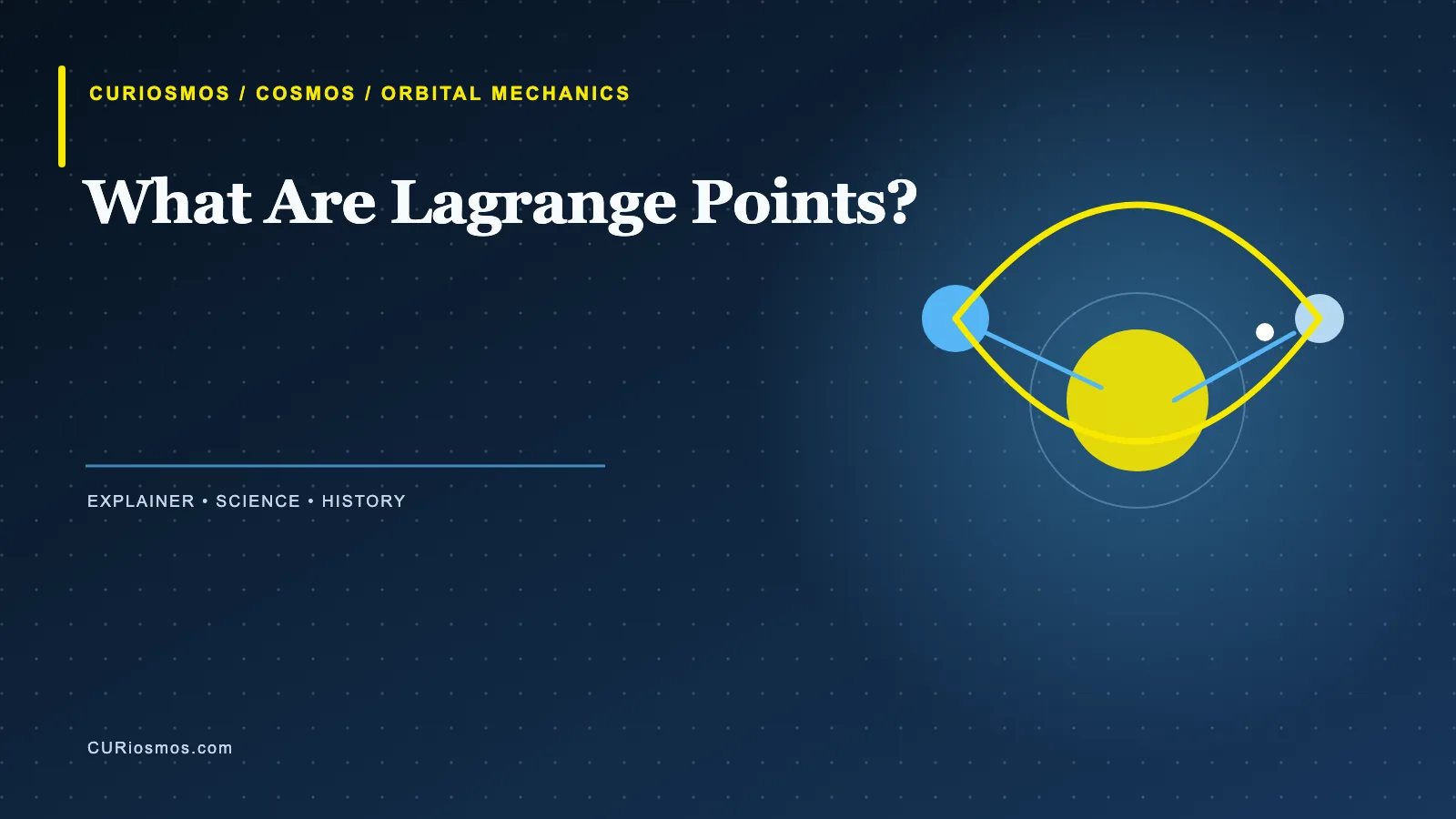
What are Lagrange points? They are five regions in a two-body system where the gravity of the larger bodies and the motion of a smaller object combine in a useful way. A spacecraft placed near one of these regions can keep pace with a planet, follow it around the Sun, or maintain a valuable view of space without burning fuel every minute.
That description can make Lagrange points sound like fixed dots painted on the Solar System. They are not. A Lagrange point belongs to a particular pair of bodies, such as the Sun and Earth, and its position changes as the system moves. The points are solutions to a three-body problem: two large bodies orbit one another while a much smaller object moves under their combined influence.
There are five points, but they do not all behave the same way
L1, L2 and L3 lie along the line connecting the two large bodies. In the Sun–Earth system, L1 sits between Earth and the Sun. A spacecraft there has a continuous view of the Sun and can provide early warning of changes in the solar wind. L2 lies beyond Earth, on the side away from the Sun. L3 is on the far side of the Sun and is difficult to use for communication.
L4 and L5 sit ahead of and behind the smaller body in its orbit. Together with the two large bodies, they form roughly equilateral triangles. These two regions can be dynamically stable when the mass ratio is right, which is why groups of asteroids can remain there for very long periods. Jupiter’s Trojan asteroids occupy its L4 and L5 regions, and smaller populations accompany other planets.
Why L2 is so useful for astronomy
The James Webb Space Telescope operates near the Sun–Earth L2 region. From there, the Sun, Earth and Moon remain on roughly the same side of the spacecraft. A large sunshield can block their light and heat while the telescope looks out into deep space. Webb does not sit exactly on the mathematical point; it travels in a wide orbit around L2, which keeps the geometry manageable and avoids passing through Earth’s shadow for long periods.
This location is one reason Webb can keep its instruments cold enough to study faint infrared light. It is not a magic place where gravity switches off. Webb still performs small course corrections, and its orbit must be monitored. The advantage is that those corrections are modest compared with the fuel a telescope would need if it had to fight the full geometry from a less favourable orbit.
NASA’s Nancy Grace Roman Space Telescope will also work near the Sun–Earth L2 region. Roman will survey huge areas of sky in infrared and visible wavelengths, studying dark energy, exoplanets and the structure of galaxies. Its job is different from Webb’s, but the orbital real estate is valuable for the same practical reason: a stable thermal environment and a wide, unobstructed view.
A point is not the same as an orbit
The phrase “parked at L2” is useful shorthand, but it hides the motion involved. L1, L2 and L3 are unstable in the simple mathematical picture. A spacecraft near one of them would slowly drift without regular corrections. Mission planners therefore design a looping orbit around the region and schedule small manoeuvres to keep the spacecraft where its instruments need it.
Lagrange points also help explain why some missions take unusual routes. A spacecraft can travel through weak gravitational pathways, use a planet’s motion, or wait in a region where a small amount of fuel produces a large change in its future orbit. The technique is part of a broader way of designing missions around the Solar System’s moving bodies rather than treating space as an empty straight road.
The Moon has its own Lagrange geometry
The same idea applies to the Earth and Moon. A mission travelling between them can use the L1 region to relay observations or the L2 region to keep a useful view of the lunar far side. Those locations are not permanent bases, but they can simplify communication and help mission planners shape low-energy routes. A spacecraft still needs propulsion and navigation; the geometry simply gives those resources more leverage.
That distinction matters when a mission is described as “at” a Lagrange point. In practice, engineers choose an orbit that balances thermal needs, line-of-sight communication and fuel reserves. The best path is often a compromise, not the exact solution on a textbook diagram.
The next time a telescope sends back an image from far beyond Earth, its success may depend on an invisible piece of orbital geometry. Lagrange points are not destinations in the ordinary sense. They are useful relationships between worlds, and spacecraft designers have learned how to turn those relationships into working observatories.
That orbital planning is also part of the story behind the James Webb Space Telescope and the upcoming Roman Space Telescope. Both missions show why a telescope’s science begins with where it is placed.
Sources and further reading: NASA Science: What are Lagrange Points?; NASA: Lagrange points explained.