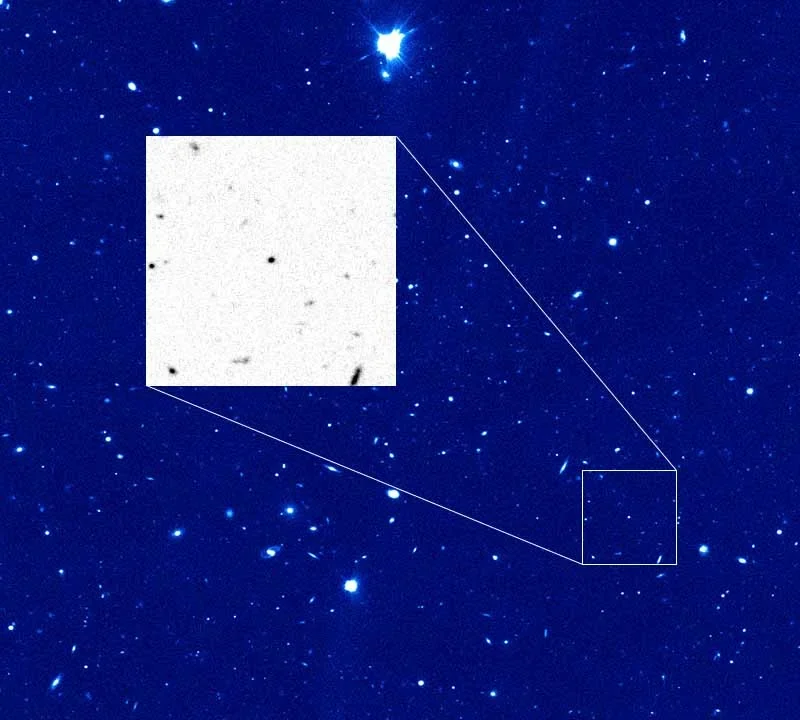
Astronomers have detected the highest-energy gamma rays ever recorded from a blazar at this distance. The source, OP 313, is an active galaxy whose central black hole is feeding on surrounding matter. Its light has travelled roughly eight billion years to reach Earth, making it the most distant very-high-energy blazar yet observed.
The signal was picked up by the Large-Sized Telescope 1, or LST-1, and the MAGIC telescopes at the Roque de los Muchachos Observatory on La Palma. The observations were reported by the Instituto de Astrofísica de Canarias and analysed in a study published in Astronomy & Astrophysics. The result extends the range over which scientists can study how black-hole jets produce extreme radiation.
What makes a blazar different?
Many galaxies contain a supermassive black hole at their centre. When gas and dust fall toward it, the material forms a hot accretion disk and can power narrow jets that shoot away from the black hole at nearly the speed of light. A blazar is an active galaxy whose jet happens to point close to Earth.
Keep exploring
Continue with Curiosmos
That alignment makes a blazar appear unusually bright. The jet’s radiation is concentrated in our direction, and changes in brightness can happen over short timescales. OP 313 was already known as a bright active galaxy, but the new detection shows that its jet produced photons with energies high enough to be measured by ground-based Cherenkov telescopes.
Why the distance is surprising
Very-high-energy gamma rays do not travel freely through the entire universe. On their journey, they can collide with photons in the faint glow known as the extragalactic background light. Those collisions create electron–positron pairs and remove gamma rays from the beam that would otherwise reach Earth.
The farther away a source is, the more of this background light the gamma rays cross. Detecting OP 313 at a redshift of about 0.997 therefore shows that some of its most energetic photons survived the trip. The measurement helps astronomers estimate how much background light exists between galaxies and how it has built up over cosmic history.
The observation also constrains the physics inside the jet. In the model favoured by the team, relativistic electrons in the jet scatter lower-energy photons and boost them into the gamma-ray range. Other mechanisms remain possible, and the source’s changing brightness gives researchers a way to test them.
Two telescopes, one difficult signal
LST-1 and MAGIC use the brief flashes of blue light produced when gamma rays strike Earth’s atmosphere. They do not see the gamma ray directly. Instead, mirrors and fast cameras record the atmospheric shower and reconstruct the energy and direction of the original particle.
Combining instruments improves confidence in a faint detection. A single telescope can be affected by background particles or changing weather, while two systems can check whether the same flare appears in both data sets. The OP 313 campaign used that combined approach during a period when the blazar was unusually active.
Curiosmos has explained what gamma rays can reveal about the universe and how astronomers measure distance across cosmic time. OP 313 connects those two ideas: the energy of the light carries information about the black-hole jet, while the redshift tells us how long the signal has been travelling.
A record that will not stand still
Blazars flare, and a brighter source can make a future distance record possible. The significance of OP 313 is not just the number attached to its redshift. It demonstrates that the next generation of Cherenkov telescopes can study active galaxies at an epoch when the universe was much younger than it is today.
Further observations will compare OP 313 with other distant blazars and refine the amount of background light between them and Earth. Those measurements could reveal whether the most powerful jets are common in the early universe or whether OP 313 is an unusually efficient accelerator.
The redshift also places the observation in a particular period of cosmic history. We see OP 313 as it was when the universe was less than half its present age, not as it looks today. Its jet had already developed the ability to accelerate particles to extreme energies at a time when galaxies and their central black holes were still growing rapidly.
That is why distant blazars are difficult but valuable targets. Their light is faint and filtered by everything between the source and Earth, yet the same filtering carries information about the intervening universe. Each new detection adds another point to the map of how high-energy particles travelled across cosmic time.