How do scientists measure distance in space? They use a chain of methods rather than one universal measuring tape. Radar can reach planets. Parallax works for nearby stars. Farther out, astronomers compare known brightnesses, stellar pulsations and the stretching of light. Each step is checked against the one below it, creating what astronomers call the cosmic distance ladder. Once a distance is known, astronomers can measure motion through the method explained in our galaxy-motion guide.
The ladder matters because the sky offers very few objects whose true distance is printed on the label. A star may look bright because it is close, or because it is intrinsically powerful. A galaxy may appear small because it is distant, or because it is genuinely compact. Astronomers need physical relationships that turn what they see into a calibrated distance.
Radar starts with the Solar System
For nearby worlds, the method is direct. A radio signal is sent toward a planet, asteroid or spacecraft, and the time it takes to return gives the distance. Radio waves travel at a known speed, so a round trip can be converted into kilometres. Spacecraft tracking uses the same principle, with the signal’s timing refined by information about the spacecraft’s motion and the Solar System’s gravity.
Radar cannot measure a galaxy. Even the nearest stars are too far away for a convenient echo. That is where geometry becomes useful.
Parallax gives nearby stars a baseline
Earth changes position as it travels around the Sun. A nearby star therefore appears to shift slightly against much more distant background stars when viewed at different points in the orbit. The shift is called parallax. It is the same basic trick your eyes use to judge the distance to a nearby object: each eye sees the object from a slightly different angle.
The angle is tiny. For a star, it may be less than a second of arc, which is roughly the apparent width of a small coin seen from many kilometres away. Space telescopes and careful measurements can detect the shift. Once the angle and the size of Earth’s orbit are known, trigonometry gives the distance.
Standard candles extend the ladder
Parallax reaches only so far. To measure more distant stars and galaxies, astronomers use objects whose intrinsic brightness can be estimated. Cepheid variable stars are a famous example. Their brightness rises and falls in a regular rhythm, and the period of that rhythm is related to how luminous the star really is. If a Cepheid looks dimmer than its known brightness would suggest, distance is the likely reason.
Type Ia supernovae provide another standard candle. These explosions can reach a similar peak brightness, allowing astronomers to compare how bright they appear across different galaxies. They are especially useful for measuring the expansion of the universe because they can be seen at enormous distances.
Redshift measures a changing universe
Light from a receding galaxy is stretched toward longer, redder wavelengths. The amount of stretching, called redshift, tells astronomers how fast the galaxy is moving away relative to the expanding universe. Redshift alone is not a simple distance measurement, but when combined with a model of cosmic expansion it becomes a powerful tool.
That model depends on other measurements, which is why the distance ladder is built step by step. If the parallax scale is wrong, the error can travel into the Cepheid scale, the supernova scale and the estimate of the expansion rate. Astronomers compare independent methods, improve instruments and look for disagreements instead of hiding them.
Why a parsec is more than a strange unit
A parsec is tied to geometry. It is the distance at which one astronomical unit—the average Earth–Sun distance—would appear to span one arcsecond of angle. The unit is useful because it connects a measurement on the sky to a baseline in Earth’s orbit. Kiloparsecs and megaparsecs extend the same idea to galaxies and the spaces between them.
At greater distances, astronomers use more than one kind of clue. The regular spacing of galaxies, the brightness of certain supernovae and the size of features in the cosmic microwave background can act as standard rulers or candles. When methods disagree, the disagreement is scientifically valuable: it may point to calibration problems or to physics that the current model does not fully describe.
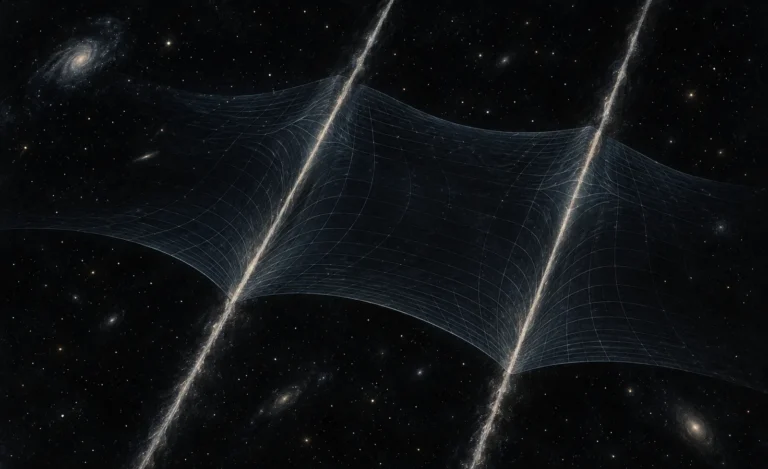
The result is not a perfect map. Distances to the most remote galaxies carry uncertainties, and the meaning of distance changes in an expanding universe. A galaxy’s light may have travelled for billions of years while the space between us and the galaxy continued to grow. That is why the universe can be much wider today than the time taken by the light might suggest.
Cosmic distance measurement is therefore a combination of geometry, physics and patient calibration. The farther astronomers look, the more they rely on relationships that have been tested closer to home.
Those measurements also explain the apparent puzzle in our guide to why the observable universe can be 93 billion light-years across. The answer depends on separating travel time from the changing distance between galaxies.
Sources and further reading: NASA: How to Measure the Universe; NASA Science: The Universe.