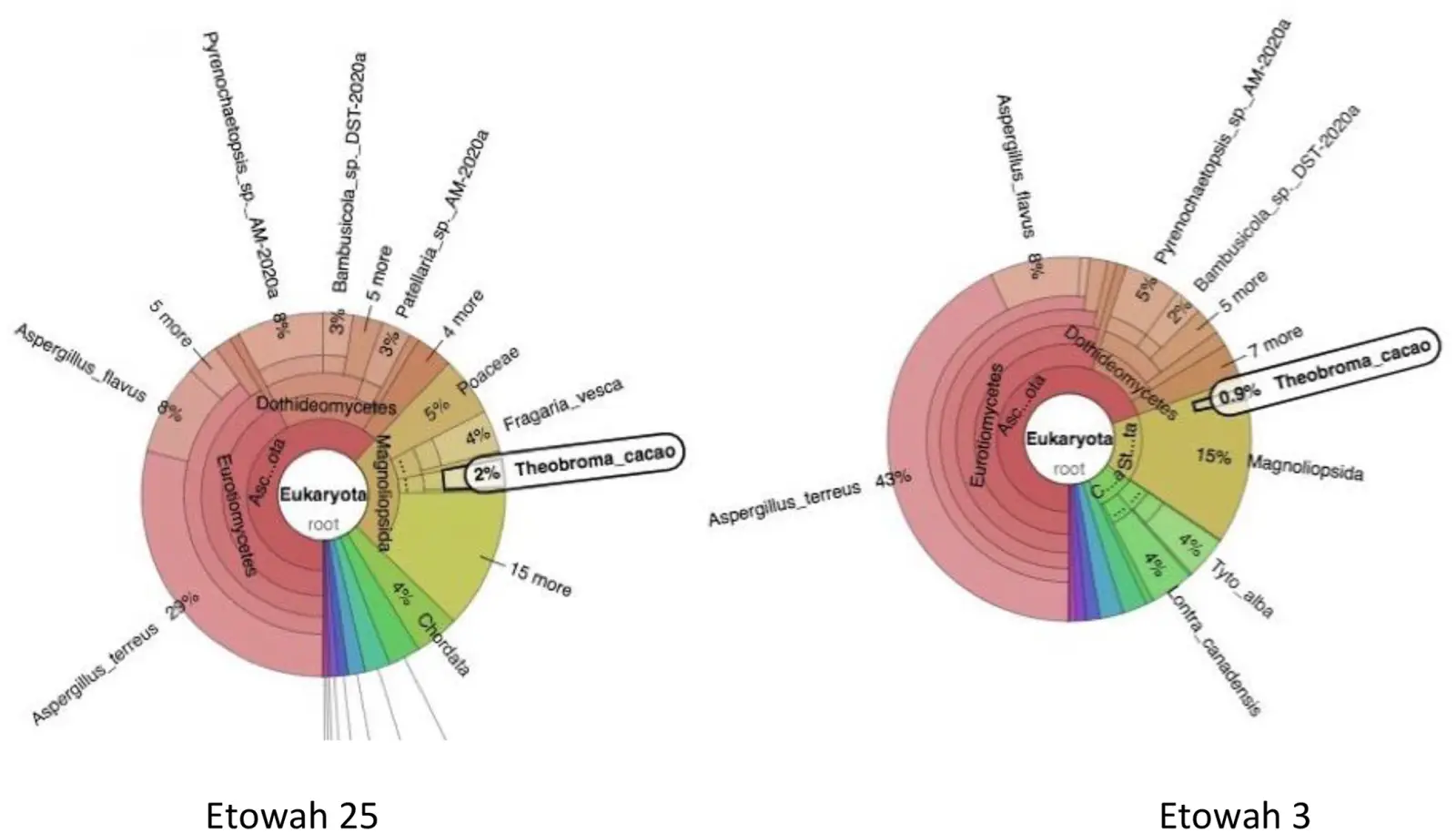
Two fragments of pottery from Etowah, a major Mississippian centre in what is now Georgia, contain traces of cacao DNA. The discovery is the first direct evidence that people at the site consumed or handled cacao between the 11th and 12th centuries—hundreds of years before Europeans arrived in North America.
Cacao does not grow naturally in the Appalachian Southeast. Its wild ancestors evolved in tropical South America and were later cultivated across Mesoamerica. Finding its genetic signature at Etowah therefore points to a supply chain that crossed very different climates and connected communities over a considerable distance.
The evidence comes from two pottery sherds recovered in contexts associated with feasting. Researchers tested microscopic residues and recovered fragments of *Theobroma cacao* DNA. The material is damaged and incomplete, but enough of the sequence survived to identify the plant. Because the samples came from separate vessels, the result is less likely to be a single modern contaminant.
Etowah was not a small village. Its platform mounds, plazas and elite burials show that it was a regional centre with the ability to organise labour, host large gatherings and maintain far-reaching relationships. The new finding adds a food item to that picture—one that would have been difficult to obtain locally and valuable enough to serve at important ceremonies.
Cacao was not simply a sweet ingredient. In many ancient American societies, drinks made from roasted cacao were tied to diplomacy, ritual and status. The Etowah vessels do not tell us exactly how the plant was prepared, or who drank it, but they place the crop within the social world of Mississippian feasting. It may have arrived as dried beans, a prepared drink or another processed product.
The find also gives archaeologists a way to revisit older collections. Pottery from mound centres has often been studied for its shape, decoration and firing technique, while tiny food residues were left untouched. DNA and chemical tests can now be applied to those sherds without reconstructing an entire vessel, making it possible to ask whether unusual foods were concentrated in elite buildings, burial areas or public plazas.
The DNA result also changes how archaeologists think about the connections between the Southeast and the wider continent. Trade is often reconstructed from distinctive shells, stone, copper or ceramic styles. Organic foods usually disappear, leaving little visible evidence. Genetic residue can reveal an exchange network that objects alone would miss.
That does not mean Etowah was part of a single centralised empire stretching to Mexico. The evidence supports contact and movement, not a map with fixed political borders. People, goods and ideas could have passed through a series of intermediaries, with each community contributing something to the journey.
The discovery is especially useful because it complements, rather than replaces, the archaeology already visible at the site. Our earlier look at pyramids in North America explains why earthen mounds should be understood on their own terms instead of being forced into an Egyptian comparison. Etowah’s cacao residues make the same point in another way: the society’s complexity is visible in its own trade, ceremonies and choices.
It also complicates the idea that long-distance exchange was reserved for durable luxury goods. A shipment of cacao would have been perishable and difficult to transport, yet someone carried it north and incorporated it into a formal gathering. That effort suggests that the value of a food can lie in the relationships and occasions it enables, not only in the object itself.
The researchers used a cautious approach because ancient DNA is easily contaminated by modern plant material. More samples from Etowah and other Mississippian sites will be needed to determine whether cacao was a rare prestige import or part of a wider pattern. Chemical residue analysis, plant microfossils and additional DNA tests could help establish how often it appeared.
For now, the two sherds are enough to show that tropical cacao reached an inland North American centre long before colonial records described such exchanges. A fragile genetic trace in an ordinary-looking piece of pottery has opened a new line of evidence for reconstructing the routes, ceremonies and relationships that held the Mississippian world together.