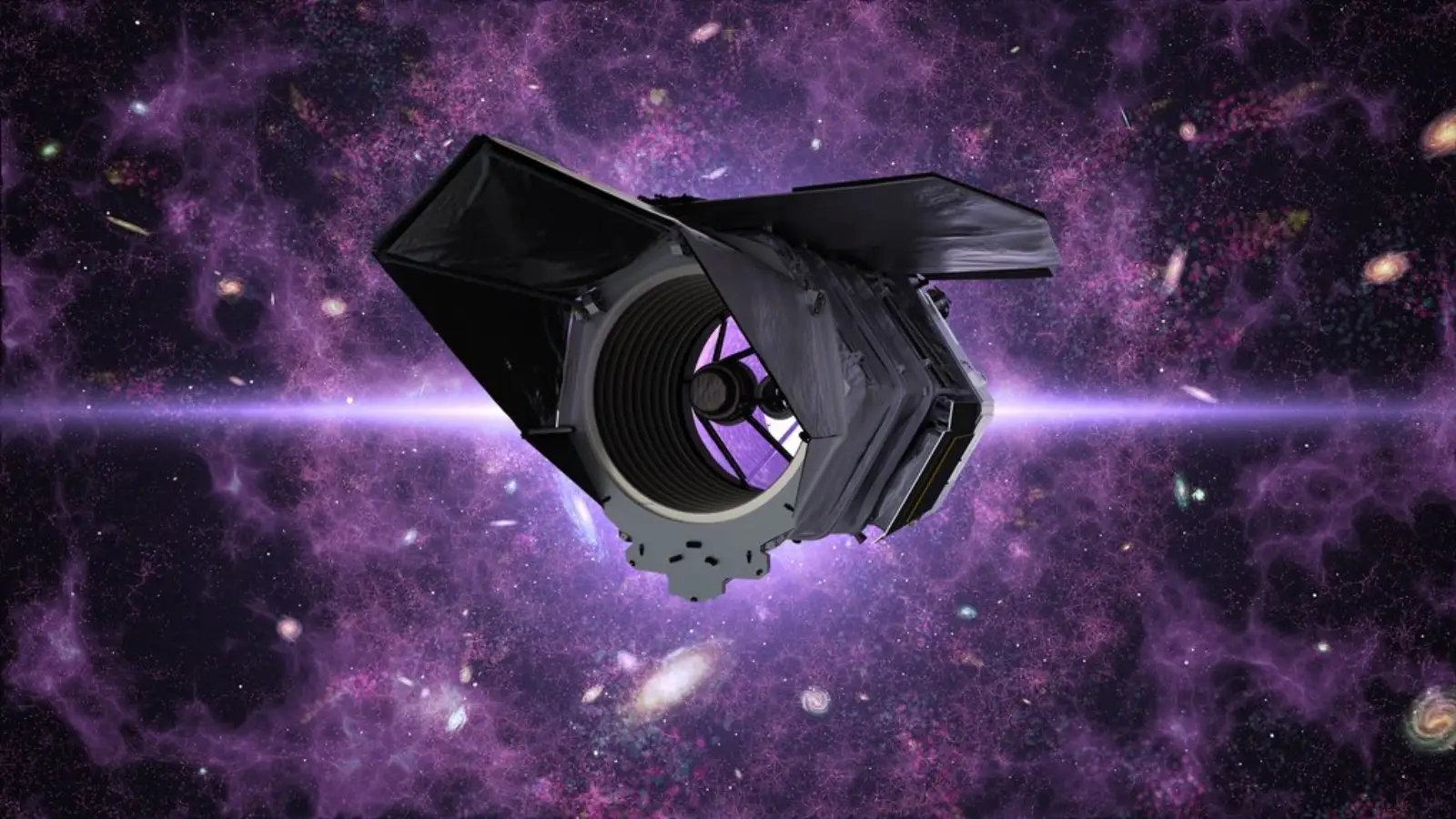
Most exoplanets are found indirectly. Astronomers watch a star dim when a planet crosses its face, or measure the tiny wobble caused by the planet’s gravity. The Nancy Grace Roman Space Telescope is being built to add a more difficult technique: blocking a star’s glare well enough to see some of its planets directly.
Roman’s coronagraph is an instrument designed for that task. It uses carefully shaped masks and deformable mirrors to suppress starlight, while a sensitive camera searches for the much fainter glow reflected by a nearby planet. The contrast is extreme. A star can be up to a billion times brighter than the planet beside it.
The mission is expected to launch later this decade, with a current target window at the end of August for a major programme milestone. Engineers and scientists are using ground tests and laboratory demonstrations to prove that the coronagraph can hold its alignment and remove scattered light without erasing the planet signal they want to measure.
Direct imaging will not turn Roman into a camera that photographs Earth-like worlds around every star. The first targets are expected to be large, young gas-giant planets whose atmospheres still glow with heat. They orbit far enough from their stars that the coronagraph can separate the planet’s light from the star’s disc.
That sample will still answer important questions. A direct spectrum can reveal methane, water vapour, clouds and the chemistry of a planet’s upper atmosphere. Repeated images can show how the planet moves along its orbit, providing a measurement of its distance and helping astronomers test how planetary systems form and evolve.
Roman’s advantage is not simply a larger mirror. Its instruments are designed to control the unwanted light that overwhelms a faint companion. The deformable mirrors can change shape thousands of times during an observation, correcting tiny imperfections in the telescope and the incoming wavefront. That precision is what makes the experiment different from ordinary imaging.
The coronagraph will also be a technology demonstration for future missions. A telescope intended to image a small, potentially habitable planet would need to suppress starlight even more aggressively. Roman can show which masks, sensors and control systems work in space, where heat, vibration and changing conditions make the problem harder than it is in a laboratory.
The instrument will be tested against stars whose planets have already been inferred from other methods. That gives the team an independent check: if a faint point appears at the predicted location and moves with the system, it is far more convincing than a single isolated spot. The comparison also helps calibrate how much light a planet reflects at different wavelengths.
The mission fits into a broader shift in exoplanet astronomy. Transit surveys tell us how common planets are, while radial-velocity measurements provide masses. Direct imaging adds the planet’s own light to the evidence. Together, those measurements can distinguish a world that merely has the right size from one with an atmosphere that behaves in an unexpected way.
Our explainer on how telescopes work and why larger mirrors see fainter worlds covers the basic optical problem. Roman’s coronagraph is the specialised solution: it creates an artificial eclipse inside the instrument so the planet is not lost in the star’s glare.
The first images will be carefully interpreted. Instrument scientists must separate a genuine planet from residual light, dust or a background star. A successful demonstration will not immediately deliver a catalogue of Earth twins, but it can establish a new way to study giant exoplanets and guide the designs of the observatories that follow.
Roman’s wider survey will add another piece of the puzzle through microlensing, the brief brightening that occurs when a foreground star magnifies a more distant system. That programme will find planets farther from their stars than transit surveys usually reach. The coronagraph and microlensing cameras therefore cover different parts of planetary space, giving the mission two complementary ways to find worlds.